Categories
News

Pound strength creates opportunity in Californian wine

  • Sterling strength against the US dollar, combined with Californian fine wine prices down 11.4% year-on-year create prime buying conditions for European investors.
  • From Screaming Eagle and Opus One to Bond Melbury and Aubert Chardonnay, select Californian wines are showing resilience and strong returns.
  • US wines are not subject to the same tariffs as European wines entering America, amplifying the current opportunity.

Currency tailwinds meet market softness

With pound sterling trading near its strongest levels against the US dollar in almost a decade, European fine wine buyers are enjoying a rare currency advantage. In addition, prices for Californian fine wine have fallen 11.4% on average in the last year – a steeper drop than Burgundy, Champagne, Italy and the Rhône. And while European exports are now subject to a 15% tariff in America, American wines enter the EU with only minimal import duties. 

For those looking west, this means more than just favourable exchange rates – it’s a window of opportunity to acquire some of California’s top investment-grade wines at effectively lower prices. The combination of market softness in the US and a relatively strong pound has created a buying climate that hasn’t been so compelling in years.

California’s investment appeal

California has long been America’s fine wine powerhouse, with its top labels regularly commanding global attention alongside Bordeaux First Growths and Burgundy Grand Crus. The state offers remarkable diversity, from the cult Cabernet Sauvignons of Napa Valley to the elegant Chardonnays of the Sonoma Coast.

Yet it is also a market where fine wines have historically been harder to acquire in Europe. Limited allocations, strong domestic demand, and brand-loyal followings have often kept supply tight. In the current environment, however, these barriers have eased slightly. Some of California’s most iconic names are trading at multi-year lows, as part of the wider correction in the global fine wine market.

Screaming Eagle: The US investment benchmark

Screaming Eagle remains the top traded US wine by value, with a market history as intense as its scarcity. With six perfect 100-point scores in just 13 vintages, it sits in a league of its own among American wines. Over the past two decades, Screaming Eagle’s prices have climbed more than 200%, making it one of the most lucrative long-term holds in the fine wine market.

That said, the past few years have been volatile. After peaking in 2022, prices fell as broader market sentiment cooled, particularly in the ultra-high-end segment. The Screaming Eagle index has since shown signs of stabilisation, rising more than 5% year-to-date. For investors, this is often the sweet spot – when a correction has bottomed and momentum begins to turn.
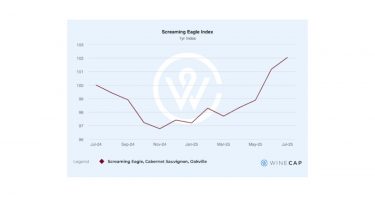
Screaming Eagle wine performance

The 2021 vintage is especially compelling. A 100-point release, it remains the most affordable among the perfect-score cohort. For those seeking a rare combination of topmost quality, brand prestige, and relative value, this vintage offers an unusually attractive entry point.

Other Californian fine wines to watch

While Screaming Eagle often dominates the conversation, California’s investment landscape is far broader. Several names have shown resilience or are quietly building momentum:

  • Opus One – This Franco-American collaboration has traded in higher volumes this year on Liv-ex than European stalwarts such as Léoville Las Cases, Ornellaia, and Pol Roger Sir Winston Churchill. Year-to-date, our Opus One wine index is up 4%, with healthy liquidity that makes it attractive for active traders.
  • Joseph Phelps Insignia – A model of consistency, Insignia’s prices have risen through the broader market downturn. The index is up 7% over the past six months and has appreciated more than 70% in the last decade. Its track record makes it one of the most reliable US names for long-term investment.
  • Dominus – Known for its Bordeaux-style Napa blends, Dominus has declined just 1% in the past year. More recently, it has begun consolidating, with a 2% rise since January 2025, suggesting a potential base is forming for the next move higher.

These examples highlight an important point: not all Californian wines follow the same market rhythm. While the ultra-luxury segment can be more volatile, there are pockets of stability and even steady growth available to more risk-conscious investors.

Top-performing US wines over the past year

According to Wine Track, several Californian labels have posted double-digit gains despite general market challenges and political uncertainty. This once again underscores the value of selective buying, even in a cooling market.
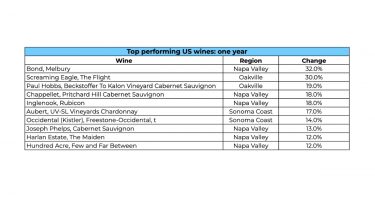
Top performing US wines

Bond Melbury and Screaming Eagle The Flight lead the field, each posting gains of 30% or more – an impressive performance given the overall market softness. Both wines share similar investment traits: small production, critical acclaim, and established brand prestige.

The appearance of Aubert Chardonnay and Occidental Pinot Noir on this list also highlights a growing trend: high-quality Californian whites and Pinot Noirs are attracting more collector attention, offering diversification beyond Cabernet Sauvignon and Bordeaux-style blends.

Investment takeaways

The combination of currency tailwinds and a market correction presents a rare opportunity for European buyers. For investors, the strategy is twofold:

  1. Target icons at cyclical lows: Screaming Eagle, Opus One, Harlan Estate, and Dominus are trading below peak levels, offering the potential for recovery-driven gains.
  2. Diversify with proven mid-tier performers: wines like Bond Melbury, Aubert Chardonnay, and Chappellet have delivered strong recent returns and often come with lower volatility than the ultra-cult names.

With sterling strong and US prices still subdued, this is a moment where timing and selectivity could translate into meaningful portfolio gains. California may be half a world away, but for European investors, the opportunity has rarely felt closer.

For more, read our United States Regional Report.

Categories
Learn

Inside the USA’s wine investment market

The following article is an extract from our USA regional wine investment report.

  • Today, the USA is one of the key fine wine investment regions.
  • Its share of secondary market trade has risen from 0.1% in 2010 to around 8% this year.
  • Demand has been stimulated by a string of good vintages in the past decade, high critic scores, and expanding distribution.

Today, the USA is one of the key fine wine investment regions. Its share of secondary market trade has risen from 0.1% in 2010 to about 8% this year, and an increasing number of previously overlooked wineries are now showing investment-worthy returns.

Inside the USA’s investment market

California has long been the driver behind the USA’s ever-growing presence in the fine wine investment landscape, accounting for roughly 99% of the country’s secondary market trade. Buying demand has been largely UK and US-driven and centred around the top names: Screaming Eagle, Opus One, Dominus, Harlan Estate, Promontory, and Scarecrow.

Price differentials

California is the second-most-expensive fine wine region after Burgundy, based on the average price of its leading estates. However, there are big differences in pricing between the region’s top names.

At the time of writing, the average case price of Screaming Eagle Cabernet Sauvignon is £39,117, compared to £7,399 for Promontory, £3,764 for Opus One, £2,773 for Dominus, and £2,719 for Ridge Monte Bello. To explore average trade prices, visit our indexing tool Wine Track.

Price performance

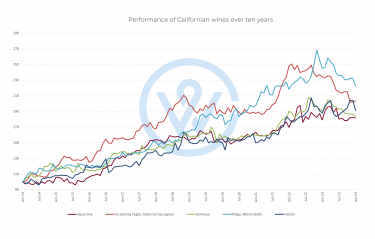
Prices for Californian fine wines have risen slowly and steadily. Over the last 15 years, the Liv-ex California 50 index which tracks the price movements of the last 10 physical vintages across five of the most traded brands (Dominus, Opus One, Harlan, Ridge, and Screaming Eagle) has outperformed both the Liv-ex 100 and Liv-ex 1000 indices. The California 50 is up 166.2%, compared to 71.6% for the Liv-ex 100 and 116.6% for the Liv-ex 1000. Moreover, over the long and short term, California has fared better than Bordeaux as an investment, yielding higher returns.

The best brands for investment

Among the most popular labels, Ridge Monte Bello has been the best-performing Californian wine, up 121.9% in the last decade. It has been followed by Screaming Eagle Cabernet Sauvignon with a 103.3% rise and Harlan, up 91.1%. All the wines in the chart below have risen over 80% in the last decade.

US wines performance

However, other producers beyond the most traded names have also been making waves. Caymus Cabernet Sauvignon has risen an impressive 154.8%, while Dunn Howell Mountain Cabernet Sauvignon is up 137.5% in the last decade. This data suggests that there is a significant number of American wines beyond the most popular names that can deliver healthy investment returns.

California: A 100-point region

Price performance has been influenced by ‘cult’ status and vintage quality. California regularly tops critic rankings as the region with the most 100-point wines. Relatively consistent climate has led to less vintage variation than in other dominant fine-wine producing regions. Major critic publications like Wine Advocate and Wine Enthusiast highlight 2001, 2007, 2012, 2013, 2015, 2016, 2018, 2019, and 2021 as particularly good.

To find out more about the investment market for US wines, read the full report here.

Categories
News

Marchesi Antinori acquires iconic Napa Valley’s Stag’s Leap

  • Marchesi Antinori has taken full ownership of Napa Valley’s iconic winery Stag’s Leap.
  • Stag’s Leap laid the foundation for the emergence of cult wines after winning the Judgement of Paris in 1976.
  • Antinori’s innovations in the ‘Super Tuscan’ revolution of the 1970s and recent acquisition of Stag’s Leap position both for continued success in the fine wine investment market.

Marchesi Antinori, one of the oldest and largest wine companies in the world, has gained full ownership of the iconic Napa Valley estate Stag’s Leap. According to Wine Spectator, the current sale includes ‘the winery, the brand and inventory, and close to 300 acres of Napa vines, including the Fay and S.L.V. vineyards’. These sites hold a near-mythical status in American wine, making the sale one of the most significant winery transactions in recent Napa Valley history.

Antinori is no stranger to Stag’s Leap. The Italian family first acquired a minority stake in 2007, partnering with Ste. Michelle Wine Estates after the property was purchased from founder Warren Winiarski. With the latest agreement, Antinori now transitions from long-standing partner to full owner – deepening its commitment to Napa Valley and expanding a global portfolio that already includes Tignanello, Guado al Tasso, and its American estate, Antica Napa Valley.

A historic Napa Valley estate

Stag’s Leap Wine Cellars holds a unique position in American wine history. It is widely credited as one of the pioneering Napa wineries that shaped the modern era of California fine wine. But it was one wine in particular that changed everything: the 1973 S.L.V. Cabernet Sauvignon.

This vintage, the estate’s second commercial release and first made at the winery, famously won the Judgment of Paris blind tasting in 1976. By outperforming top French estates – including Château Mouton Rothschild and Château Haut-Brion – Stag’s Leap stunned the global wine community and forced critics to take New World wines seriously. It was a defining moment not just for Napa Valley, but for American fine wine as a whole.

The S.L.V. vineyard, along with the Fay Vineyard, remains central to the estate’s identity. Both sites are now fully under Antinori ownership, giving the Italian group complete control over the terroir that shaped one of the wine world’s most important breakthroughs.

The rise of Stag’s Leap in the fine wine market

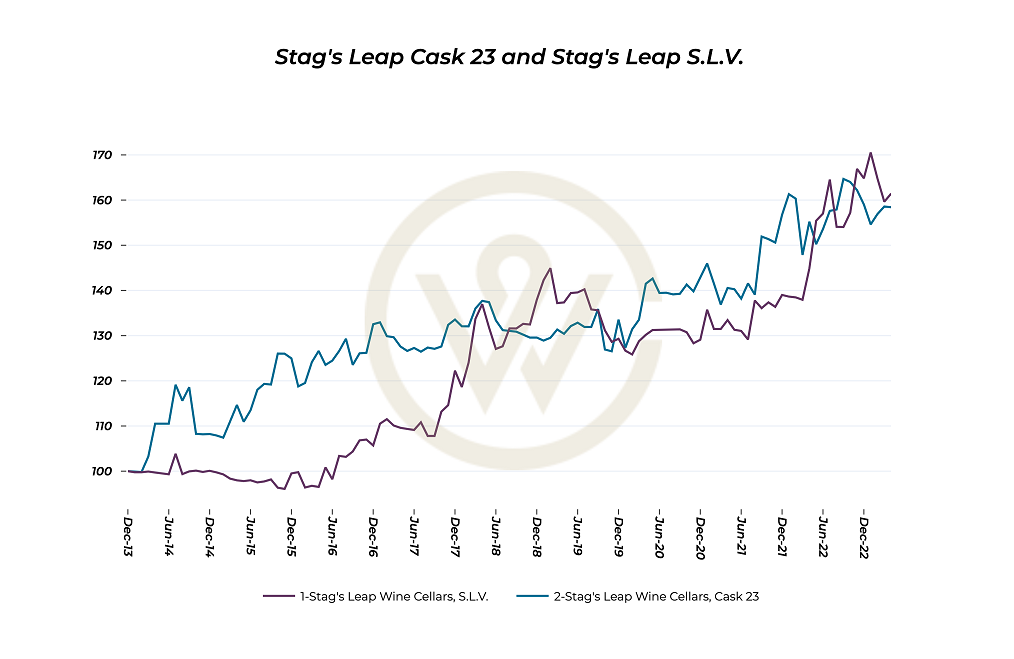
Over the last decade, Stag’s Leap has experienced substantial growth in the secondary market. Collectors have increasingly turned to the estate’s top wines – particularly Cask 23, S.L.V., and Fay – as demand for high-quality yet comparatively accessible Californian Cabernet Sauvignon continues to rise.

Several performance trends underscore Stag’s Leap’s strong market momentum:

1. Price appreciation

  • Cask 23 has increased 59% on average over the past 10 years.

  • S.L.V. Cabernet Sauvignon has risen 61% over the same period.

These gains reflect confidence among collectors who view Stag’s Leap as a historically significant winery with long-term growth potential.

2. Value for money

One of the brand’s greatest competitive advantages is its relative affordability compared to other Napa “cult” producers.

This stark gap highlights why many fine wine buyers see Stag’s Leap as offering high quality without extreme price premiums, a factor that has contributed to its increased trading activity.

3. Standout vintages

The estate’s 2014 releases, in particular, have shown remarkable performance:

  • S.L.V. 2014 has surged 80.5% since release.

  • Cask 23 2014 has climbed 77.4% in the past two years alone.

Such growth places these wines alongside some of Napa’s strongest performers in recent market cycles.

Why Antinori’s ownership matters

While Stag’s Leap helped establish the reputation of California Cabernet Sauvignon, Marchesi Antinori played an equally transformative role in Italy during the 1970s. Its groundbreaking wines – including Tignanello, Solaia, and others – helped spark the Super Tuscan revolution, challenging traditional DOC rules and elevating Italian red wine to new global heights.

Together, the two wineries share several parallels:

1. Both reshaped their national wine identities

  • Stag’s Leap redefined American wine after the Judgment of Paris.

  • Antinori reshaped Italian wine through innovative vineyard and cellar practices.

2. Both expanded the definition of “fine wine” beyond Bordeaux

Their success helped diversify the global fine wine conversation – proving that excellence could emerge from Tuscany and Napa Valley as convincingly as from France.

3. Both maintain powerful global brands

Antinori’s Tignanello is now one of the world’s most traded luxury wines. Liv-ex ranked it the 49th most powerful wine brand, partly due to its attractive average case price of £1,076, making it the best-value Italian label in the top 100.

With Antinori’s full acquisition of Stag’s Leap, the synergy between these two historic producers may deepen even further.

What comes next?

It remains to be seen exactly how Antinori will integrate Stag’s Leap into its global strategy. However, its track record suggests a continued focus on:

  • Estate-driven expression

  • Investment in vineyard health and sustainability

  • International distribution strength

  • Long-term legacy building

For Napa Valley, the acquisition signals sustained interest from established European wine families, affirming the region’s global prestige. For Antinori, it represents a strengthening of its American footprint. And for collectors, the transition offers reassurance that Stag’s Leap – already a historic and fast-rising winery – may be entering an era of renewed energy.

Final outlook

With its deep heritage, exceptional vineyards, and growing market demand, Stag’s Leap stands poised for an exciting new chapter under Antinori’s full stewardship. For both producers, this union brings together centuries of winemaking knowledge with some of Napa’s most important terroirs. As the dust settles on the acquisition, one thing seems certain: both Marchesi Antinori and Stag’s Leap are positioned to reach even greater heights in the fine wine market in the years ahead.

WineCap’s independent market analysis showcases the value of portfolio diversification and the stability offered by investing in wine. Speak to one of our wine investment experts and start building your portfolio. Schedule your free consultation today.

Categories
Report

United States | Regional Report

1976 was the turning point for California and US wine in general. ‘The Judgement of Paris’ blind tasting on May 24th proved that France had a serious contender when top Californian Bordeaux blends were tasted against Bordeaux classed growths, and Californian Chardonnays against white Burgundy. To the surprise of many, California led on both fronts.

This was the first step that set the region in motion. In the 1990s, the first Californian ‘cult wines’ emerged – big brands that attracted collector followings. Producers such as Inglenook, Stag’s Leap, and Robert Mondavi were the pioneers, but it was Screaming Eagle that established the formula for success that many followed: tiny volumes, word-of-mouth hype, and soaring prices. Robert Parker’s appraisal and perfect scores further bolstered their image.

The global market for US wines, dominated by California but also featuring wines from Washington and Oregon, has exploded in recent years. Its share of secondary market trade has risen from 0.1% in 2010 to around 7% this year, and an increasing number of previously overlooked wineries are now showing investment-worthy returns.

Our USA Report delves into the development of its investment market, historic performance, recent expansion and key players.

Discover more about:

  • History of the US wine industry
  • International and domestic trade
  • California’s most significant AVAs
  • Napa Valley’s investment-worthy wines

Do not hesitate to get in touch and speak to one of our wine investment advisors for further information and to reserve your allocations.