Categories
News

Top-performing fine wines of 2025 so far

  • Several fine wine regions made gains over the last month, including Burgundy, California, and the Rhône.
  • ‘Off’ vintage Bordeaux wines have delivered the best returns so far in 2025. 
  • The spread between the top-performing fine wines (+18% on average) and the Liv-ex 1000’s broad decline (around -4.7%) highlights why selection is key.

The fine wine market remains subdued in 2025, continuing the recalibration that began in late 2022. Yet even in a broadly negative environment, certain wines have surged ahead (see H1 winners), delivering double-digit gains and reaffirming that in fine wine investment, selectivity defines success.

Signs of stability emerge across key fine wine regions

After more than two years of correction, there are tentative signs of stabilisation. Several regional indices posted positive month-on-month (MoM) movements in September, hinting that momentum could be shifting beneath the surface.

The Liv-ex Burgundy 150, California 50, Rhône 100 and Rest of the World 60 indices each rose 0.6–0.7% month-on-month. These modest upticks may not yet signal a broad recovery, but they do suggest that the worst of the selling pressure may be easing.

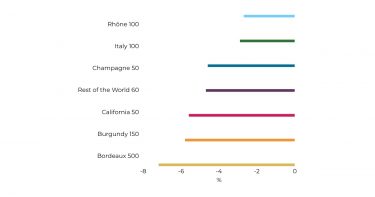
Still, the year-to-date picture remains negative across the board:

Wine region performance

Even as indices remain in the red, the range of outcomes within them has widened, revealing a growing divergence between outperformers and laggards. A select few wines have posted strong gains – a reminder that even in downturns, opportunities persist.

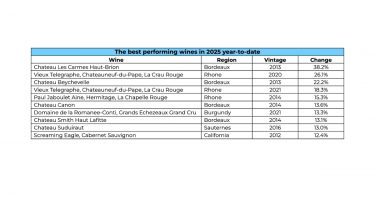
The top-performing wines so far this year

Best performing wines 2025 table

‘Off’ vintage Bordeaux leads the way

Despite the Bordeaux 500 Index falling 7.2% year-to-date, four of the ten best-performing wines come from the region, proving that careful vintage and producer selection remain key.

Château Les Carmes Haut-Brion 2013 stands out as the year’s star, up 38.2%. The 2013 vintage, long dismissed due to challenging weather conditions, has found new appreciation as enthusiasts and investors rediscover its finesse.

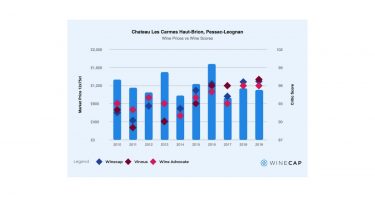
Over the past decade, prices for the brand have risen 148%. The 2014 and 2017 vintages are other attractive ‘off’ vintage alternatives. 

Les Carmes Haut-Brion fine wine performance

Château Beychevelle 2013 follows a similar line. Once overlooked, its reputation in Asian markets and steady critic support have lifted prices 22.2% year-to-date. Likewise, Château Canon 2014 and Château Smith Haut Lafitte 2014 each gained over 13%, highlighting a broader off-vintage resurgence in the region.

These gains suggest that Bordeaux’s correction phase may be creating attractive entry points for investors willing to look beyond the obvious trophy years.

The Rhône: The value region continues to deliver

The Rhône 100 remains the best-performing regional index of 2025, down just 2.7% year-to-date, with a recent 0.6% month-on-month gain adding to its reputation as a steady performer.

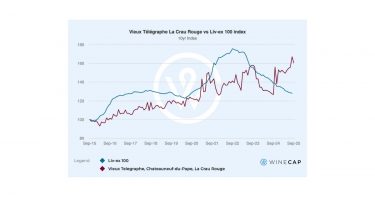
The standout is Vieux Télégraphe La Crau Rouge, appearing twice in the top five for its 2020 (26.1%) and 2021 (18.3%) vintages. The wine’s longevity, critical consistency, and relative affordability have made it a favourite among both collectors and long-term investors.

Vieux Telegraph wine performance vs Liv-Ex

Meanwhile, Paul Jaboulet Aîné’s Hermitage La Chapelle 2014 climbed 15.3%, underscoring the growing investor appetite for Rhône’s great single-vineyard wines. With smaller yields and limited back-vintage supply, demand has begun to outpace availability – a sign that the Rhône’s ‘quiet outperformance’ may continue into 2026.

Burgundy and Sauternes: Scarcity reigns supreme

Though the Burgundy 150 Index remains 5.8% down so far this year, its top producers continue to enjoy demand driven by scarcity.

Domaine de la Romanée-Conti (DRC) Grands Échezeaux Grand Cru 2021 rose 13.3%, proving once again that rarity trumps sentiment. Over the last decade, prices for the wine have risen on average 300%. 

Sauternes has also enjoyed a quiet renaissance so far this year, with Château Suduiraut 2016 making it into the top ten, with a 13% rise in value.  With prices still well below their historical highs, the sweet wines segment could offer contrarian upside heading into 2026.

California: Cult wines stay strong

Although the California 50 index is down 5.6% year-to-date, the 0.7% rise last month hints at price recovery. This year, despite softer global sentiment, high-end Napa continues to attract attention domestically and abroad (from Asia in particular). 

The region’s top label, Screaming Eagle Cabernet Sauvignon 2012, has advanced 12.4% year-to-date.  

As previously noted, Screaming Eagle remains the top traded US wine by value. With six perfect 100-point scores in just 13 vintages, it sits in a league of its own among American wines. Prices for the brand have risen more than 200% in the last 20 years, making it one of the most lucrative long-term holds in the fine wine market.

Divergence defines 2025

The spread between the top-performing wines (+18% on average) and the Liv-ex 1000’s broad decline (around -4.7%) reveals just how uneven performance has become.

Wines that combine scarcity, maturity, and reputation have emerged as the safest harbours, while those driven by hype or youth have seen steeper declines. Investors who focused on undervalued vintages (2013, 2014), critically reliable producers and globally recognised names (DRC, Screaming Eagle) have fared significantly better than the market at large.

Looking ahead: A market finding its floor

With multiple indices turning slightly positive month-on-month, the fine wine market may be approaching an inflexion point. The next phase of the cycle could favour those already positioned in high-quality, limited-production wines that have held steady during the downturn.

As 2025 enters its final stretch, it has become even clearer that scarcity, selectivity, and substance continue to outperform broader market sentiment.

For more on the fine wine market, read our Q3 2025 Fine Wine Report

WineCap’s independent market analysis showcases the value of portfolio diversification and the stability offered by investing in wine. Speak to one of our wine investment experts and start building your portfolio. Schedule your free consultation today.

Categories
Learn

Understanding Burgundy’s quality and ownership divisions

Following on from our guide on Burgundy’s sub-regions, we turn our focus to the region’s quality and ownership divisions, which are equally integral to understanding what makes Burgundy’s wines so exceptional.

Quality divisions

Grand Cru
At the pinnacle of Burgundy’s wine hierarchy are the 33 Grand Crus, which represent around 2% of total production. These wines are the epitome of excellence, with yields restricted to a maximum of 35 hectolitres per hectare (hl/ha) and often far lower. Revered for their age-worthiness, these wines generally require five to seven years to begin showing their potential, with many capable of aging for decades. Grand Cru wines are among the most prestigious and collectible in the world.

Premier Cru
Premier Cru wines, comprising 12% of Burgundy’s production, are crafted from 640 officially recognized superior vineyard sites. With permitted yields of up to 45 hl/ha, these wines showcase the terroir’s expressive character. They typically require three to five years of aging but can develop even greater complexity with extended cellaring. These wines are highly regarded by connoisseurs for their balance of quality and accessibility.

Village Wines
Village wines account for 36% of Burgundy’s production and are produced under 44 communal appellations. These wines can be blends from various vineyards within a village or from single, unclassified plots. With a yield allowance of 50 hl/ha, Village wines offer excellent value for money and are known for their approachable nature. While they are often enjoyed young, many can be aged for two to four years or more, depending on their origin and vintage.

Regional Appellations
Regional appellations, collectively known as Vin de Bourgogne, make up nearly half of Burgundy’s total production. With yields of up to 70 hl/ha for reds and 75 hl/ha for whites, these wines are ideal for everyday enjoyment. While they lack the investment potential of higher classifications, they offer an accessible introduction to the region’s styles and are valued for their straightforward appeal.

Ownership Divisions

Monopoles
Monopoles are vineyards with a single owner, a rarity in Burgundy where fragmented ownership is the norm. There are fewer than 50 monopoles in the entire region, and many are associated with some of the most iconic wines. Examples include Domaine de la Romanée-Conti’s Romanée-Conti, Domaine du Comte Liger-Belair’s La Romanée, and Domaine du Clos de Tart’s Clos de Tart. These monopoles exist across Grand Cru, Premier Cru, and Village levels, and their exclusivity adds to their allure.

Domaine Wines
A domaine refers to an estate that grows its own grapes and produces its wine in-house. This approach allows the producer complete control over viticulture and winemaking, ensuring consistency and quality. Domaine wines are highly esteemed for their reflection of the estate’s unique terroir and meticulous craftsmanship. These wines are considered benchmarks of Burgundy’s artisanal winemaking tradition.

Négoce Wines
A négociant is a merchant who sources grapes, juice, or finished wine from growers and produces wine under their own label. While some perceive négociant wines as inferior, many are of exceptional quality due to the long-standing relationships between négociants and growers. This collaborative model enables access to fruit from top-tier vineyards, allowing skilled winemakers to craft extraordinary wines. Prestigious négoce producers, such as Maison Leroy, often rival their domaine counterparts in quality and acclaim.

Looking for more? Read our Burgundy Regional Report, which delves into the fundamentals of this fascinating region and the development of its investment market.

Categories
Learn

A guide to Burgundy wine regions

Burgundy – one of the world’s most revered and world class wine regions – is a mosaic of tiny appellations, historic villages, and deeply expressive terroirs. Understanding the regions in Burgundy is essential to understanding why it produces some of the most sought-after fine wines on earth.

The region is defined by complexity: geography, ownership, grape variety, and thousands of grand cru vineyards split into small parcels. Yet its most fundamental structure is its five core Burgundy wine regions, each contributing something distinct.

Below, we explore these five regions, spanning from the cool hills of Chablis to the warmer valleys of the Mâconnais.

Burgundy’s regional structure

Burgundy is divided into four contiguous regions and one satellite, creating a long corridor of vineyards running from north to south. Although Beaujolais is sometimes considered part of Burgundy through tradition and style, administratively it belongs to the Rhône.

The total vineyard area is around 30,000 hectares, with more than 80% classified under the AOC system. In terms of volume, Burgundy produces roughly a quarter of Bordeaux’s output, despite its global prestige and smaller surface area.

Chablis (Satellite)

Just two hours southeast of Paris, Chablis is Burgundy’s northern outpost and one of the world’s great sources of white Burgundy, made exclusively from Chardonnay grapes. The region’s identity is defined by its ancient Kimmeridgian limestone soils – once a prehistoric seabed – which lend Chablis its signature minerality.

Chablis wines are known for:

  • purity and tension

  • minimal oak influence

  • chalky minerality

  • long ageing potential at the highest levels

Appellations of Chablis

Chablis is divided into four tiers:

  1. Chablis Grand Cru

  2. Chablis Premier Cru

  3. Chablis

  4. Petit Chablis

The Grand Cru vineyards – just seven climats along the Serein River – form one of Burgundy’s smallest and most prestigious fine-wine zones. Premier Cru holdings include celebrated names like Vaillons, Montmains, Fourchaume and Vaulorent.

Côte de Nuits

The Côte de Nuits forms the northern half of the Côte d’Or and is the spiritual home of the world’s greatest Pinot Noir. This narrow strip of hillside produces some of Burgundy’s most celebrated bottles – home to legendary appellations like Gevrey-Chambertin, Morey Saint-Denis, Vosne-Romanée, and the most iconic estate of all, Domaine de la Romanée-Conti.

A long history of prestige

Viticulture here dates to Roman times and expanded significantly under Benedictine and Cistercian monks, who first mapped Burgundy’s concept of climats – the small, precisely defined vineyard sites that shape Burgundy’s identity.

Côte de Nuits Grand Crus

Some of the most revered grand cru vineyards in the world lie here, including:

  • Chambertin

  • Clos Saint-Denis

  • Clos de Vougeot

  • Échézeaux

  • Richebourg

  • Romanée-Conti

  • La Tâche

Demand for these wines is consistently high, driven by rarity, tiny production levels, and global acclaim.

Côte de Beaune

The Côte de Beaune, centred around the historic town of Beaune, is known for producing both exceptional reds and some of Burgundy’s finest white wines, including iconic appellations like Corton-Charlemagne and Puligny-Montrachet.

A region of diversity

Historically, wines from this area were called “Beaune wines,” long before the 1936 AOC system. Today, it remains the beating heart of the Burgundy trade, with many négociants and wine merchants based here.

The Côte de Beaune contains more than 40 Premier Cru climats, producing structured reds and elegant whites prized for their balance and ageing capacity.

Côte Chalonnaise

Located south of the Côte de Beaune, the Côte Chalonnaise produces approachable and high-quality wines from Pinot Noir, Chardonnay, and Aligoté. With southeast-facing slopes and warm summers, the region often delivers excellent ripeness.

Notable appellations

Côte Chalonnaise is home to well-known villages including:

  • Mercurey

  • Givry

  • Montagny

  • Rully

These appellations offer outstanding value compared to their Côte d’Or neighbours. A notable historical moment occurred here when sparkling wines were first produced in Rully and Mercurey – ultimately giving birth to Crémant de Bourgogne.

Mâcconais

The Mâconnais is Burgundy’s southernmost region, characterised by rolling hills, warm climates, and impressive limestone outcrops. Historically, monastic orders – especially the Abbey of Cluny – played a significant role in cultivating vineyards here as early as 909.

Wine styles

Around 80% of vineyards are planted to Chardonnay, producing wines that are richer and more fruit-forward than those of the north. The region also grows Gamay and small amounts of Pinot Noir.

The Mâconnais is home to several renowned appellations, including:

  • Pouilly-Fuissé

  • Pouilly-Vinzelles

  • Saint-Véran

  • Viré-Clessé

These areas consistently offer superb quality and excellent value while maintaining Burgundy’s signature minerality and precision.

Final thoughts

Burgundy’s complexity is part of what makes it magical. From the steely purity of Chablis to the haunting depth of Vosne-Romanée and the crystalline brilliance of Puligny-Montrachet, each region offers its own interpretation of Pinot Noir and Chardonnay.

Together, these Burgundy wine regions form one of the most fascinating and diverse wine landscapes in the world – one whose depth, history, and craftsmanship continue to captivate wine lovers and collectors globally.

Looking for more? Read our Burgundy Regional Report, which delves into the fundamentals of this fascinating region and the development of its investment market. 

Categories
News

Top 10 most expensive wines in the world

Wine has captivated collectors for centuries – not just for its flavour and artistry, but for its extraordinary ability to increase in quality and value over time. For many enthusiasts, this appreciation has made fine wine one of the most compelling collectible assets in the world.

In recent years, fine wine has also evolved into a global luxury asset. Record-breaking sales at Sotheby’s and Christie’s, particularly from Burgundy and Bordeaux, have drawn the attention of collectors across Europe, the United States, and Asia. The fine wine market has proven remarkably resilient, consistently outperforming traditional investment sectors during periods of volatility. As more investors and collectors explore alternative assets, interest in understanding what drives the value of the world’s rarest bottles has grown rapidly.

But what is the most expensive wine on earth? And why are some bottles worth more than luxury cars or even homes? In this guide, we explore the top 10 most expensive wines in the world, breaking down their prices, regions, rarity, and what makes a single bottle so valuable.

Ten of the world’s most expensive wines

The wines featured below have achieved legendary status in the world of fine wine, not only due to their craftsmanship but also because of the unique stories and circumstances that have shaped their value. From minuscule production levels to historic vintages and iconic vineyard sites, each bottle reflects centuries of winemaking heritage and a global appetite for rarity.

Domaine Georges & Christophe Roumier, Musigny Grand Cru

Producer: Domaine Georges & Christophe Roumier

Average price: £13,595

Wine type: Red

Grape: Pinot Noir

Region: Burgundy, France

Domaine Roumier is one of Burgundy’s most revered wineries, producing some of the most expensive wines in the world. Its Musigny Grand Cru – grown on exceptional limestone soils in the Côte de Nuits – offers remarkable finesse and longevity. As a Grand Cru, Burgundy’s highest classification, this wine is treasured for its age-worthiness, rarity, and ability to command high auction prices.

Production levels from Musigny are extremely limited, and the vineyard’s old vines contribute to the wine’s intensity and depth. Collectors value Roumier for its consistency across vintages and for the estate’s meticulous approach to viticulture, which further drives demand and premium pricing.

Château Margaux

Producer: Château Margaux

Price: $225,000 (gained by insurance reimbursement in America)

Wine type: Red

Grape: Bordeaux blend

Region: Bordeaux, France

A bottle of this wine, created in 1787, was said to be a part of Thomas Jefferson’s personal collection.

A wine trader called William Sokolin later acquired it and took it to a dinner in Bordeaux, where the waiter knocked it off the table and smashed the bottle. Sokolin was later reimbursed with $225,000 by his insurance company, but the bottle was originally thought to be worth $500,000. Château Margaux is also a consistent producer of top-performing Cabernet Sauvignon-led blends, making it a pillar of fine wine investment.

Classified as a First Growth in the historic 1855 Classification, Château Margaux’s reputation spans centuries. Pre-phylloxera bottles such as the 1787 are exceptionally rare, making them prized artefacts of wine history. Provenance plays a major role in the value of such wines, and Jefferson-linked bottles remain some of the most sought-after in the world.

Domaine Leroy, Musigny Grand Cru

Producer: Domaine Leroy

Average price: £31,691

Wine type: Red

Grape: Pinot Noir

Region: Burgundy, France

Founded in 1868 by wine merchant François Leroy, the Domaine (vineyard) is now owned by Lalou Bize-Leroy, who also owns Domaine d’Auvenay.

This dry red wine is produced from Pinot Noir grapes and is the by-product of biodynamic farming. This ethical approach to farming provides nutrients to the plants by using their own composting measures, as opposed to using chemical fertilisers. Although more labour intensive, this method produces high-quality crops and is better for the environment.

Domaine Leroy’s wines are often considered on par with, or even superior to, those of Domaine de la Romanée-Conti. Micro-production levels mean only a few barrels are produced each year, resulting in extremely limited global availability. This scarcity, combined with critical acclaim, contributes significantly to its exceptionally high market value.

Krug Vintage Brut Champagne

Producer: Krug

Price: Sold for £14,800

Wine type: Sparking wine

Grape: Champagne

Region: Champagne, France

Krug is known for being one of the renowned houses in the Champagne region, making their wines some of the most sought-after and expensive in the area.

At a Hong Kong wine auction in 2009, the 1928 Krug Vintage Brut set a record as the most expensive Champagne ever sold at the time. Its combination of rarity, craftsmanship, and historical prestige make it a pinnacle of sparkling wine collecting.

Older Champagne vintages like 1928 are incredibly rare because sparkling wine is typically consumed young. Bottles that survive nearly a century in pristine condition gain immense value. Krug’s long ageing process on lees, combined with its dedication to complexity and structure, makes its older vintages particularly collectible.

Screaming Eagle Sauvignon Blanc

Producer: Screaming Eagle

Average price: £4,610

Wine type: White

Grape: Sauvignon Blanc

Region: Oakville, USA

Although not the most expensive wine on the list, this is one of the most expensive white wines from the North Coast of the United States.

As one of Napa Valley’s original “cult wines,” Screaming Eagle produces extremely limited quantities – often fewer than 1,000 cases per year. While known primarily for its Cabernet Sauvignon, its Sauvignon Blanc has become one of the most expensive white wines in the world, driven by rarity and intense demand.

Screaming Eagle’s allocation list is famously difficult to join, with waiting lists spanning years. This exclusivity fuels secondary-market prices, as collectors compete for the winery’s rarest bottles. Napa Valley’s rise as a luxury wine region has further elevated Screaming Eagle’s iconic status.

Domaine Leflaive, Montrachet Grand Cru

Producer: Domaine Leflaive

Average price: £12,430

Wine type: White

Grape: Chardonnay

Region: Burgundy, France

Montrachet is considered the best white wine vineyard in the world, with bottles often dominating top 10 most expensive wine lists. Domaine Leflaive’s Grand Cru Chardonnay – barrel-fermented and known for citrus, hazelnut, and buttery richness – remains a benchmark of Burgundy craftsmanship.

Leflaive’s plots in Montrachet sit on prime limestone-rich soils, offering exceptional drainage and mineral expression. With only a very small portion of the already tiny Montrachet vineyard under its control, Leflaive produces minuscule quantities of this wine each year, contributing significantly to its rarity.

Liber Pater

Producer: Liber Pater

Average price: The 2015 variety had an average price of £27,500

Wine type: Red

Grape: Bordeaux blend

Region: Bordeaux, France

Liber Pater produces some of the most expensive wines on earth. This vintage wine was created in 2015, and due to its very low production numbers and the use of grapes from ungrafted vines, it has become a true collector’s item.

Liber Pater aims to recreate the taste of pre-phylloxera Bordeaux by using nearly extinct grape varieties and traditional winemaking techniques. The estate produced just 550 bottles in 2015, making it one of the lowest-production wines in Europe. Its experimental approach attract collectors looking for something truly singular.

Château d’Yquem

Producer: Château d’Yquem

Price: Sold for £75,000

Wine type: Dessert

Grape: Semillon & Sauvignon Blanc

Region: Sauternes, France

As the only Premier Cru Supérieur in the 1855 Classification, Château d’Yquem has no rivals in the world of sweet wine. The 1811 vintage – one of its most celebrated – sold for £75,000 and was recognised by Guinness World Records as the most expensive standard bottle of white wine ever sold at auction. The wine bottle is said to be on display in Mr Vanneque’s restaurant in Bali, protected by bulletproof glass.

Château d’Yquem benefits from a unique microclimate that encourages the development of noble rot, allowing the estate to produce extraordinarily concentrated and long-lived wines. Many vintages of Yquem can age for over a century, which further enhances its allure among collectors.

Domaine Leroy, d’Auvenay Chevalier-Montrachet Grand Cru

Producer: Domaine d’Auvenay (part of Domaine Leroy)

Average Price: £23,439

Wine Type: White

Grape: Chardonnay

Region: Burgundy, France

Another masterpiece from Lalou Bize-Leroy, this ultra-rare Grand Cru comes from a tiny four-acre estate. Minuscule yields and perfect craftsmanship make it one of the top 10 most expensive wines in the world.

In certain vintages, only one or two barrels of this wine are produced, placing it among the most limited-production white wines in existence. The combination of terroir precision, strict biodynamic principles, and extremely low output fuels exceptionally high prices.

Egon Müller, Scharzhofberger Riesling Trockenbeerenauslese

Producer: Egon Müller

Average Price: £12,147

Wine Type: Dessert

Grape: Riesling

Region: Mosel, Germany

Egon Müller is synonymous with world-class Riesling. Their Trockenbeerenauslese – made from individually selected botrytised berries – is among the most expensive dessert wines globally, often achieving record prices at international wine auctions.

TBAs are among the rarest and most labour-intensive wines to produce, requiring hand-picking berry by berry. Egon Müller consistently commands the highest Riesling prices in the world, with some vintages selling for tens of thousands of pounds on release.

What makes wine so expensive?

When exploring the most expensive wine in the world, several factors consistently influence both rarity and price:

1. Reputation and provenance

Producers like Domaine de la Romanée-Conti, Lafite Rothschild, and Krug have global reputations for exceptional quality. Strong brand prestige pushes demand upward – especially when paired with historical significance.

2. Critical acclaim

Fine wine critics such as Robert Parker and major publications like Wine Spectator influence global pricing. High scores often trigger strong interest at wine auctions, driving prices even higher.

3. Ageing potential

Investment-grade wines improve dramatically with age. A wine built for long-term cellaring – such as Bordeaux blends or Grand Cru Burgundy – will usually appreciate in value.

4. Scarcity

Rarity is the backbone of luxury pricing. Limited-production wines, low-yield vineyards, or single-parcel bottlings make wines more exclusive. When only a single bottle or a few hundred bottles exist, demand can skyrocket.

5. Historical or cultural importance

Bottles owned by notable figures (e.g., Thomas Jefferson) or from legendary vintages often become priceless artifacts.

Valuation is also influenced by condition and storage history. Wines stored in professional, temperature-controlled cellars command higher prices, while bottles with damaged labels, signs of leakage, or poor provenance may lose significant value. Auction houses play a major role in establishing price benchmarks, and the presence of original wooden cases, wax seals, or château documentation can increase a bottle’s desirability.

Why invest in fine wine?

Fine wine is a powerful alternative investment because:

  • it has low correlation with global stock markets

  • values tend to rise steadily over time

  • supply naturally decreases as bottles are consumed

  • the category remains more stable than gold or real estate

  • prestige wines retain global demand regardless of economic cycles

Fine wine is also considered tax-efficient in several regions, further increasing its appeal for investors seeking long-term growth without excessive tax burdens. Its global nature – traded actively in London, New York, Hong Kong, and Singapore –provides a diverse base of demand. Historically, fine wine has demonstrated resilience during economic downturns, making it an attractive hedge against inflation and uncertainty.

For collectors, investing also provides the joy of building a cellar filled with some of the most extraordinary wines ever created.

Your wine investment journey starts here

WineCap gives you access to the top investible wine allocations. Once we have discovered your preferences, you will have access to a vast portfolio of the most investable wines stored in secure government bonds.

We don’t charge a management fee and our brokerage charges are very low, so you have access to rare wines at a fair price.

Whether you are looking to begin your portfolio with classic investment wines like First Growth Bordeaux or are exploring ultra-rare bottles such as Domaine Leroy, WineCap provides expert guidance at every stage. Our team can help ensure proper storage, verify provenance, and identify the strongest long-term performers in the market, giving you confidence as you build your wine investment portfolio.

To start your wine investment journey, schedule a consultation with one of our experts.