Categories
News

The best-performing wines of H1 2025: the bright spots in a soft market

  • Fine wine prices continued to decline in H1 2025 against a challenging global economic backdrop. 
  • A small group of wines outpaced the broader market by a wide margin, with the best-performing wine rising over 36%.
  • In a recalibrating market, scarcity, selectivity, and substance will continue to define success.

The global fine wine market continued its cautious descent through the first half of 2025, extending a downward trend that began in earnest in late 2022. From Champagne to California, regional indices recorded further losses – a sobering contrast to the post-pandemic surge that peaked in September 2022. What followed has been nearly 18 months of persistent price softening.

Yet even in this declining market environment, select wines showed resilience and in some cases, delivered double-digit growth. A small group of wines outpaced the broader market by a wide margin, with the best-performing wine rising over 36% in H1 alone. These rare outliers were not driven by hype or thematic rotation, but by a return to fundamentals: scarcity, maturity, critical acclaim, and name recognition. In a soft market, selectivity became strategy, and quality, its own form of currency.

The macroeconomic backdrop: volatility returns

H1 2025 unfolded against a challenging global economic backdrop, with fine wine caught in the crosscurrents of:

Reignited trade tensions

The surprise announcement of 200% US tariffs on EU wine imports in March rattled the industry. While the final figure was scaled back to 20% and implementation delayed by 90 days, the initial shock had an immediate effect. US demand plummeted initially, and confidence took time to recover – despite evidence of resilient buying behaviour by Q2.

Subdued Asian demand 

In Asia, sentiment remained quiet. Many buyers – particularly in Hong Kong and mainland China – adopted a wait-and-see posture, citing political and market uncertainty. The result was lower volume and thinner trading conditions for key regions like Burgundy, Bordeaux, and Champagne.

Monetary pressures impact

Persistent interest rate pressure globally has reduced the appeal of illiquid assets such as wine. With safer yields available in cash or bonds, some collectors have hesitated to commit fresh capital or have chosen to sell.

A tepid Bordeaux En Primeur campaign

The Bordeaux 2024 En Primeur campaign, already burdened by a slow market and a hesitant consumer base, failed to inspire broad demand. Pricing fatigue, underwhelming back-vintage performance, and merchant overstocking created difficult conditions even for well-scored wines.

Liv-ex indices reflected the climate:

    • Liv-ex 50 (tracking First Growth performance): -6% in H1, now back to 2016 levels.
    • Liv-ex 100 (Liv-ex benchmark index): -4.9% in H1, now back to 2020 levels.
    • Liv-ex 1000 (broadest market measure): -4.7% in H1, now back to 2020 levels.

Amid these headwinds, investment allocations required precise selection more than ever.

Regional performance – H1 2025

Though every major region ended H1 in negative territory, the magnitude of decline varied, offering insight into what categories still command investor attention and which ones may face longer-term repositioning.
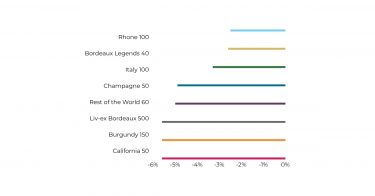
best performing wine regions half 1 2025

The best-performing region: the Rhône

The Rhône 100 index emerged as the most defensive performer in H1, down just 2.5%. This may come as a surprise, given Rhône’s traditionally lower liquidity compared to Bordeaux or Burgundy. Yet in periods of risk aversion, the region’s combination of world-class producers (e.g. Jean Louis Chave, Guigal), lower pricing, critical appraisal, and hence good value for money have made it an increasingly attractive hunting ground for value-driven buyers.

Several Rhône wines appeared in the H1 top 10 performance list, including Chave’s Hermitage Rouge 2021 (+36.8%) and Guigal’s Côte Rôtie Château d’Ampuis 2018 (+20.0%) – reinforcing Rhône’s reputation as a quiet outperformer in challenging times.

The worst-performing regions: Bordeaux, Burgundy and California

Three major regions – California, Burgundy, and the broader Bordeaux 500 – each fell 5.6%, making them the weakest performers year to date.

  • Burgundy’s fall reflects an overdue correction after its dramatic run-up in 2021–2022. Though top-tier names (like DRC and Clos de Tart) remain in demand, the broader category has struggled under inflated pricing and speculative fatigue.
  • Similar to Burgundy, California, particularly its cult Cabernet segment, has suffered from reduced international demand.
  • Bordeaux’s broader weakness may be attributed to the underperformance of back vintages. However, its Legends 40 sub-index, focused on top estates with market longevity, proved more resilient (-2.6%).

H1 2025 top performers: the outliers that defied the trend

While most indices slipped, a handful of wines delivered double-digit returns.
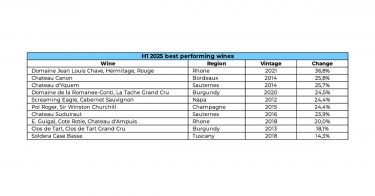
best performing wines half 1 2025

Insights from the standouts

The Rhône leads with Chave’s Hermitage

Despite the Rhône 100 index declining 2.5%, Jean Louis Chave’s 2021 Hermitage Rouge rose 36.8% – a stark outperformance driven by limited availability and increased global recognition of its collectible status.

Sweet wines surged

Both Château d’Yquem 2014 and Château Suduiraut 2016 featured in the top ten, defying the quiet backdrop for Sauternes. This suggests renewed collector interest in undervalued dessert wines, particularly when linked to exceptional vintages.

US cult wines hold their own

Screaming Eagle 2012 proved resilient, with a 24.4% rise in value since the start of the year. Despite the California 50 index falling 5.6%, high-end Napa commands global attention in top-tier vintages.

Champagne’s prestige cuvées still sparkle

While the Champagne 50 index fell 4.9%, Pol Roger Sir Winston Churchill 2015 bucked the trend with +24.4%, showing how top releases can outperform broader categories when aged and ready to drink.

Key takeaways for investors

Market-wide corrections are not uniform. Even in downturns, well-selected wines can deliver strong returns.

Rarity and recognisability drive results. Names like DRC, Yquem, Chave, and Screaming Eagle continue to act as safe harbours.

Blue-chip vintage selection matters. Wines from ‘off’ vintages like Canon 2014 offered some of the best entry points and upside surprises.

Sweet wines are staging a quiet comeback. This suggests contrarian plays may have room to run in H2.

Selectivity as the strategy for H2 2025

The first half of 2025 has confirmed what seasoned collectors already know: not all wines move with the market. Even as regional indices declined across the board, a handful of exceptional bottles bucked the trend, delivering standout returns through a combination of rarity, critical reputation, and maturity.

In today’s climate, the challenge isn’t access to wine but making the right decisions. Broad market exposure has offered little protection. Instead, performance has come from targeted allocations, where deep knowledge of producers, vintages, and release histories gives investors the edge.

Looking ahead to H2, the outlook is cautiously constructive. While macroeconomic headwinds remain – from tariffs and interest rates to uneven global demand – opportunities still exist for those willing to look beyond the indices.

In a recalibrating market, scarcity, selectivity, and substance will continue to define success.

WineCap’s independent market analysis showcases the value of portfolio diversification and the stability offered by investing in wine. Speak to one of our wine investment experts and start building your portfolio. Schedule your free consultation today.


Categories
Report

Italy Regional Report

Our Italy Regional Report examines the development of its investment market, historic performance, and key players.

Italy is the world’s largest wine producer, responsible for more than 6.5 billion bottles annually across nearly two million acres of vineyards. While its dominance in the mass wine market is undisputed, Italy’s fine wine sector has undergone a remarkable transformation over the past half century.

The modern era of Italian fine wine began in the 1970s with the emergence of the Super Tuscans – wines such as Sassicaia and Tignanello that challenged traditional classifications and redefined quality expectations. This shift elevated Italy’s global reputation and laid the foundations for a serious fine wine investment market.

Today, Italy stands as one of the most dynamic and resilient regions in the global fine wine landscape. Once overshadowed by Bordeaux and Burgundy, it now accounts for over 15% of secondary fine wine trade by value, with a growing roster of investment-grade wines. The complementary strengths of Tuscany and Piedmont, alongside emerging regions such as Veneto and Sicily, have positioned Italy as a compelling choice for portfolio diversification.

WineCap’s Italy Regional Report examines how this evolution has unfolded – and where the most attractive opportunities now lie.

Key findings from the Italy Regional Report

Italy has become a core fine wine investment region

Over the past two decades, Italy’s presence in the secondary market has grown steadily. In 2010, Italian wines represented less than 2% of global fine wine trade. Today, they account for more than 15%, reflecting rising international demand, increased critical acclaim, and greater investor confidence. This growth has been achieved without the extreme volatility seen in some other regions, reinforcing Italy’s reputation as a stable, long-term investment option.

Consistent performance with lower volatility

Italy’s investment appeal is underpinned by steady performance. The Italy 100 index has risen by over 200% in the past twenty years, outperforming both the Liv-ex 100 and Liv-ex 1000 indices over the last decade. Importantly, Italian wines have shown greater resilience during market downturns, with less pronounced corrections than Burgundy or Champagne.

This combination of growth and stability makes Italy particularly attractive to investors seeking diversification with reduced risk.

Accessibility and affordability set Italy apart

One of Italy’s defining advantages is accessibility. Top Italian wines are generally priced well below their French counterparts, offering a more approachable entry point into fine wine investment. In addition, higher production volumes for flagship wines such as Tignanello, Sassicaia, and Ornellaia enhance liquidity and ease of acquisition, particularly when compared to the extremely limited production of top Burgundy or Californian wines.

This balance of quality, availability, and price makes Italy an effective way to build meaningful exposure within a diversified portfolio.

Tuscany and Piedmont play complementary eoles

Italy’s two leading investment regions serve distinct but complementary functions. Tuscany provides scale, brand recognition, and liquidity through its iconic Super Tuscans and Brunello di Montalcino, delivering consistent returns over time. Piedmont, often compared to Burgundy, offers greater scarcity and potential upside through its Barolo and Barbaresco wines, driven by limited production and strong critical demand.

Together, these regions allow investors to balance stability and growth within a single country allocation.

Emerging regions are gaining traction

Beyond Tuscany and Piedmont, Italy’s regional diversity is increasingly reflected in the investment market. Veneto, Abruzzo, Umbria, Sicily, Campania, and Alto Adige are attracting attention for their quality, value, and growing international recognition. As exposure increases, these regions are expected to play a larger role in Italy’s fine wine trade. This depth and breadth of opportunity is unmatched by any other fine wine-producing country.

Explore the full report

WineCap’s Italy Regional Report provides a comprehensive analysis of Italy’s investment performance, accessibility, regional diversity, and best-performing wines – alongside a clear framework for understanding Tuscany, Piedmont, and the country’s most promising emerging regions.

Download the full Italy Regional Report to explore the data, insights, and opportunities shaping one of the most resilient and accessible fine wine investment markets in the world.

Categories
Report

Bordeaux Regional Report

Our Bordeaux Regional Report examines the evolution of its investment market, the First Growths, their second wines and En Primeur.

Bordeaux has long been the backbone of the fine wine market. Its unique combination of history, scale, and globally recognised brands has positioned it not just as a leading wine region, but as the reference point for fine wine investment worldwide.

As early as 1787, Thomas Jefferson recognised the collectible potential of Bordeaux’s finest estates. More than two centuries later, that early insight still holds true. While the fine wine market has diversified significantly in recent years, Bordeaux continues to play a defining role – often setting the tone for broader market performance.

At its peak in 2010, Bordeaux accounted for an extraordinary 96% of the fine wine market by value. Although its share has since moderated as regions such as Burgundy and Champagne have risen, Bordeaux remains the most influential and liquid region in the investment landscape.

WineCap’s Bordeaux Regional Report explores why this remains the case – and where the most compelling opportunities now lie.

Key findings from the Bordeaux Regional Report

Bordeaux remains the most important fine wine investment region

Despite increased diversification, Bordeaux still accounts for over a third of the fine wine market by value today. Its long-established distribution networks, global demand, and deep secondary market continue to underpin its dominance, particularly for investors prioritising liquidity and long-term stability.

The First Growths continue to anchor the market

The Bordeaux First Growths – Château Lafite Rothschild, Château Latour, Château Margaux, Château Haut-Brion, and Château Mouton Rothschild – remain the cornerstones of fine wine portfolios. While their share of total trade has declined from historic highs, they still represent around 30% of Bordeaux’s secondary market activity, reinforcing their role as pricing benchmarks and confidence indicators.

Second Wines and “Super Seconds” offer compelling value

One of the most notable trends highlighted in the report is the growing importance of second wines and so-called “Super Second” estates. These wines benefit from the same terroirs and technical expertise as their flagship counterparts but offer more accessible entry points. In many cases, they have delivered stronger relative performance over the past decade, driven by rising quality and growing global recognition.

Older vintages are often undervalued

The report shows that some of the most attractive opportunities in Bordeaux today lie not in the latest releases, but in older, overlooked vintages. These wines frequently trade at favourable price-to-quality ratios and can offer greater upside potential than more recent En Primeur releases, particularly in a more price-sensitive market environment.

En Primeur’s influence has weakened

While En Primeur remains a defining feature of Bordeaux, its role has evolved. Pricing misalignment in recent campaigns has reduced its appeal, shifting the focus towards disciplined, selective participation. The report highlights that En Primeur can still present opportunities, but only when release prices reflect broader market conditions and long-term value.

Bordeaux’s role in a diversified market

As the fine wine market has broadened to include Burgundy, Champagne, Italy, and California, Bordeaux has increasingly positioned itself as the region of stability. Its slower but steadier appreciation, combined with unrivalled liquidity, continues to make it a foundational allocation within diversified fine wine portfolios.

Explore the full report

WineCap’s Bordeaux Regional Report provides a detailed analysis of the region’s evolution, historic performance, key investment estates, and future outlook in an increasingly diversified fine wine market.

Download the full Bordeaux Regional Report to explore the data, insights, and opportunities shaping one of the world’s most important fine wine regions.