Categories
News

Wine Advocate’s top-scoring Bordeaux 2022 wines

  • Bordeaux 2022 is a vintage of ‘potential greatness’ but also ‘heterogeneity’, according to the Wine Advocate’s En Primeur report.
  • The reviewers, William Kelley and Yohan Castaing, found potential for perfection in eight wines, and included a list of En Primeur recommendations.
  • Kelley noted that the second wines ‘merit more serious consideration than usual this year’.

Potential greatness and heterogeneity

During the En Primeur trade tastings last week, and following James Suckling’s report, another major publication released its assessment of the 2022 Bordeaux vintage – Robert Parker’s Wine Advocate. William Kelley and Yohan Castaing reviewed 459 wines ‘after several weeks of intensive tasting and hundreds of visits to wineries’.

The critics found ‘potential greatness’ in this vintage that has surprised many, but also ‘heterogeneity’.

Kelley explained that ‘Bordeaux has produced some monumental wines in 2022, but unlike many of the great vintages of the 20th century, the year was not a rising tide that raised all boats’.

He added that ‘at its best, this is a vintage of remarkable concentration, energy and harmony’. According to him, ‘the accumulated experience of 2015, 2018, 2019 and 2020 meant that intelligent winemakers were ready to harvest at the right time, a choice of decisive importance’. However, he noted that ‘the less-successful wines are jammy, astringent and rustic’.

The vintage heterogeneity means that buyers will have to be selective; 2022 ‘is not a year to buy blind,’ the critic argued.

Top-scoring wines
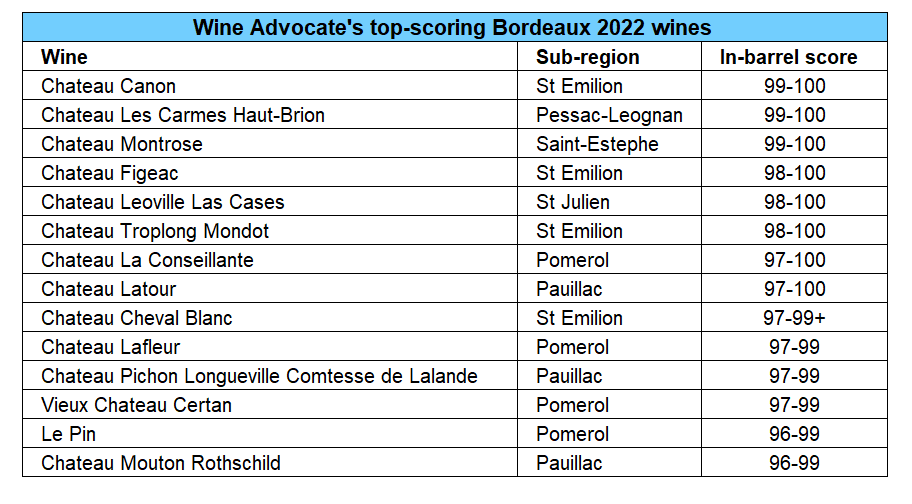
The critics found potential for perfection in eight wines, with Canon, Les Carmes Haut-Brion and Montrose coming on top (99-100 points).

Among the three, Les Carmes Haut-Brion has been the best performing investment wine over the last five years, up 56%, while also having the lowest average case price. Castaing singled it out as ‘a strong candidate for the title of wine of the vintage’.

One First Growth, Château Latour, was also among contenders for perfection, although the wine is not released En Primeur. Meanwhile, Château Mouton Rothschild, received 96-99 points. Kelley called it ‘a brilliant wine that likely sits somewhere between the 2019 and 2020 in quality’.

Kelley also noted that second wines ‘merit more serious consideration than usual this year’. In 2022, they ‘often exhibit similar structure and texture to their grand vin counterparts’.

Apart from their top-scoring wines, the critics made a list of En Primeur recommendations to buy, which included Branaire-Ducru and Langoa Barton.

En Primeur pricing

A great vintage usually translates to expensive releases.

However, Kelley suggested that there were grounds ‘for optimism with regard to pricing this year,’ if the chateaux take into account the global economic uncertainty and the state of the secondary market.

He remarked that ‘it is not always necessary to purchase great Bordeaux as futures,’ as sometimes older vintages might represent better value today.

To spot the best value opportunities and explore the historic performance of any fine wine brand, visit Wine Track. Our tool provides a clear overview of a fine wine’s track record, including critic scores, average price and investment returns.


WineCap’s independent market analysis showcases the value of portfolio diversification and the stability offered by investing in wine. Speak to one of our wine investment experts and start building your portfolio. Schedule your free consultation today.

Categories
News

James Suckling releases Bordeaux 2022 report

‘A new benchmark’

James Suckling has released his report on the Bordeaux 2022 vintage ahead of the upcoming En Primeur campaign. The critic claimed that in the 40 years he has tasted Bordeaux in-barrel, he had ‘never come across anything like the 2022 vintage’.

2022 will stay in memory as one of the hottest years on record, featuring severe droughts and heatwaves. Despite the challenges, Suckling suggested that 2022 ‘gives us hope that both man and nature can adapt to these circumstance and produce outstanding wines, both red and white’.

He further observed that dryness and heat no longer mean bold ripeness in the resultant wines. Most winemakers have prioritised freshness and lower alcohol, ‘picking their grapes at optimal ripeness, with this “al dente” fruit giving a crunchy and clean character to the wines, with fine yet structured tannins’.

Suckling found the young wines to be ‘dynamic and fascinating’ and noted that ‘there was high quality from top to bottom’ – a sign of a great vintage.

Top-scoring wines

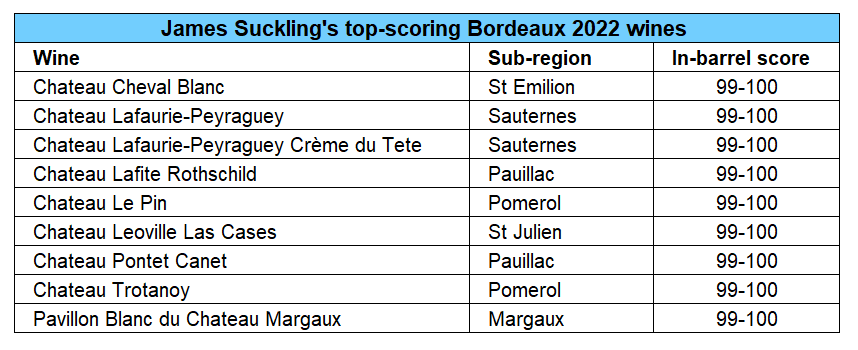
Suckling found nine candidates for perfection in Bordeaux 2022, awarding them a barrel range of 99-100 points.

Cheval Blanc stood out as his potential ‘wine of the vintage’, which ‘soars to new heights with its brightness and weightlessness’.

The critic was also full of praise for two Sauternes from Château Lafaurie-Peyraguey, calling the Crème du Tête ‘magical. The new 1929?’

Only one First Growth made the list, Château Lafite Rothschild, which Suckling described as ‘a classical Lafite that reminds me of something like the 1986 […] but it’s so today with its purity and precision’.

A white wine also featured among the top-scoring – Pavillon Blanc du Château Margaux. According to him, this ‘feels like a great Montrachet’ and is ‘one for the cellar’.

The question of pricing

Suckling’s verdict on the 2022 vintage is that the quality of the wines is ‘exceptional’ but ultimately ‘the market will decide’ the success of the new releases. ‘High interest rates, volatile stock prices and recent bank failures’ are some of the factors that will influence purchasing of young Bordeaux.

While the excitement of the new is guaranteed, high release prices might make older vintages look more attractive – especially if they offer value, and faster returns on investment.


WineCap’s independent market analysis showcases the value of portfolio diversification and the stability offered by investing in wine. Speak to one of our wine investment experts and start building your portfolio. Schedule your free consultation today.
 

Categories
Learn Report

Burgundy Regional Report

Our Burgundy Report delves into the fundamentals of this fascinating region, including its investment market and key players.

There is a long-held maxim in the wine trade: no matter where a wine lover starts, they end up in Burgundy. The same increasingly applies to investors.

Burgundy’s appeal lies in its contradictions. It is the most romantic fine wine region, yet also the most expensive. Quality is consistently high, but production volumes are exceptionally low. Intuition plays a central role, yet it is one of the most researched wine regions in the world.

With just two primary grape varieties and three quality classifications, Burgundy can appear deceptively simple. In reality, its patchwork of AOCs, fragmented vineyard ownership, and thousands of individual bottlings make it one of the most complex fine wine regions to navigate – for drinkers and investors alike.

WineCap’s Burgundy Regional Report explores how this complexity has translated into extraordinary long-term performance, how the investment market has expanded in recent years, and where opportunities are emerging today.

Key findings from the Burgundy Regional Report

Burgundy is the best-performing fine wine region

Over the past two decades, Burgundy has delivered the strongest price performance of any major fine wine region. Burgundy prices have risen by over 500%, with a significant proportion of that growth occurring since 2016, driven by rising global demand and extreme supply constraints. This performance has cemented Burgundy’s reputation as a high-return – albeit high-entry – investment region.

Rarity is the primary driver of Burgundy prices

Unlike Bordeaux, where scale and brand power underpin liquidity, Burgundy’s market dynamics are driven by scarcity. Fragmented vineyard ownership and tiny production volumes mean there is very little of any single wine available globally. This structural rarity has amplified price growth, particularly for top producers, and continues to underpin long-term demand even during broader market corrections.

Burgundy’s investment market has expanded significantly

As prices for the most famous names have climbed, the Burgundy investment market has broadened. Buyers have increasingly looked beyond the very top labels, exploring a wider range of producers, appellations, and classifications in search of relative value. This expansion has increased market participation and liquidity, making Burgundy more accessible than ever, despite its reputation as the most exclusive fine wine region.

Price corrections have created entry opportunities

Following a prolonged period of rapid appreciation, Burgundy prices have fallen by over 30% from their most recent peak. Historically rare, this correction has improved availability and created opportunities for investors to access high-quality wines at more attractive levels, without undermining Burgundy’s long-term upward trajectory.

Burgundy fragmentation creates both complexity and opportunity

Burgundy’s highly fragmented structure – with dozens of producers often sharing a single vineyard – is a defining feature of the region. While this complexity presents challenges, it also creates opportunity. Differences in producer reputation, vineyard location, and relative pricing mean that careful selection can materially impact investment outcomes. Understanding this fragmentation is essential when identifying wines with the strongest risk-reward profile.

How WineCap selects Burgundy for investment

The report outlines WineCap’s disciplined approach to Burgundy selection, focusing on liquidity, historic performance, value within individual producers’ ranges, and relative pricing within vineyards. In a region where availability is limited and pricing dispersion is wide, informed selection is critical to long-term success.

Explore the full report

WineCap’s Burgundy Regional Report provides an in-depth analysis of Burgundy’s price performance, market expansion, historic foundations, structural complexity, and key producers – alongside a clear framework for identifying investment-grade opportunities.

Download the full Burgundy Regional Report to explore the data, insights, and strategies shaping one of the world’s most sought-after fine wine regions.


Categories
Report

Fine Wine Investment | Guide

A renaissance in the market over the last two decades has let the secret of fine wine out, and the mainstream investment community has responded in kind. The word on fine wine is that it’s not just for the privileged few: it is an ideal choice for everyday investors looking to diversify their portfolios.

By choosing fine wine, you benefit from a proven market that is stable, relatively detached from the mainstream, and consistent in its double-digit returns. What’s more, fine wine offers you a great hedge against inflation.

Discover in our Fine Wine Investment Guide:

  • How to invest successfully in fine wine
  • What WineCap will do for you
  • The beauty of fine wine as an investment
  • The long-term returns of fine wine
  • The influence of wine critics
  • How to create the perfect portfolio

Click the button below to download our Fine Wine Investment Guide and learn more about our proven strategy for investment success.

Do not hesitate to get in touch and speak to one of our wine investment advisors for further information and to reserve your allocations.