Categories
Learn

Wine investor vs collector: which one are you?

  • On the outside, wine collecting and investment look similar, but they are different activities with unique objectives.
  • Wine collectors and wine investors have different considerations and motivations.
  • Most fine wine lovers are a mix of collector and investor and need professional guidance for optimal decision-making.

Many wine lovers curate an expanding cellar over time. However, while some earmark these special wines for future dinner parties and family events, others regard them as financial assets with growth and return potential. From the outside, wine collecting and wine investment often look similar – but the mindsets, motivations, and strategies that drive these activities are fundamentally different.

As the fine wine investment space continues to grow and garner interest as an alternative asset class (owing to its record of stability, low correlation to equities, and years of consistent wine investment returns), understanding these differences is crucial.

Are you a private wine collector or a global wine investor – or a combination of both? Read on to find out.

What is wine collecting?

What drives wine collecting is, above all, passion. Fine wine collectors buy items they admire because of their storytelling, ability to evoke memories, or simply because they align with their tastes. When making decisions about which wines to buy, financial goals are not a key factor.

Collectors of wine typically:

  • Buy wines they intend to enjoy one day.
  • Curate their collection around regions or producers they esteem.
  • Purchase wines spanning a range of styles, including niche bottles.
  • Build verticals for pleasure rather than profit.
  • Store wines at home or in mixed-use cellars.
  • Open rare bottles to celebrate important milestones.

For a collector, the ‘return on wine investment’ is the quality of the experience when a treasured bottle is finally opened and enjoyed.

What is wine investment?

In contrast, wine investment is a financial strategy, rather than purely an expression of taste. Investors regard fine wine as an asset – one that has shown strong returns over decades, enjoys low volatility, and displays reliable resilience in periods of economic turbulence. It is often regarded as a valuable addition to a wider investment portfolio, performing as an asset that can weather the volatility sometimes seen in equities.

Investors typically:

  • Select wines which have strong capital appreciation.
  • Concentrate on blue-chip regions with deep and consistent demand globally such as Bordeaux, Burgundy, Champagne, Tuscany, Piedmont, Napa, and the Rhône.
  • Use wine investment market data: indicators of market liquidity, critic scores, scarcity, and historical performance to evaluate the best wines to invest in.
  • Put provenance, condition, and professional storage first.
  • Buy and store wine via trusted wine investment platforms.
  • Are guided by data, analytics, and market signals over personal taste.
  • Have a clear time horizon and exit strategy.

Investors measure success by risk-adjusted return, not just by how pleasurable a wine might be to enjoy at a future date.

See our Wine Investors Guide for more information.

Asset behaviour: drinkable luxury vs financial instrument

Investors and collectors are each interested in pricey wines because of their quality and historical significance. However, while the former values prestige wines mostly for their potential financial value, the latter appreciates their cultural capital.

Collectors value wine for its:

Against this background, they may be comfortable purchasing wines with imperfect provenance or storage, as the drinking enjoyment overrides any financial return of wine investment.

Investors value wine as:

  • An object with unique economic and structural features and potential.
  • A reliable portfolio diversifier.
  • Having a finite supply, which can work in favour of price performance.
  • Possessing global demand and growth potential as established markets grow and new ones emerge.
  • An asset with advantageous low correlation with stocks, currency, and commodities.

These characteristics are key influencers in wine investor decisions and can play a stabilising role in diversified portfolios during periods of market volatility.

Financial mechanics

Both categories of wine lovers have to navigate factors that impact if and when they buy, sell, or enjoy their bottles. The most significant are costs, liquidity and wine investment growth.

Costs

Both collectors and investors may face costs associated with:

  • Professional storage.
  • Insurance.
  • Shipping and logistics.
  • Potential taxes depending on jurisdiction.

While costs are similar for both collecting and investing, how they are approached varies vastly. Collectors usually accommodate expenses as part of their hobby. Investors, however, have to take them into account when calculating net returns. For example, storage and fees can impact long-term profits.

Liquidity

Wine as an asset class is less liquid than equities. Due to its tangibility, selling can take days or weeks, meaning investors need:

  • A platform or experienced broker.
  • Impeccable provenance records.
  • Timely demand for the particular wine and/ or vintage.

In contrast, collectors don’t necessarily factor selling into the equation. In fact, they often don’t sell at all, with most of their bottles eventually being opened and enjoyed.

Returns

Investment-grade wine has a long history of producing solid long-term returns, with many indices outperforming conventional markets during major downturns. However, fine wine performance is cyclical, like all assets.

Meanwhile, for collectors, the return is the pleasure they enjoy when they choose to open a bottle for private enjoyment or to mark a special occasion. It does not correlate to the rise and fall of the market.

Other considerations

Collectors and investors have different buying motivations but they still need to consider how to balance their cellars or portfolios. 

Collectors buy based on emotion, which can mean that they: 

  • Overbuy wines they don’t drink. 
  • Don’t have proper or enough storage.
  • Build imbalance cellars.
  • Are too sentimental to sell or open valuable bottles when the time is right (in their peak drinking window).

Investors purchase wine for its returns potential, which means they need to consider the market and operations:

  • Market cycles, shifts in regional demand, and the influence of critics.
  • Optimal liquidity. 
  • Buying the right wine from a reputable supplier. 
  • Reliable storage and logistics.

Where are you on the spectrum?

Most wine enthusiasts do not fall 100% into either the collector or investor category; they are usually a hybrid of both. The key question you need to ask yourself is: Do you buy wine for emotional or financial return?

If you buy wine because you love what’s in the bottle, you’re a collector. If you purchase wine because of how it can enhance your portfolio, you’re an investor. If you are somewhere in between and are looking to fine-tune your objectives, WineCap can guide you with clarity, confidence, and data-driven precision as you take the next step. 

WineCap’s independent market analysis showcases the value of portfolio diversification and the stability offered by investing in wine. Speak to one of our wine investment experts and start building your portfolio. Schedule your free consultation today.
Categories
News

Bordeaux 2022 leads critics’ top wines of 2025

  • Global critic lists show unprecedented diversity across regions and styles.
  • Bordeaux 2022 was in the spotlight across major publications.
  • Collectible wines and investment-grade wines differ – only some critic favourites have long-term market potential.

Each November, major critic publications around the world release their annual Top 100 wines of the year rankings. Rather than showcasing the wines only released in the past twelve months, the lists highlight standout bottles tasted throughout the year, spanning vintages, regions, and stylistic expressions.

A clear trend emerges from looking at past and current lists: increasing diversity. Critics are no longer focusing exclusively on tried-and-true regions like Bordeaux, Napa, or Barolo. Instead, their selections – this year spanning wines from Etna to Stellenbosch, Central Otago to Morgon – reflect the global expansion of fine wine quality, elevated vineyard management, and the growing maturity of the market.

Critic choices largely align with broader shifts seen in the fine wine investment landscape. As quality rises around the world, more wines now boast age-worthiness, critical acclaim, and technical precision. However, this raises an important point: not all critic-favourite wines carry investment potential.


A collectible wine may be rare, high-scoring, or culturally important, while an investment-grade wine must also demonstrate a proven secondary-market track record, liquidity, stable long-term demand, and price performance history.


Below, we explore three of the most influential 2025 global rankings and what the top wines reveal about the state of the fine wine market going into 2026.

Wine Spectator’s Wine of the Year

Wine Spectator’s annual Top 100 list is arguably the most commercially impactful ranking in the global wine calendar. Historically, the No. 1 Wine of the Year has triggered immediate surges in demand, and often dramatic price rises, across global markets. A clear example came in 2023, when Argiano Brunello di Montalcino 2018 – previously quiet on the secondary market – experienced a rapid uptick in both demand and value within days of receiving the top spot.

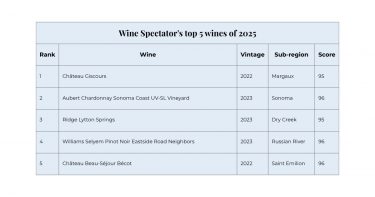
Wine Spectator's top 5 wines 2025

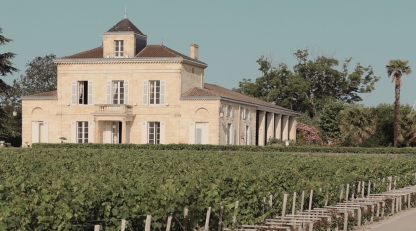
In 2025, the top position went to Château Giscours 2022, marking a major endorsement for Bordeaux’s strong 2022 vintage at a time when the region often finds itself facing criticism. Senior Editor James Molesworth explains: ‘Recent vintages have been mercurial in quality, while the region’s annual spring en primeur campaigns have fizzled. Tariffs haven’t helped. But if you needed a reminder that Bordeaux still makes some of the greatest wines in the world – and that its producers can evolve with changing times – the Château Giscours Margaux 2022 is your wine. This third-growth classified estate earns our top honor this year.’ 

Molesworth further highlights the wine as the culmination of decades of rebuilding work at the estate: ‘The efforts of Van Beek to surpass numerous obstacles over a generation is a clear example of how wine is a long game.’ The critic notes that recent improvements, including refined harvesting practices and guidance from consultant Thomas Duclos, have helped elevate quality, vintage after vintage. In 2022, these efforts culminated in a grand vin that Wine Spectator describes as fresh, seductive and finely detailed, with no second wine produced due to the exceptional quality of the harvest.

The rest of the top four represent a strong showing for California. Aubert’s UV-SL Chardonnay (No. 2) was praised as the union of ‘a renowned winemaker, a special vineyard and an exceptional vintage.’ Meanwhile, Ridge’s Lytton Springs 2023 and Williams Selyem’s Eastside Road Neighbors Pinot Noir 2023 reflect the continued strength and stylistic diversity of Californian wine across Dry Creek Valley and Russian River Valley.

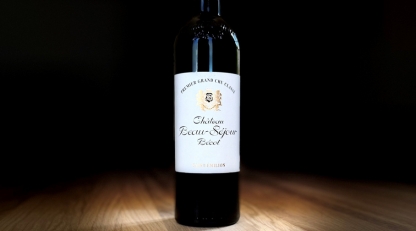
Rounding out the top five is another Bordeaux 2022 wine: Château Beau-Séjour Bécot. Wine Spectator calls it a ‘dreamy wine’, reinforcing the broader pattern seen across both critic and market attention this year. Bordeaux 2022 is clearly one of the defining narratives of the 2025 rankings, earning major positions across multiple publications.

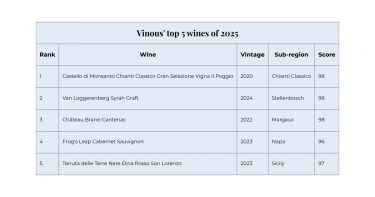
Vinous’ top 100 wines of 2025

Vinous’ annual list, which Antonio Galloni says aims to capture the ‘diversity and dynamism of today’s wine world,’ showcases wines of exceptional quality, character, and excitement rather than simply the highest-scoring bottles.

Vinous' top five wines 2025

This year, Italy takes the top spot with Monsanto’s Il Poggio, which Galloni calls “a total stunner” and “one of the very finest Il Poggios ever made.”

One of the most notable placements comes at No. 2: Van Loggerenberg’s “Graft” Syrah 2024 from South Africa. Neal Martin awarded it 98 points, praising its mineral character, balance, and crystalline finish – another sign of South Africa’s accelerating rise in fine wine quality.

The third wine in the list represents a more classical pick, but with a symbolic shift. With ownership passing to Henri Lurton’s children, Martin sees the 2022 Château Brane-Cantenac as a defining benchmark: ‘A year when… the 2022 is a benchmark for the Margaux estate, its future North Star.’

The list continues with strong representation from both New and Old World producers, including Frog’s Leap’s classically styled 2023 Cabernet Sauvignon and Tenuta delle Terre Nere’s deeply structured Etna Rosso San Lorenzo.

James Suckling’s favourite wines of 2025

James Suckling’s team tasted over 45,000 wines in the last year, making his Top 100 one of the most globally comprehensive. His selections prioritise balance and drinkability – wines that shine immediately, whether from bottle or barrel.

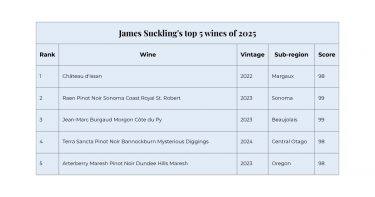
James Suckling's top five wines 2025

His top wine – Château d’Issan 2022 – reflects the broader dominance of Bordeaux’s 2022s across his list. Suckling emphasises that the vintage remains one of the biggest stories of the year, praising how the wines show focus, brightness and precision despite extreme heat and drought. He compares 2022 to other hot-vintage classics such as 1982, 1959, 1947 and 1928, all of which have stood the test of time, an important indicator for long-term growth. 

Suckling also notes how the accessibility of 2022 Bordeaux – widely released, easy to sample, and available across markets – enabled more comprehensive evaluation this year, contributing to their strong representation.

The remaining wines illustrate the global reach of modern fine wine quality. American Pinot Noir features prominently, with standout bottles from Raen and Arterberry Maresh. Meanwhile, two of the most surprising inclusions – Burgaud’s Morgon Côte du Py and Terra Sancta’s Bannockburn Pinot Noir – are also among the most affordable on the list, reinforcing Suckling’s point about the exceptional value emerging from Beaujolais and regions such as Central Otago. His report proposes that once-overlooked regions are now producing wines of extraordinary finesse and consistency.

Across all three critic rankings, a consistent narrative emerges: fine wine quality is more global, diverse and dynamic than ever before. At the same time, the spotlight on Bordeaux 2022 signals a vintage with both critical momentum and long-term relevance, firmly positioning it as one of the defining investment stories of the year.

Not every critically acclaimed wine is an investment wine, but the themes that surface – regional momentum, stylistic shifts, the performance of key vintages, and the critics’ influence on market behaviour – will all shape the fine wine landscape as we move into 2026.

WineCap’s independent market analysis showcases the value of portfolio diversification and the stability offered by investing in wine. Speak to one of our wine investment experts and start building your portfolio. Schedule your free consultation today

Categories
News

Bordeaux: Is the downturn finally ending?

  • Bordeaux prices have hit support levels across top wines and prime vintages.
  • First Growths lead the way in market stabilisation. 
  • The market’s most reliable signals of recovery – improved liquidity, narrowing spreads, and renewed price consistency – are beginning to appear in Bordeaux.

In July, WineCap reported that Champagne prices appeared to be stabilising. Our research into the ten most-searched prestige cuvées on Wine-Searcher found that 47 out of 50 wines had maintained price stability for at least three months – and 40 for six months or more. Since then, the Liv-ex Champagne 50 index has risen 1.6% on average.

Fast forward a few months, and signs of stabilisation have begun to emerge across the broader fine wine market. The Liv-ex 100 index, which represents the most sought-after fine wines globally, rose 2% over September and October. Gains were supported by sterling weakness, renewed buyer demand, and an improving bid:offer ratio, all suggesting that confidence is returning to the market.

Bordeaux, still the largest and most liquid segment of the fine wine world, also reflects this shift. Our latest research reveals that a growing share of Bordeaux’s top wines – from First Growths to leading Second Growths – have found support levels after a prolonged correction, suggesting the market may be nearing its floor.

Our methodology

To identify whether Bordeaux prices are indeed hitting support levels, WineCap analysed two baskets of wines across fifteen physical vintages:

  • First Growths + Cheval Blanc: Lafite Rothschild, Mouton Rothschild, Château Margaux, Haut-Brion, and Cheval Blanc – 75 wines across 15 vintages.
  • Top Second Growths: Pontet-Canet, Lynch-Bages, Palmer, Montrose, Cos d’Estournel, and Léoville Las Cases – 90 wines across the same period.

Because of Château Latour’s unique release schedule and limited market volume since the 2011 vintage, it was excluded from the analysis. To ensure coverage of all recent prime vintages, we expanded our dataset to include the 2005 vintage alongside the 2008–2021 range.

Price stability was defined as a period of at least three months without meaningful movement – a signal that buying and selling pressure have reached equilibrium. This approach captures early indicators of market turning points, where sellers have adjusted expectations and buyers begin to re-engage.

First Growths: Signs of strength

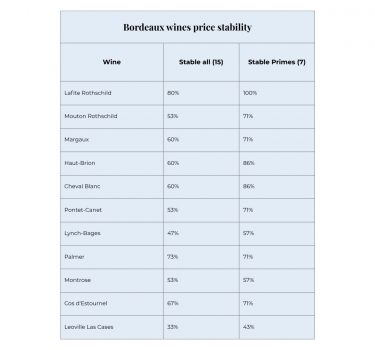
Among the first group of wines, covering four of the First Growths and Cheval Blanc, 47 out of 75 wines (just over 60%) have kept their value firm. Lafite Rothschild is the standout performer, with 12 of its 15 vintages maintaining stable prices.

When isolating the prime vintages – 2005, 2009, 2010, 2016, 2018, 2019, and 2020 – the pattern becomes even clearer. Across these, 29 of 35 wines (83%) are price stable, including every single Lafite vintage in the set. Mouton Rothschild and Château Margaux, meanwhile, have maintained stability in five out of seven vintages (just over 70%).

The data further highlight the gap between prime and off-vintages. Among the less-heralded years of 2011–2014, only four out of twenty wines are stable, suggesting continued downward pressure where trading volume is lower. This divergence reinforces a key principle: in periods of market weakness, liquidity and confidence concentrate around the most established players.

Bordeaux fine wine prices table

Second Growths: Following the leaders

Second Growths often act as the market’s echo chamber. They don’t move first, but when they start to stabilise, it confirms that sentiment is improving and buyers are returning.

Among Bordeaux’s 90 elite Second Growths, 49 (55%) are now price stable. When focusing on prime vintages, that figure rises to 26 out of 42 (62%).

This suggests that the stabilisation process has been underway for several months, gradually filtering from First Growths down to the wider market. Historically, such a pattern has preceded broader upturns, as investors and collectors begin to seek relative value further down the classification ladder.

Château Palmer and Cos d’Estournel have led this segment, with 11 and 10 of 15 vintages respectively showing resilience. Both have five out of seven stable prime vintages, alongside Château Pontet-Canet. Lynch-Bages and Léoville Las Cases, meanwhile, have seen stability emerge more recently and across a narrower base of vintages.

Broader market context

The timing of this Bordeaux stabilisation coincides with modest gains across major Liv-ex indices, including the Bordeaux Legends 50 and Fine Wine 1000, both of which posted small rises in recent months.

Beyond wine-specific factors, macroeconomic influences have also played a role. Sterling weakness since late summer has improved overseas buying power, while rising global demand (reflected in a higher bid:offer ratio on Liv-ex) signals growing confidence.

In short, the market’s most reliable signals of recovery – improved liquidity, narrowing spreads, and renewed price consistency – are beginning to appear in key regions.

Taken together, the evidence suggests that prime-vintage Bordeaux First Growths have reached stability, while top Second Growths are close behind. In standout years such as 2005, 2010, 2016, and 2019, all tracked wines are now price stable, indicating strong market support.

Weaker vintages remain under pressure, but history shows that stabilisation at the top of the market often precedes wider recovery. With the Liv-ex 100 up 2%, the bid:offer ratio climbing, and sentiment improving, the fine wine market appears to be entering a new phase of balance. Indeed, these conditions may represent the most compelling entry point into Bordeaux since 2020.

WineCap’s independent market analysis showcases the value of portfolio diversification and the stability offered by investing in wine. Speak to one of our wine investment experts and start building your portfolio. Schedule your free consultation today.
Categories
Learn

Wine auctions vs wine investing – which offers the best growth strategy?

  • Both auctions and portfolio approaches have a role to play in wine investment, but the latter is a more viable route to steady growth.
  • Auctions can provide useful signals, but investors should identify and avoid market noise and hype.
  • An expertly-managed portfolio focuses on growth, diversification, and liquidity over chasing auction trophy wines.

The wine world frequently makes headlines for astronomical prices at attention-catching auctions. Bottles can fetch sky-high sums as multimillion-dollar collections capture international interest. For investors, such record-breaking spectacles can appear to be proof of fine wine’s irresistible upwards trajectory.

However, glamorous and inspiring as they are, these auctions are not the market. They are the sharpest tip of it – distinct moments where scarcity, storytelling, and sentiment come together. A pristine bottle of Domaine de la Romanée-Conti or Château Pétrus with impeccable provenance might clear 20–50% above its estimate in a single-owner sale. While impressive, such outliers don’t speak of underlying market performance.

Understanding the difference between prices that make the news and the reality of the market is essential for any serious wine investor.

What ‘auction price’ really is

An auction price is more than meets the eye; it’s a composite shaped by multiple components. What does that sales figure really mean? 

Hammer vs all-in costs

The hammer price is the winning bid declared by the auctioneer – but that’s not the final price. The buyer then pays a buyer’s premium (10%–25%), plus taxes, shipping, and insurance. A bottle that hits the headlines at £100,000 could ultimately cost the buyer £120,000.

Single-owner vs mixed-owner sales

Provenance is all-important. Bottles from single-owner collections, especially with engaging stories and original documentation, often command premiums far above market average. In contrast, mixed-owner sales tend to be a more accurate mirror of demand.

Estimate bands and marketing psychology

Auction houses set low and high estimates to guide bidding – and to generate excitement. These figures act equally as marketing tools and predictive indicators. Only a lot that exceeds the high parameter of its estimate band hits the news; one that sells within its estimated range represents the quieter reality.

True liquidity

A record price for a single bottle does not automatically translate into similar highs for other lots. Headline-making hammer prices are outliers, influenced by rarity, media coverage, and competitive auction frenzy rather than a broader trend in the market. 

Wine auction record setters

The following are examples of headline-making auctions which illustrate the factors that drive remarkable performance: wine rarity, media frenzy, storytelling, and collector pedigree.

$34.5 mln – Henri Jayer, “The Heritage” (2018, Geneva)

  • Legendary producer’s last 855 bottles from private cellar.
  • 209 coveted magnums.
  • Rare Vosne-Romanée vintages.

$28.8 mln – William I. Koch, “The Great American Wine Collector” (2025, New York)

  • 750 large formats (Jeroboams, Methuselahs, Salmanazars).
  • Leading Bordeaux, Burgundy, Rhône, Napa, and Piedmont wines.
  • Single-owner collection.

$25.3 mln – Joseph Lau, “Iconic Wines” I–III (2022–2025, Hong Kong)

  • Rare Burgundy and Bordeaux.
  • Single-owner collection auctioned over three years created story.

$16.8 mln – Pierre Chen, “The Epicurean’s Atlas” (2023–2025, Hong Kong, Paris, Burgundy, New York)

  • Iconic Burgundy, Bordeaux, Champagne, and New World wines.
  • Legendary vintages.

$11.16 mln – Jacqueline Piatigorsky (2025, New York)

These auctions were hugely successful, but outcomes weren’t solely due to wine calibre. The unique auction environment also played a role. Such heady sums are not necessarily representative of wider market pricing.

What auctions can tell investors

While not presenting a definitive picture, auctions do generate a treasure trove of information. However, it’s important to follow results with a discerning eye because not all of the information is useful for a wine investor. You need to learn how to separate signal from media noise to understand the true meaning of auction prices.

Useful signals for investors

  • Provenance premiums: Illustrates how much collectors are willing to pay for documented bottles over generic lots. Formats, condition, and original packaging often contribute to worthwhile premiums.
  • Bidding depth: The number of bidders within the estimate band indicates genuine demand. Likewise, consistent competition across lots can point to authentic appetite that exists beyond the auction house.
  • Regional and vintage momentum: Repeated strong results across particular regions or vintages can signal emerging segments rather than one-off auction-driven prices.
  • Thin trading: The highest-profile bottles typically sell only once a decade. Such rare transactions can provide valuable insights into the wider market.

Limits and noise

  • Selection bias: “Survivorship bias” can distort average values. For a range of reasons, some wines survive the test of time while others don’t. Not every mature wine deserves high valuation.
  • Seasonality and venue effects: Marquee sales held in the spring and summer tend to attract more bidders and media coverage, inflating prices temporarily. The location of the auction can also impact results.
  • Story premium: Worth repeating is the character of the narrative surrounding an auction can elevate prices far beyond what would be achievable in normal market conditions. Celebrity collections, charity sales, and unique stories fall into this category.

Buying at auction

Auctions offer both opportunity and challenge for collectors and investors. Understanding their structure sets realistic expectations before bidding.

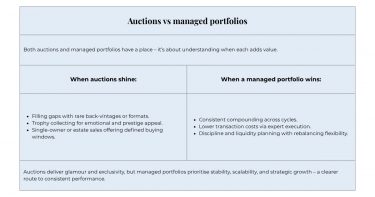
Pros

Cons

Building a wine investment portfolio with a trusted manager

While auctions can offer wine performance insights, a structured, portfolio-driven approach is most optimal for serious investors. This method focuses on growth, diversification, and liquidity planning in response to the genuine market, rather than chasing one-off, high-performer auction house bottles. In short, headline bottles make news; diversified cases make portfolios.

Strategy-led

Discipline drives serious wine investment. A considered portfolio allocates across regions, producers, and vintages. Tiered maturity and style diversification help smooth returns and reduce volatility.

Execution

Acquiring wine at scale requires access to multiple channels: primary releases, négociant networks, ex-château allocations, and selective secondary market opportunities. Professional execution ensures consistent quality, provenance verification, and optimal pricing.

Expert oversight

A trusted manager maximises successful outcomes by safeguarding custody, insurance, and exit strategies, targeting holding periods and rebalancing, to shield investments from market swings.

Research & data

Continuous market monitoring is critical to disciplined investment. This data-driven strategy identifies trends and fair-value bands, so investors can avoid the pitfall of overpaying for hype and market noise.

Cost clarity

Unlike auctions, wine investment portfolio costs – custody, insurance, execution – are transparent upfront, allowing granular knowledge of charges for clear return comparisons.

fine wine auction summary table

Next steps

The fine wine world will always carry glamour, but serious investors should see auction headlines as stories, not signals. The real market for fine wine investment and value growth is built on data, liquidity, and expert execution rather than the excitement of ‘show-stopping’ headlines.

Key takeaways:

  • Don’t fixate on record breakers – they rarely mirror market performance.
  • Focus on repeatability and liquidity for sustainable returns.
  • Calculate all-in costs for true value comparison.
  • Diversify and plan exits through portfolio management for resilience.

Fine wine investment is guided by expertise, patience, data, and structure, separating steady compounding from the volatile environment of speculation.

WineCap’s independent market analysis showcases the value of portfolio diversification and the stability offered by investing in wine. Speak to one of our wine investment experts and start building your portfolio. Schedule your free consultation today.