Categories
News

2023 harvest forecasts for France and Italy: a balancing act

  • France’s 2023 wine harvest projects between 44-47 million hectolitres, benefiting from potentially strong yields in Champagne and Burgundy.
  • Italy anticipates up to 14% reduction in its 2023 harvest due to extreme weather, marking it among its smallest harvests.
  • Historical trends showcase climatic vulnerabilities, emphasising the need for sustainable viticulture practices.

As harvest time approaches, we take a look at forecasts for the 2023 vintage in France and Italy. While France appears to be set for a stable year – in line with the five-year average, Italy’s harvest might shrink as a result of extreme weather, as climate change continues to leave its mark.

French wine regions face diverse conditions

According to the French agriculture ministry, France’s wine harvest in 2023 looks promising, with estimates suggesting a national production between 44 million and 47 million hectolitres. This figure nudges slightly ahead of the previous year’s 45.4 million hectolitres. One reason for optimism is the performance in regions like Champagne and Burgundy, which is expected to offset challenges in Bordeaux.

Indeed, Bordeaux has not had it easy. Consecutive thunderstorms, high temperatures, and downy mildew have plagued the region. Notably, Gironde’s chamber of agriculture reported that a whopping 90% of vines have been affected by downy mildew. Languedoc and Roussillon have also been suffering from persistent drought.

Meanwhile, Champagne and Burgundy are set for an above-average harvest. Champagne has successfully averted frost and hail damage and diseases have been contained. Similarly, Burgundy looks poised for grape production higher than the five-year average. The situation in neighbouring Beaujolais is also looking better than last year.

If projections hold, France may place as Europe’s largest wine producer in 2023, especially given the challenging outlook for Italy.

Italy’s climate woes

Italy is staring at a potentially reduced harvest in 2023. From searing heatwaves to devastating floods, the nation’s vintners have confronted multiple challenges. Extreme weather events could result in a harvest that is up to 14% smaller than in 2022. If this forecast proves accurate, 2023 could rank with years like 1948, 2007, and 2017 as one of Italy’s smallest harvests on record.

However, while the national outlook seems daunting, the situation varies by region. The north, including areas like Piedmont, Lombardy, and Veneto, has remained relatively stable despite recent fierce hailstorms. By contrast, southern and central Italy might see significant drops in production, with Sicily in particularly struggling with wildfires, heat, and mildew. Still, the Assovini Sicilia wine association noted that grape quality remains intact for 2023.

Historical context

France and Italy have witnessed harvest highs and lows over the decades. Historically, France’s most significant harvest was in 2004 with a record 58.3 million hectolitres. In contrast, 2017 saw a decline of almost 20% due to weather adversities.

Italy’s bumper harvest year was 1982, with a record production of 65 million hectolitres. The country’s most challenging years have been spaced apart, with significant lows in 1948, 2007, and potentially 2023.

In conclusion, the 2023 harvest projections for France and Italy offer a revealing snapshot into the challenges and opportunities presented by the ever-shifting climate. While France gears up for a potentially favorable yield, owing largely to robust performances in regions like Champagne and Burgundy, Italy grapples with the stark realities of climate change, which threatens to render 2023 one of its leanest harvests. These trends not only highlight the adaptability of the wine industry but also underscore the urgent need for sustainable practices and proactive measures to mitigate the impacts of adverse weather patterns on viticulture. As the historical data indicates, while wine-producing regions have faced fluctuations in the past, the growing unpredictability of climate patterns demands heightened vigilance and innovation in the realm of winemaking.

WineCap’s independent market analysis showcases the value of portfolio diversification and the stability offered by investing in wine. Speak to one of our wine investment experts and start building your portfolio. Schedule your free consultation today.
 

Categories
Learn

The art of diversification: can fine wine create it?

  • Diversification is a risk management strategy that involves spreading investments across various financial instruments, sectors, and regions.
  • It is not just about different sectors and asset classes but also about different revenue streams.
  • Fine wine can serve as a practical alternative investment, providing portfolio diversification and being a hedge against inflation.

Understanding diversification

Diversification, often referred to as the only ‘free lunch’ in investing, is a cornerstone of modern portfolio theory. At its core, it is a risk management strategy used in investing where one spreads their investments across various financial instruments, sectors, and regions.

The goal of diversification is to mitigate risk by reducing the negative impact of a poor-performing investment on the overall portfolio. This is achieved by investing in assets that are not perfectly correlated. In simpler terms, when some investments are down, others may be up.

Debunking the diversification myth

A common myth in investing is that diversification only means investing in different sectors, asset classes, and locations. While these are significant aspects of diversification, it is not the whole story.

The essence of diversification is about establishing multiple revenue streams. The importance of different revenue streams cannot be overstated. The reason being, if one stream suffers due to economic downturns or sector-specific issues, the impact on the total income is cushioned by the performance of other streams. It is all about not putting all your eggs in one basket.

For instance, consider an investment portfolio that has stocks, bonds, and real estate investments. Even if the stock market faces a downturn, the bond market may still perform well, and rental income from real estate could continue to provide stable income. This way, different revenue streams ensure the portfolio remains balanced and resilient in the face of volatility.

Fine wine: an alternative avenue for diversification

When we talk about diversification, alternative investments often come into play. These can range from art and antiques to cryptocurrencies and fine wine. Fine wine as an asset class for investment purposes has been gaining traction over the past decade.

Fine wine offers several attractive characteristics as a diversification asset. It is tangible, finite, and its value tends to increase with age, making it a useful hedge against inflation. Moreover, the performance of wine as an asset class does not necessarily correlate with traditional financial markets, providing the much-needed diversification.

In periods of financial crisis, where traditional stocks and bonds may underperform, alternative investments like wine often remain steady or even appreciate. This is partly because they are driven by different demand dynamics – for example, the increasing global appreciation of fine wines, especially in emerging markets.

Investing in wine also offers the potential for impressive returns. A well-chosen wine portfolio can deliver strong performance over time. You can now see the best and worst performing wines over the last year on Wine Track.

Diversification within fine wine

Diversification also exists in the fine wine market. All wines are not made the same. Wines from different regions can deliver varying returns so it is important to have a broad understanding of the market dynamics that may affect performance over time.

For instance, rare Burgundies are known for delivering exceptional returns; however, the entry point tends to be higher, prices are more volatile, and the wines are harder to source. Bordeaux and the Rhône tend to offer greater stability at lower price points, but returns might not be as impressive.

Moreover, different factors may affect performance: while Champagne prices tend to exhibit greater correlation with age – as the wines mature, prices rise – the Bordeaux market tends to be influenced by critic scores and vintage quality. Scarcity, demand and supply, significant events, critic rankings, changes in ownership and the ‘death effect’ are other fine wine specific factors that can affect the performance of different regions.

In conclusion, while diversification may seem like a complex concept, it is a fundamental strategy in managing risk and ensuring the growth of your investment portfolio. Whether it is stocks, bonds, real estate, or fine wine, the idea is to spread out your investments, thereby creating different revenue streams to safeguard against market volatility. With its unique characteristics, fine wine offers an exciting opportunity to achieve portfolio diversification.

WineCap’s independent market analysis showcases the value of portfolio diversification and the stability offered by investing in wine. Speak to one of our wine investment experts and start building your portfolio. Schedule your free consultation today.

Categories
Learn

The role of wine ratings in fine wine investment

  • Wine ratings play a crucial role in wine investment, with high scores from influential critics impacting demand and market value.
  • To use ratings effectively, investors should consider both the initial score and potential for growth.
  • The Wine Track score provides a broader view of a wine’s quality across multiple vintages and publications, helping investors assess wines at a glance.

In the fine wine market, few factors influence demand and long-term value as powerfully as wine ratings. For collectors and investors building an investment grade wine portfolio, scores from leading critics act as signals – not only of quality, but of longevity, market confidence, and future price potential.

However, while high scores often attract immediate attention, successful wine investment requires a deeper understanding of how ratings work, how they evolve over time, and how they interact with broader market forces such as global demand, scarcity, and drinking windows.

This article explores how wine ratings shape the fine wine market, how investors use them strategically, and why aggregated tools such as the Wine Track Score provide a clearer framework for assessing investment grade wines over the long term.

Why wine ratings matter for investment grade wine

Wine ratings emerged as a way to communicate quality quickly in an increasingly complex global wine industry. Today, they play a central role in shaping demand, pricing, and investor behaviour.

For wine investors, ratings provide insight into:

  • Quality and consistency across vintages

  • Longevity, including projected drinking windows

  • Market demand from collectors and consumers

  • Price stability in the secondary market

  • Investment potential relative to comparable wines

High scores from influential critics such as Robert Parker, Neal Martin, Jancis Robinson, James Suckling, and publications like Wine Spectator can materially affect prices – sometimes within days of publication.

As a result, ratings have become foundational to identifying investment grade wine, particularly for those seeking long-term capital appreciation rather than short-term trading.

How wine ratings influence the fine wine market

The fine wine market operates on reputation, scarcity, and trust. Ratings reinforce all three.

1. Ratings can drive immediate price movements

When a wine receives a benchmark score – especially 99+ or 100 points – it often enters a new tier of desirability.

A clear example is Marqués de Murrieta Castillo Ygay Gran Reserva Especial 2010, which saw rapid secondary-market price appreciation after being named Wine Spectator’s Wine of the Year. Similar reactions have historically followed 100-point scores awarded to Bordeaux First Growths and Burgundy Grand Crus.

For investment grade wine, wine scores act as a catalyst, accelerating demand and compressing supply.

2. Ratings shape long-term reputation

Consistent scoring matters more than isolated highs.

Producers such as:

  • Château Lafite Rothschild

  • Domaine de la Romanée-Conti

  • Harlan Estate

  • Gaja

  • Penfolds Grange

have built long-term investment credibility through repeated critical recognition. This consistency supports price resilience, even during broader market corrections.

For wine investors, this track record is a key differentiator between speculative wines and true investment grade wine.

3. Ratings influence regional prestige and global demand

Critics can also elevate entire regions, beyond just individual wines.

  • Robert Parker’s support helped propel Napa Valley into the global investment spotlight

  • James Suckling championed Super Tuscan wines, accelerating international demand

  • Jancis Robinson played a key role in highlighting Austria’s quality renaissance

As regional reputations rise, so does global demand – a crucial driver of long-term price appreciation in investment grade wine.

Ratings change over time – And so do investment opportunities

One of the most misunderstood aspects of wine ratings is that they are not fixed.

As wine matures in bottle, critics often revisit their assessments. Tannins soften, structure integrates, and complexity develops – sometimes leading to upward score revisions.

The impact of score changes

  • Upward revisions often trigger renewed buying interest

  • Downward revisions may stall demand or price momentum

  • Barrel scores can differ meaningfully from bottled assessments

This evolution creates opportunity for informed investors.

Strategic approaches for investors

  • Buy early when barrel scores and critic commentary are strong

  • Hold strategically as wines approach peak maturity

  • Sell your wine when demand aligns with optimal drinking windows

Understanding how ratings interact with a wine’s maturity curve allows investors to identify undervalued vintages before wider market recognition.

Knowing the critics and their influence on investment grade wine

Not all critics evaluate wine the same way.

Robert Parker, for example, historically favoured powerful, concentrated styles from Bordeaux, California, and the Rhône. As his influence has waned, the critical landscape has diversified, reflecting broader consumer preferences for balance, freshness, and terroir expression.

For wine investors, understanding critic bias is essential. A wine overlooked by one reviewer may be favoured by another, particularly in more divisive regions like Burgundy, Piedmont, or Germany.

This diversity reinforces the importance of looking beyond single scores when assessing investment grade wine.

The Wine Track score – ratings at a glance

To address inconsistency across critics, many investors now rely on aggregated metrics.

The Wine Track Score provides:

  • A unified 100-point score

  • Data from 100+ critics across 12 major publications

  • Vintage-by-vintage performance tracking

  • Insight into producer consistency over time

By smoothing out individual preferences, the Wine Track score offers a more holistic view of investment grade wine performance – particularly useful when comparing regions, estates, or vintages.

Using ratings strategically in a wine investment portfolio

Ratings are most effective when used as part of a broader framework.

1. Identify consistently high-scoring producers

Bordeaux First Growths, Burgundy Grand Crus, and top Napa Cabernet producers continue to anchor the fine wine market because of sustained critical support.

2. Look for sleeper vintages

Some wines receive modest early scores but improve significantly with age. These vintages often offer strong risk-adjusted returns.

3. Understand vintage variation

Even elite producers experience variability. Ratings help identify which vintages offer superior long-term value.

4. Use aggregated data

Relying on multiple critics reduces bias and improves decision-making.

5. Align with drinking windows

Wines approaching peak maturity often see increased demand from drinkers, supporting secondary-market pricing.

Ratings are powerful but not the whole story

While ratings are essential, they are only one part of evaluating investment grade wine.

Investors should also consider:

  • Producer reputation

  • Vineyard classification (e.g. Grand Cru, First Growth)

  • Market liquidity

  • Provenance and storage facility conditions

  • Historical price performance

  • Long-term global demand

Professional storage in bonded warehouses preserves quality and protects value – a critical factor when preparing to sell wine in the future.

Building a long-term investment grade wine portfolio

In today’s fine wine market, ratings remain one of the most influential tools available to investors. They help signal quality, predict demand, and highlight wines with the potential to outperform over time.

However, ratings are most effective when paired with market insight, disciplined storage, and a long-term perspective. When used intelligently, they can help investors build resilient portfolios anchored by true investment grade wine.

WineCap’s independent market analysis showcases the value of portfolio diversification and the stability offered by investing in wine. Speak to one of our wine investment experts and start building your portfolio. Schedule your free consultation today.



Categories
News

The best-performing wines in H1 2023

  • The fine wine market softened in H1 2023 amid a complex economic landscape, creating opportunities for savvy investors to purchase well-priced stock.
  • The 2022 Bordeaux En Primeur campaign stimulated demand for older Bordeaux vintages, which in turn pushed their prices.
  • Sweet Bordeaux dominated the best-performing wines in H1 2023, with Château Climens 2014 claiming the top spot.

Market overview

The first half of 2023 brought a mixed bag of developments for the fine wine market, with interesting shifts underway. Amid a complex economic landscape, the market softened, creating opportunities for savvy investors to purchase high-quality stock at appealing prices. Major fine wine indices experienced a minor slump when calculated in sterling but remained steady in other currencies.

Meanwhile, the 2022 Bordeaux En Primeur campaign generated excitement among critics and buyers due to the high quality of the wines, yet its pricing underlined the value that back vintages offer. Indeed the majority of the best-performing wines so far this year have been older Bordeaux vintages, with two exceptions.

The top performers so far this year

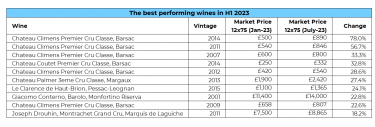
While major fine wine indices have experienced a slowdown, demand remains robust and some wines have continued to overdeliver. The table below shows the best performers in H1 2023, which have all risen between 18% and 78%.

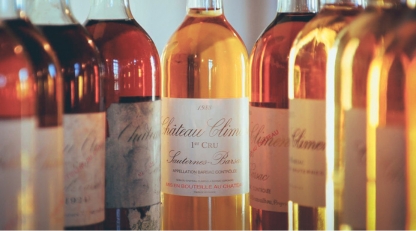
Five out of the top ten spots, including the prime position, have gone to Château Climens. Much of this stellar growth happened in the last quarter. Back vintages saw increased demand, following the 2022 En Primeur release, which was offered with a 139.4% increase on the 2016. Château Climens has also been one of the best-performing Bordeaux brands so far this year, according to Wine Track, rising 36%.

Another wine from Barsac, Château Coutet 2014, has also risen an impressive 32.8% in value over the past six months, cementing the prevalence of sweet Bordeaux among the biggest risers. It seems that a category often overlooked has come to the investment spotlight in 2023, replacing the stars of 2022 – Burgundy and Champagne.

The sixth and seventh spots went to red Bordeaux, with Château Palmer 2013, up 27.4%, and Le Clarence de Haut-Brion 2015, up 24.1%.

The exceptions to the Bordeaux-themed half were Giacomo Conterno Barolo Monfortino Riserva 2001 (22.8%) and Joseph Drouhin Montrachet Grand Cru Marquis de Laguiche 2011 (18.2%).

To find out more about the most recent developments in the fine wine market, download our Q2 2023 wine investment report.

WineCap’s independent market analysis showcases the value of portfolio diversification and the stability offered by investing in wine. Speak to one of our wine investment experts and start building your portfolio. Schedule your free consultation today.
Categories
News

Ten years on: the top-performing Bordeaux 2013 wines

  • The Bordeaux 2013 vintage saw a tepid response at release due to challenging weather conditions that impacted its quality and quantity.
  • The vintage provided a low entry point into top Bordeaux brands, and interesting investment opportunities.
  • Ten years on, some wines have risen over 200% in value, including second wines Petit Mouton and Carruades de Lafite.

As the 2013 Bordeaux vintage sees its tenth anniversary, critics are once again turning their attention to these wines. Our retrospective provides a glimpse into the market performance of the vintage, and the best-performing wines today.

Bordeaux 2013: a difficult year for winemaking

Bordeaux’s 2013 vintage was met with lukewarm reception upon release, primarily due to adverse weather conditions that took a toll on both its quality and quantity. Coming on the heels of two poorly priced campaigns did not help either.

A wet winter transitioned into an equally damp spring, delaying budburst and resulting in many grapes suffering from coulure. Unpredictable temperature fluctuations, frost, and an extraordinarily rainy May led to a disrupted flowering in June, further complicating the growing season.

July brought extreme heat, one of the hottest in over six decades, culminating in torrential rainstorms that significantly reduced yields in the Médoc and Pessac-Léognan appellations. August continued the trend with destructive hailstorms in the Entre-deux-Mers region. Consequently, growers were forced to discard damaged and unripe berries, causing further reductions in yield.

A mixed bag

Despite the less-than-ideal weather conditions, certain areas and grape varieties fared better than others. Saint-Estèphe, for instance, benefited from a drier growing season, resulting in some of the most successful wines of that year. Late-ripening varieties like Cabernet Sauvignon also made the best of the limited summer weather. However, earlier-ripening varieties like Merlot struggled due to the damp, cold start to the year.

In general, the 2013 vintage yielded smaller quantities of wine with dramatic variations in quality. The best reds were light, with lower alcohol content and a fresh fruity character, whereas the less successful examples were marked by overextraction and astringent tannins. Whites performed better overall, the best of which possessed aromatic freshness.

In terms of style, Bordeaux 2013 significantly deviates from the richer, sunnier vintages of recent years. It has produced lighter-bodied wines imbued with a tangy acidity, making them more suitable for short- to medium-term drinking rather than long-term cellaring. Many of the wines are now ready to drink.

A lower entry point into the market for Bordeaux

The inconsistency in quality led to a range of price points in the market. This presented an opportunity to acquire Bordeaux wines at lower prices than usual, especially those from estates with a proven track record of producing high-quality wines in challenging years.

This made the vintage an interesting entry point for those looking to invest in Bordeaux without the high initial price that other ‘on’ vintages command – a trend identified among buyers in Asia, and particularly for the First Growths and their second wines.

This has stimulated investment interest in the vintage, and some Bordeaux 2013 wines have seen considerable price appreciation, delivering over 200% returns in less than a decade.

A vintage for second wines

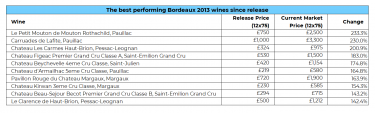
Four second wines are among the best performing Bordeaux 2013s. The second wine of Château Mouton Rothschild, Petit Mouton, leads the way with a 233% rise since release. The wine offered a low entry point into the brand at £750 per case; by comparison, this year’s 2022 vintage was released for £2,196 per 12×75.

The second wine of Château Lafite Rothschild has been the second-best performing label, up 230% in value since release.

Pavillon Rouge du Château Margaux and Le Clarence de Haut-Brion also feature among the biggest risers, with increases of 163.9% and 142.4% respectively.

Bordeaux 2013 – an unexpected opportunity

A decade on, the Bordeaux 2013 vintage has shown that even in challenging growing conditions, wines of interest and value can be produced. The vintage offered a lower entry point into Bordeaux, resulting in several significant performers. The legacy of the Bordeaux 2013 vintage may well be seen as a fascinating anomaly – an unexpected opportunity for wine collectors and investors.


WineCap’s independent market analysis showcases the value of portfolio diversification and the stability offered by investing in wine. Speak to one of our wine investment experts and start building your portfolio. Schedule your free consultation today.
 

Categories
Report

Q2 2023 Fine Wine Report

Our Q2 2023 report has now been released. The report examines the macroeconomic factors affecting fine wine demand, the Bordeaux 2022 En Primeur campaign, recent winery acquisitions and other industry news.

Key findings include:

  • UK and US stocks experienced a positive upswing, but a note of caution prevails for the second half of the year.
  • Major fine wine indices drifted in Q2, partly due to stronger sterling.
  • Fine wine demand remains solid, with wealth managers and financial advisors predicting it is set to increase.
  • Bordeaux enjoyed sustained interest in Q2, due to the release of the high-quality 2022 vintage.
  • The high release prices, however, led buyers to older vintages of comparable quality and the majority of the best-performing wines in Q2 were Bordeaux.
  • Marchesi Antinori took full ownership of Napa Valley’s iconic winery Stag’s Leap, while Joseph Drouhin expanded its Burgundy vineyard holdings.
  • New World releases will likely dominate the Q3 headlines.

Click below to download your free copy of our quarterly investment report.

Categories
Report

En Primeur Report – Bordeaux 2022: Unfulfilled Potential

Bordeaux 2022 is a great vintage that, despite its high quality, failed to reverse the waning sentiment for En Primeur. The excitement of the new was counteracted by the value on offer.

Although there was a significant increase in the number of visitors at the En Primeur tastings this spring, the campaign did not succeed in capitalising on this positive momentum.

Our latest report, Bordeaux 2022: Unfulfilled Potential, delves into the reasons why the campaign didn’t quite deliver on hopes and the event’s place within the industry in coming years.

Key findings:

  • Bordeaux 2022 is a high-quality vintage that has surpassed expectations, given the challenges of the growing season.
  • Neal Martin’s average 2022 in-barrel score was below 2020, 2019, and 2016, with most critics noting that it is a vintage to be selective.
  • The En Primeur tastings saw a significant increase in the number of visitors this spring, indicating continued interest in the region.
  • Some wines managed to offer value and were met with high demand upon release, including Château Cheval Blanc, Château Beychevelle, and Château Lafleur.
  • Average price increases between 15% and 25%, and as high as 55%, did not resonate well with the soft Bordeaux market.
  • Bordeaux 2022 vintage failed to reverse the declining sentiment for En Primeur due to high release prices in the context of older vintages offering better value.
  • Producers should evaluate the market dynamics to navigate the evolving fine wine market, and the role of En Primeur within it.


Categories
Report

Special UK Report – Fine wine: the journey from passion asset to mainstream asset class

  • Our special report, entirely based on primary research, reveals wealth managers’ and financial advisers’ attitudes toward fine wine.
  • Almost all (96%) UK wealth managers expect demand for fine wine to increase.
  • Fine wine is ahead of watches (86%) and luxury handbags (80%) in second and third place respectively.

UK wealth managers see demand for fine wine comfortably outstripping other passion assets, such as watches, luxury handbags, and art. This is one of the findings in our special UK report, Fine Wine: The Journey from Passion Asset to Mainstream Asset Class.

Fine wine – the most in-demand passion asset

The report, based on a study conducted among 50 UK-based wealth managers and financial advisers who only deal with high-net worth clients (£100K+), revealed that fine wine will attract most demand from investors over the coming year amongst all leading passion assets. 96% expect demand to increase, of which three out of five (60%) said that it will increase “significantly”.

This placed fine wine comfortably ahead of watches (86%) and luxury handbags (80%) in second and third place respectively. Other well-established passion assets such as art (68%) and classic cars (62%) placed much lower in sixth and tenth place.

Fine wine in investment portfolios

The report found that fine wine is already featuring prominently in many wealth managers’ client portfolios. UK wealth managers and advisers estimated that over 40% of their high-net-worth (“HNW”) client base invest in fine wine with an average portfolio allocation of around 10%.

Fine wine’s growing prevalence among HNW client portfolios provides compelling evidence, if any is needed, that it has graduated to a genuine alternative asset, a highly effective portfolio diversifier, operating alongside other popular alternatives such as hedge funds, real assets, and private capital as well as mainstream assets such as fixed income and equities.

In common with other alternative assets, fine wine tends to feature more prominently in larger portfolios belonging to more sophisticated investors where there is a greater premium on diversification. Almost all respondents (98%) said that clients investing in fine wine are mainly experienced investors, with 62% saying they were “very experienced”.

Please fill in the form below to download your complimentary copy of the report.

Categories
Report

Special US Report – Fine wine: the journey from passion asset to mainstream asset class

  • Our special report reveals how US wealth managers and financial advisers perceive fine wine as an investment.
  • Almost all (92%) US wealth managers expect demand for fine wine to increase.
  • Fine wine is ahead of jewelry (78%) and antique furniture (78%) in joint second.

In recent years, fine wine has grown in popularity among affluent and high-net worth individuals in the US, driven by a greater recognition of the role it can play in delivering stability, attractive returns, and diversification to investment portfolios.

To date, there has been limited research into how fine wine is perceived by the key gatekeepers to sophisticated private investors, namely wealth managers and financial advisors.

Our special US report, Fine Wine: The Journey from Passion Asset to Mainstream Asset Class, seeks to bridge this gap by drawing on independent primary research among 50 US-based wealth managers and financial advisors.

Fine wine demand to increase

Our findings revealed that fine wine will attract most demand from investors over the coming year amongst all leading passion assets, with almost all (92%) of the surveyed expecting demand to increase.

This placed fine wine comfortably ahead of jewelry (78%) and antique furniture (78%) in joint second. Other well-established passion assets such as classic cars (64%) and art (54%) placed much lower in sixth and ninth place.

Fine wine’s place in a portfolio

The report found that fine wine is already featuring prominently in many wealth managers’ client portfolios. US wealth managers and advisors estimated that almost half (45%) of their high-net-worth (“HNW”) client base invest in fine wine with an average portfolio allocation of around 13%.

Fine wine’s growing prevalence among HNW client portfolios provides compelling evidence, if any is needed, that it has graduated to a genuine alternative asset, a highly effective portfolio diversifier, operating alongside other popular alternatives such as hedge funds, real assets, and private capital as well as mainstream assets such as fixed income and equities.

The report further provides in-depth research on the most common reasons for US investors to consider fine wine, and catalysts for further growth.

Please fill in the form below to download your complimentary copy of the report.

Categories
Learn

Navigating the fine wine market: insights for savvy investors

A version of this article by WineCap’s CEO Alexander Westgarth was first published in Forbes.

  • Fine wine has been traded for millennia although its popularity as an investment is more recent.
  • The fine wine market’s stability compared to stocks make it an effective volatility smoother, preserving wealth during market downturns.
  • Investors should consider factors such as illiquidity risk, storage costs, and insurance coverage, while positioning wine as a complementary asset within a diversified portfolio.

The world of fine wine has long captivated investors with its timeless allure. Wine appreciation and collection is one of the oldest practices; the ancient Greeks, Egyptians, Phoenicians and Romans were all big traders of wine. Perhaps the first evidence of wine investment in the more traditional sense can be found in the writings of Thomas Jefferson, America’s third president. In 1787, he wrote that the 1786 vintage for top Bordeaux wines cost 1800 livres per tonneau compared to 2000 livres for the older 1783.

Today, the fine wine market is gaining popularity, not just among oenophiles; investors and wealth managers are looking to reap the benefits of this diverse asset class. New participants are eager to ensure they avoid potential pitfalls and make informed investment decisions. This article provides some of the key considerations for successful wine investing, showcasing the market’s potential at a glance.

Wine as a hedging asset

When constructing a well-rounded investment portfolio, it is crucial to consider the inclusion of fine wine as a hedging asset. Fine wine has a historical track record of retaining and increasing its value, even during periods of economic recession or financial uncertainty. Recent years are a case in point. While the world grappled with pandemics, wars and inflation, fine wine enjoyed an incline. Over the last half-decade, the average bottle of fine wine has increased in value by a notable 45%, according to the Liv-ex 1000 index.

Certain wines did exceptionally well over the pandemic. The standout players were Burgundy, Champagne and Bordeaux. At the start, fine bottles of Burgundy were selling for just under £200 (May 2020). But within two and a half years, average prices soared to over £325 (September 2022)—a return of 62%.

There are several reasons why wine tends to buffer against market shocks. Firstly, as a physical asset, it is less sensitive to inflation – just like property, gold or excellent art. Secondly, the market is private. Buyers are often high net worth or ultra-high net worth individuals, so they are wealthy and passionate. Thirdly, it is a rare and depleting asset.

The scarcity factor of fine wine makes it increasingly valuable over time. As purveyors open bottles, the demand outweighs supply and prices can soar. For instance, Domaine Leroy’s Nuits-Saint-Georges’ Aux Lavieres has experienced a remarkable 353% increase in value over the past five years, driven by its scarcity.

Wine can smooth out volatility

An excellent wine must be enjoyed slowly. In the same way, the wine market tends to move at a more gentle pace too. While stocks can sky-rocket or plummet in weeks, wine movements often take months. This can add much-needed stability to investment portfolios.

Wealth managers have harnessed the volatility-smoothing properties of wine to offset the erratic performance of other assets. Even a modest allocation of up to 10% can significantly reduce overall portfolio volatility and act as a valuable tool during market downturns. When inflation rockets, it can also help to preserve some of the wealth eroded through bonds and cash-like instruments.

Liquidity, storage and insurance considerations

Potential investors should be mindful of the illiquidity risk associated with wine investments. While the wine itself is a liquid asset, the investment tends to lack immediate liquidity. Investors should carefully assess their liquidity needs before embarking on a wine investment journey. Those who might need quick access to cash may want to include some cash-like investments like T-Bills or Bank CDs in their portfolio.

A buy-and-hold strategy typically yields the best results in wine investment. Selling too early can result in missed opportunities for substantial profits, especially when considering the maturity of the vintage. While digital platforms offer relatively quicker selling options, physical auction routes may take longer but can still deliver favorable outcomes.

Investors must also factor in the costs associated with wine investments. Unlike investing in public markets, fine wine incurs additional expenses such as secure storage and temperature control. Investors may also consider insurance, particularly when transporting wines between locations. Although these costs are generally affordable, it is advisable to research storage options, seek reviews, and negotiate insurance coverage within annual fees.

In the United Kingdom, fine wine investments often benefit from exemptions from capital gains tax. This favorable tax treatment can offset storage costs multiple times over, further enhancing the investment’s attractiveness.

Investing soberly

While the potential for substantial returns in fine wine investment is evident, it is crucial to navigate the market with prudence and awareness of potential pitfalls. Investors should maintain sufficient liquidity in their portfolios to handle unforeseen emergencies and consider the long-term costs associated with wine investments.

The key to successful wine investing lies in positioning wine as a hedging asset and volatility smoother within a broader array of assets. Although an exceptional bottle of wine holds its own allure, it should not overshadow the rest of the portfolio. Wine should be viewed as a stable and valuable component, working harmoniously with other investments to help investors achieve their long-term financial goals.

With careful consideration of market dynamics, wine’s inherent hedging properties, and a prudent approach to investment, investors can embrace the timeless elegance of fine wine while capitalising on its investment potential.

WineCap’s independent market analysis showcases the value of portfolio diversification and the stability offered by investing in wine. Speak to one of our wine investment experts and start building your portfolio. Schedule your free consultation today.