Categories
News

Bordeaux 2022 leads critics’ top wines of 2025

  • Global critic lists show unprecedented diversity across regions and styles.
  • Bordeaux 2022 was in the spotlight across major publications.
  • Collectible wines and investment-grade wines differ – only some critic favourites have long-term market potential.

Each November, major critic publications around the world release their annual Top 100 wines of the year rankings. Rather than showcasing the wines only released in the past twelve months, the lists highlight standout bottles tasted throughout the year, spanning vintages, regions, and stylistic expressions.

A clear trend emerges from looking at past and current lists: increasing diversity. Critics are no longer focusing exclusively on tried-and-true regions like Bordeaux, Napa, or Barolo. Instead, their selections – this year spanning wines from Etna to Stellenbosch, Central Otago to Morgon – reflect the global expansion of fine wine quality, elevated vineyard management, and the growing maturity of the market.

Critic choices largely align with broader shifts seen in the fine wine investment landscape. As quality rises around the world, more wines now boast age-worthiness, critical acclaim, and technical precision. However, this raises an important point: not all critic-favourite wines carry investment potential.


A collectible wine may be rare, high-scoring, or culturally important, while an investment-grade wine must also demonstrate a proven secondary-market track record, liquidity, stable long-term demand, and price performance history.


Below, we explore three of the most influential 2025 global rankings and what the top wines reveal about the state of the fine wine market going into 2026.

Wine Spectator’s Wine of the Year

Wine Spectator’s annual Top 100 list is arguably the most commercially impactful ranking in the global wine calendar. Historically, the No. 1 Wine of the Year has triggered immediate surges in demand, and often dramatic price rises, across global markets. A clear example came in 2023, when Argiano Brunello di Montalcino 2018 – previously quiet on the secondary market – experienced a rapid uptick in both demand and value within days of receiving the top spot.
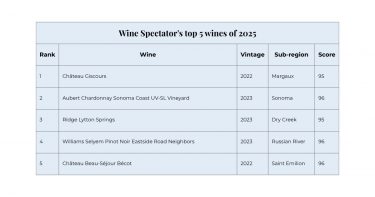
Wine Spectator's top 5 wines 2025

In 2025, the top position went to Château Giscours 2022, marking a major endorsement for Bordeaux’s strong 2022 vintage at a time when the region often finds itself facing criticism. Senior Editor James Molesworth explains: ‘Recent vintages have been mercurial in quality, while the region’s annual spring en primeur campaigns have fizzled. Tariffs haven’t helped. But if you needed a reminder that Bordeaux still makes some of the greatest wines in the world – and that its producers can evolve with changing times – the Château Giscours Margaux 2022 is your wine. This third-growth classified estate earns our top honor this year.’ 

Molesworth further highlights the wine as the culmination of decades of rebuilding work at the estate: ‘The efforts of Van Beek to surpass numerous obstacles over a generation is a clear example of how wine is a long game.’ The critic notes that recent improvements, including refined harvesting practices and guidance from consultant Thomas Duclos, have helped elevate quality, vintage after vintage. In 2022, these efforts culminated in a grand vin that Wine Spectator describes as fresh, seductive and finely detailed, with no second wine produced due to the exceptional quality of the harvest.

The rest of the top four represent a strong showing for California. Aubert’s UV-SL Chardonnay (No. 2) was praised as the union of ‘a renowned winemaker, a special vineyard and an exceptional vintage.’ Meanwhile, Ridge’s Lytton Springs 2023 and Williams Selyem’s Eastside Road Neighbors Pinot Noir 2023 reflect the continued strength and stylistic diversity of Californian wine across Dry Creek Valley and Russian River Valley.

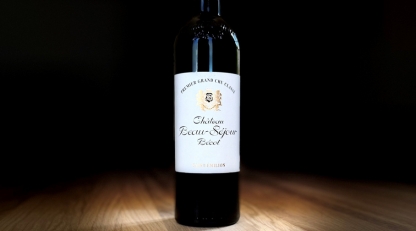
Rounding out the top five is another Bordeaux 2022 wine: Château Beau-Séjour Bécot. Wine Spectator calls it a ‘dreamy wine’, reinforcing the broader pattern seen across both critic and market attention this year. Bordeaux 2022 is clearly one of the defining narratives of the 2025 rankings, earning major positions across multiple publications.

Vinous’ top 100 wines of 2025

Vinous’ annual list, which Antonio Galloni says aims to capture the ‘diversity and dynamism of today’s wine world,’ showcases wines of exceptional quality, character, and excitement rather than simply the highest-scoring bottles.
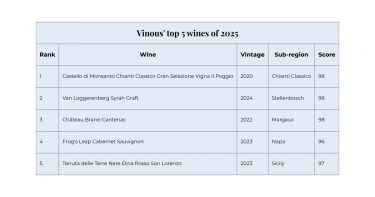
Vinous' top five wines 2025

This year, Italy takes the top spot with Monsanto’s Il Poggio, which Galloni calls “a total stunner” and “one of the very finest Il Poggios ever made.”

One of the most notable placements comes at No. 2: Van Loggerenberg’s “Graft” Syrah 2024 from South Africa. Neal Martin awarded it 98 points, praising its mineral character, balance, and crystalline finish – another sign of South Africa’s accelerating rise in fine wine quality.

The third wine in the list represents a more classical pick, but with a symbolic shift. With ownership passing to Henri Lurton’s children, Martin sees the 2022 Château Brane-Cantenac as a defining benchmark: ‘A year when… the 2022 is a benchmark for the Margaux estate, its future North Star.’

The list continues with strong representation from both New and Old World producers, including Frog’s Leap’s classically styled 2023 Cabernet Sauvignon and Tenuta delle Terre Nere’s deeply structured Etna Rosso San Lorenzo.

James Suckling’s favourite wines of 2025

James Suckling’s team tasted over 45,000 wines in the last year, making his Top 100 one of the most globally comprehensive. His selections prioritise balance and drinkability – wines that shine immediately, whether from bottle or barrel.
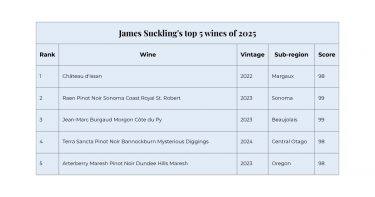
James Suckling's top five wines 2025

His top wine – Château d’Issan 2022 – reflects the broader dominance of Bordeaux’s 2022s across his list. Suckling emphasises that the vintage remains one of the biggest stories of the year, praising how the wines show focus, brightness and precision despite extreme heat and drought. He compares 2022 to other hot-vintage classics such as 1982, 1959, 1947 and 1928, all of which have stood the test of time, an important indicator for long-term growth. 

Suckling also notes how the accessibility of 2022 Bordeaux – widely released, easy to sample, and available across markets – enabled more comprehensive evaluation this year, contributing to their strong representation.

The remaining wines illustrate the global reach of modern fine wine quality. American Pinot Noir features prominently, with standout bottles from Raen and Arterberry Maresh. Meanwhile, two of the most surprising inclusions – Burgaud’s Morgon Côte du Py and Terra Sancta’s Bannockburn Pinot Noir – are also among the most affordable on the list, reinforcing Suckling’s point about the exceptional value emerging from Beaujolais and regions such as Central Otago. His report proposes that once-overlooked regions are now producing wines of extraordinary finesse and consistency.

Across all three critic rankings, a consistent narrative emerges: fine wine quality is more global, diverse and dynamic than ever before. At the same time, the spotlight on Bordeaux 2022 signals a vintage with both critical momentum and long-term relevance, firmly positioning it as one of the defining investment stories of the year.

Not every critically acclaimed wine is an investment wine, but the themes that surface – regional momentum, stylistic shifts, the performance of key vintages, and the critics’ influence on market behaviour – will all shape the fine wine landscape as we move into 2026.

WineCap’s independent market analysis showcases the value of portfolio diversification and the stability offered by investing in wine. Speak to one of our wine investment experts and start building your portfolio. Schedule your free consultation today

Categories
Learn

The best fine wines to invest in 2025

How to pick the best investment wines

The fine wine secondary market is still working through a correction that began in late 2022. Prices declined further throughout the first half of this year, with the Liv-ex 100 index down 5.2%. For investors, this means many blue-chip wines are available at levels not seen for years, yet careful selection matters more than ever. 

When choosing fine wines for investment in 2025, the following five criteria should be considered:

  1. Liquidity: depth of secondary market trading 
  2. Scarcity: limited production and strong back-vintage demand. 
  3. Proven vintage quality: critics’ consensus across strong years.
  4. Price momentum and entry point: assets that corrected to historically attractive bands.
  5. Fundamentals: brand power, distribution, and ageing potential.

These filters reflect a cautious market where ‘selectivity and scarcity’ are driving the handful of winners that still posted gains in H1 2025.

Best Bordeaux wines to invest in: value in maturity

Bordeaux’s share of global trade has shrunk over the past decade – from a once dominant force to now accounting for just over a third of the market by value. It’s also been one of the hardest-hit regions in terms of price performance during the recent downturn. On the surface, that may look like a negative but in reality, it has opened a window of opportunity for new buyers.

The recent correction has created compelling value in back vintages. The long-standing myth that ‘the best Bordeaux to invest in is always the latest release’ has been debunked by recent market behaviour and En Primeur campaigns. In 2025, many of the most sought-after Bordeaux wines for investment were not recent releases but mature, well-stored vintages offering proven quality, established critic scores, and immediate drinkability.

Even the 2024 En Primeur campaign underscored this shift in thinking: while release prices were often cut aggressively to stimulate demand, in many cases, comparable back vintages offered more value for money.

Where to focus

  • Classed growth Left Bank from strong years: First Growth prices have fallen with the market, but that’s precisely where patiently-awaited value emerges in proven vintages with long drinking windows.
  • High-momentum châteaux like Les Carmes Haut-Brion: its critical trajectory and scarcity keep it on many ‘accumulate on dips’ lists.
  • Second wines are mixed: prefer estates with consistent quality vs the Grand Vin and strong brand equity.

A cyclical downturn, steeper primary price cuts, and abundant back-vintage supply allow building positions in classic names at 2014-era equivalents.

Best Burgundy wines to invest in: buy selectively

Burgundy, which has fallen 5.8% year-to-date, remains one of the regions most affected by the broader market correction. After leading the charge in the 2020-2022 price surge, it’s now working off those highs, but that’s drawing in patient buyers. Liv-ex recently reported that their Burgundy 150’s bid:offer ratio is climbing as buyers take advantage of softer conditions. 

The best opportunities are in domaines with transparent distribution, consistent critic backing, and production levels that support liquidity. The aim isn’t to chase the rarest unicorns with the widest spreads, but to target ageworthy Premiers and Grands Cru wines from established producers – especially where pricing has stabilised.

Where to focus

Tip: Our full list of best-performing Burgundies is updated live on Wine Track – use it to cross-check performance momentum against your shortlist before committing capital.

Best Italian wines to invest in 2025: Super Tuscans and Piedmont

Italy’s indices have been more resilient than much of the market since 2023, with the Italy 100 showing a ‘tale of two cities’ – some weakness, but better relative performance than Burgundy and Bordeaux in the drawdown. Price discipline at release and broadening global demand help.

Where to focus

For diversification within Italy, combining steady Super Tuscan exposure with carefully chosen Piedmont parcels can balance liquidity with potential upside.

Best Champagnes to invest in 2025: stabilisation & early upside

Champagne combines brand prestige with broad global demand, strong critical reputations, and genuine scarcity in top vintages. After more than a year of declines, Champagne’s investment market is showing its first signs of recovery. In June 2025, the Liv-ex Champagne 50 posted its first monthly gain in twelve months, rising 0.8%. 

Individual brand performances are another encouraging sign. Across 50 flagship vintages from Dom Pérignon, Cristal, Salon, Krug, and Taittinger Comtes, over 85% have halted their price declines, with most holding steady for at least six months, reaching a classic consolidation phase. 

Moreover, demand is back on the rise. Champagne’s market share on Liv-ex has climbed to 12.4% year-to-date, above 2024’s average.

With prices now at more attractive entry points, this could be the first major fine wine region to re-enter growth mode, potentially ahead of Bordeaux, Burgundy, and Italy in the recovery cycle.

Where to focus

For investors seeking diversification with cyclical upside, the signs suggest Champagne may soon be popping again.

Best California wines to invest in 2025: pound strength opportunity

Sterling’s strength against the US dollar – at near decade highs – has combined with an 11.4% year-on-year price decline in Californian fine wine to create one of the most attractive buying climates in recent memory for European investors. 

Market leaders such as Screaming Eagle, Dominus and Opus One offer strong recovery potential, relative scarcity and top quality. Screaming Eagle’s long-term track record is particularly impressive, with six 100-point vintages in just 13 releases, and index growth of over 200% in the last two decades.

Where to focus

  • Icons at cyclical lows: Screaming Eagle 2021, Opus One, and Dominus for recovery-driven gains.
  • High-growth, small-production labels: Bond Melbury and Screaming Eagle The Flight, combining scarcity with recent strong momentum.
  • Diversification beyond Cabernet: Aubert Chardonnay and Occidental Pinot Noir for breadth and reduced volatility in US exposure.

With pricing, currency, and availability aligning, California offers a unique short-term window to secure both blue-chip icons and emerging stars at levels not seen in years.

Best investment vintages: quick compass in 2025

2005 (Bordeaux & beyond):
Now entering a glorious drinking window for Left Bank and Right Bank; quality is broadly exceptional with structure to age. Availability exists across the spectrum, often at meaningful discounts to 2022 highs. Great for ‘drink or hold’ strategies.

2009 (Bordeaux):
Riper, glamorous wines with huge critical appeal. Prices inflated in prior cycles, but the correction has pruned excess. Choose château by château; prime cellaring histories command premiums, but fair value has returned for top Left Bank and Right Bank bottlings. 

2016 (Bordeaux + Italy):
Among the most investable ‘modern classics’. Left Bank 2016 remains a reference point for balance, precision, and longevity; Tuscany 2016 (including Bolgheri) also shines. If you want one core vintage anchor for Bordeaux exposure in 2025, 2016 is the workhorse – especially as prices have softened. 

2020 (Burgundy + Tuscany + select Bordeaux):
A high-quality, warm year with strong critic support in many regions. In Burgundy, 2020 reds can be concentrated yet poised; in Tuscany, 2020 offers ripe, polished profiles for Ornellaia and peers. Corrections since 2023 have made select Bordeaux 2020s attractive relative to peak price points. 

En Primeur 2024 (context for new allocations):
Not a ‘vintage to chase at any price’, but the pricing is the story: releases down roughly 30% from 2023 at top estates, in several cases the lowest since 2014. If you buy En Primeur in 2025, do it for value vs readily available back vintages and only for estates with a clear historical discount at release.

Producers to watch in 2025

  • Les Carmes Haut-Brion combines small volumes, soaring critical trajectories, and a style that has captivated collectors. Pricing cooled with the market – use corrections to build modest positions with strict provenance.
  • Piedmont rarities with widening global followings, like Roagna’s single-vineyard Barbarescos and Barolos and Bartolo Mascarello. Watch for select back vintage offers post-correction.
  • Bolgheri peers beyond the ‘Big Three’ such as Le Macchiole Paleo and La Messorio, Tua Rita Redigaffi, and Soldera.
  • Select white Burgundy domaines with stronger availability (e.g. PYCM, Leflaive, Dauvissat). There is renewed interest in mature whites amid the broader correction.

Fine wine market 2025: why timing matters

Several data points contextualise 2025 positioning:

  • Market performance: Liv-ex’s broad Fine Wine 1000 is down 10.1% over one year and 20.9% over two years, illustrating the size of the reset. H1 2025 specifically saw the Fine Wine 100 fall roughly 4.4%, below the trade’s own start-of-year expectations.
  • Investor demand: Our primary research among wealth managers in both the UK and US showed they expect fine wine demand to rise this year – the highest expectation across luxury assets – despite the price falls. That tells you professional allocators are eyeing the dip.
  • Trade news: Quarterly round-ups from the wine trade echo the general market softness, highlight pockets of strength and cross-asset diversification appeal.

How to invest in fine wine in 2025

  1. Favour maturity or proven classics over speculative juveniles. The 2024-2025 buyer trend is toward ready-to-drink, mature vintages at corrected prices; that’s often the cleanest risk-adjusted exposure right now.
  2. Cross-check new releases vs back vintages for value. If the new release isn’t clearly cheaper than equal-or-better scored back vintages, skip it.
  3. Diversify by region and producer style. Italy’s relative resilience helps balance Burgundy/Bordeaux cyclicality; include Champagne/Rhône sleeves if your strategy allows.

Key takeaway: best fine wines to invest in 2025

2025 remains a buyers’ market. Liquidity is uneven, but the combination of cheaper Bordeaux, normalised Burgundy, and resilient Super Tuscans offers a compelling entry point. The market correction is still visible in the broader benchmark indices, but the best names at the right vintages and prices are being quietly accumulated again.

View our full Fine Wine Investment Guide

FAQs: Fine wine investment in 2025

1) Is fine wine a good investment in 2025?
Yes. 2025 remains a buyer’s market after a multi-year correction. Returns will be driven by selectivity (region/producer/vintage), provenance, and a longer holding period rather than quick flips.

2) Which regions offer the best value right now?
Bordeaux (mature back vintages), Burgundy (disciplined buys; mature whites and select 2019–2020 reds), Italy (Super Tuscans with steady liquidity), Champagne (early stabilisation), and California (GBP strength vs USD creating entry points).

3) How long should I hold investment wine?
Plan for 5-10+ years. Liquidity varies, but blue-chip Bordeaux can require 10-20 years to peak; Super Tuscans and Champagne often realise value earlier. Shorter holds increase friction and pricing risk.

4) What’s the minimum budget to start?
Practically, £5k-£25k builds a diversified starter portfolio. 

5) En Primeur or back vintages – which is better in 2025?
Often back vintages: you avoid waiting, see real critic consensus, and can compare prices like-for-like. Buy En Primeur only when the release clearly beats equivalent back vintages.

6) How important is provenance and storage?
Critical. Favour in-bond stock, original cases, full paper trails, professional storage, and inspection photos. 

7) How do currency and tariffs affect returns?
FX can add or subtract several percentage points. Tariff and duty regimes differ by route and change over time.

8) How do I manage liquidity?
Diversify across regions and styles and buy wines with established secondary market depth.