Categories
News

Bordeaux En Primeur 2024: critic scores and best releases

  • There have been some notable releases in a quieter En Primeur campaign. 
  • All of the top releases have represented the best entry point into their respective brands in the last decade. 
  • Critics have emphasised selectivity in a challenging vintage.

One month in since the start of the Bordeaux 2024 En Primeur campaign, which seems to be nearing its end, we look at critic scores and price trends to evaluate the best releases.

What the critics are saying

After the Wine Advocate’s William Kelley called Bordeaux 2024 ‘the weakest vintage of the last decade’, other critics have echoed his concerns with greater nuance. 

For Jane Anson, ‘the vintage was better than expected […] and clearly better than, for example, 2013 – and 2021 in the best cases.’

Meanwhile, Antonio Galloni (Vinous) observed: ‘The 2024s are all over the place in terms of quality and style, so readers will have to be selective. Within that context, the very best wines have a lot to offer.’ His ‘magnificent eight’ were Beychevelle, Clos Puy Arnaud, Cos d’Estournel, Jean Faure, Larcis Ducasse, Lascombes, La Conseillante and Rauzan-Ségla.

Neal Martin concluded his report, arguing that 2024 is ‘the ideal vintage for a reset’. He noted that ‘given the obstacles placed along the growing season, any 2024 that scores above 90 points is a success’. Martin’s highest barrel range was 96-98 points for La Mission Haut-Brion Blanc. Among the reds, his top wines with 95-97 points were Lafite Rothschild, Trotanoy, Lafleur and Vieux Château Certan.

The state of the market

As Bordeaux continues to lose market share to other regions, and fine wine prices overall are in a correction phase, releasing En Primeur has only worked with heavy discounts. We spoke with leading producers on how they determine their release prices, with strategies ranging from consulting négociants  and importers, and weighing in volumes and vintage quality. 

In his report, Martin speaks of the following reality: ‘There is no saviour riding over the horizon, no emerging country of insatiable Bordeaux-lovers, all against a backdrop of a vine-pull scheme […] and the fact that Bordeaux is wrestling with an image crisis.’ 

The solution? He goes back to the beginning of his career, when ‘off-vintages in the mould of 2024 would be discounted, and […] nobody lost face, including the grandest châteaux, and crucially, it kept the primeur system flowing, bottles passing through the distribution chain to the all-important final consumer’.

Within this context, we look at the releases that have worked so far – where pricing has aligned with trade and consumer expectations, and has offered a window for long-term profitability. 

Best En Primeur releases to date

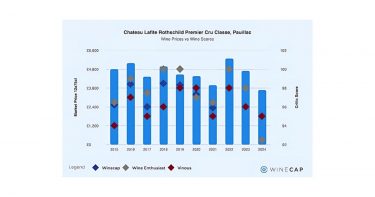
One of the standout releases of the campaign has been First Growth Château Lafite Rothschild.

The 2024 vintage emerged as the most attractively priced Lafite in recent memory. In fact, only one other vintage from the past 40 years comes within 25% of its release price. Even lower-rated vintages like 2013 and 2007 – both released before the transformative investments that elevated Lafite’s quality – now trade at considerably higher levels.
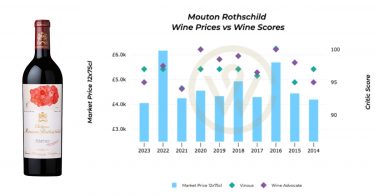
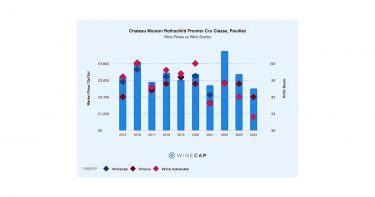
Much like Lafite, the 2024 Mouton Rothschild represents a rare opportunity. It is the best-priced Mouton vintage currently available on the market. Adjusted for inflation, only one other vintage in the last two decades compares in affordability. 

Moreover, Mouton has been the best-performing First Growth over the last five years, while also being Wine-Searcher’s most searched-for wine globally. 

History shows that these ‘less celebrated’ vintages often outperform their more hyped counterparts. For both Lafite and Mouton, vintages such as 2007, 2008, 2013, and 2014 have significantly outpaced the more acclaimed 2009, 2010, or 2016 in price performance.
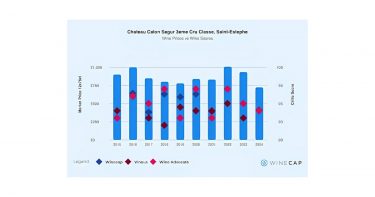
Another notable performer is Calon Ségur. While it may have flown slightly under the radar, its 2024 release represents the best entry point into the brand in over a decade. Calon has built a strong reputation among critics, frequently earning 95+ scores from Wine Advocate and Vinous. 

Its investment credentials are equally impressive: between 2015 and 2023, Calon prices surged more than 80%. Even with recent market dips, our Calon Ségur index remains 75% higher than it was ten years ago – making it one of Bordeaux’s most dynamic performers.
Looking for more? Read our Bordeaux Regional Report.
Categories
News

Mixed signals: correction continues but top wines prove the exception

  • Despite a broader market correction, some fine wines have risen over 10% year-to-date. 
  • The top-performers are united by their strong value proposition. 
  • The 2024 En Primeur is all about momentum and timing, given the mixed quality and the availability of well-priced older vintages.

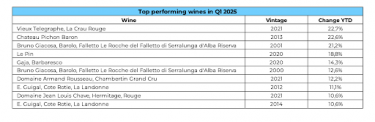
Despite a broader market correction – with the Liv-ex 1000 index declining 2.1% year-to-date – select fine wines have demonstrated remarkable resilience. A closer look at Q1’s top performers reveals a diverse spread across key wine regions: Bordeaux, Piedmont, the Rhône, and Burgundy.

The best performing wines

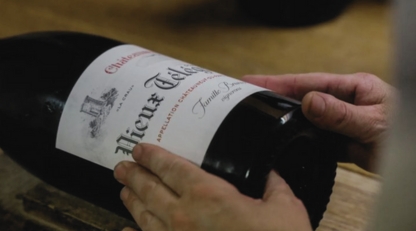
The best performing wine was Vieux Telegraphe La Crau Rouge 2021, which surged 22.7%. The long-term trajectory of the brand has been upwards, with a 54% rise in value over the past decade.

The second spot was taken up by Pichon Baron 2013 with a 22.6% rise. Often overlooked due to the vintage’s cooler weather, it now stands out for its relative value and strong long-term potential. Over the past ten years, the brand’s prices have climbed by 58% on average.

From the Northern Rhône, Guigal’s La Landonne secured two spots on the leaderboard: the 2012 vintage rose 11.1%, while the 2014 – 10.6%. Across the past decade, the La La wines have appreciated by 47%, affirming their iconic status among Rhône collectors.

From Barolo, the 2001 Bruno Giacosa Serralunga d’Alba made the top ten with a 21.2% rise, showcasing continued demand for aged, cellar-ready Nebbiolo from one of Piedmont’s most revered producers.

Regional trends: pressure persists

While these individual wines bucked the trend, broader regional indices tell a more sobering story. Both Burgundy and Bordeaux, the primary pillars of the fine wine market, fell by 2.9% in Q1. Even regions that showed resilience – such as the Rhône, which rose 1.1% in March – remain down overall for the quarter.

This pattern underscores the current investor mindset: cautious, value-driven, and increasingly selective.

2024 En Primeur: momentum and timing

The 2024 Bordeaux En Primeur campaign has landed in challenging terrain. With the market in retreat and the specter of new U.S. tariffs, producers have had no choice but to re-evaluate pricing strategies. The first releases came in below last year’s prices, and before critic scores were published.

While these adjustments reflect an awareness of the macroeconomic environment, price cuts alone don’t guarantee demand. Investors are weighing these new offers against older vintages available at comparable – or better – value.

The swift pace and early start of this year’s campaign echo the successful 2019 En Primeur release, which capitalised on momentum and timing. However, given the mixed vintage quality and volatile market, strategic selectivity is more essential than ever.

Looking for more? Read our Q1 2025 Fine Wine Report.

Categories
Learn

How does Bordeaux set its release prices?

In the springtime of each year, all eyes turn to Bordeaux as the region begins its extended En Primeur campaign when châteaux across this prominent region set their wine prices.

Such decisions require the navigation of multiple factors within a delicate financial and cultural ecosystem. WineCap spoke with eminent producers for insights into what influences the all-important price setting.

  •         Previous vintages and price key influences
  •         Profitability for all players is an important driver
  •         Compelling price point for customers is critical
  •         Brand and critical ratings have some impact

Château Smith Haut-Lafitte, Grand Cru Classé, Graves

“Don’t believe people say, ‘I do it all by myself’,” said Florence Cathiard who co-owns the Graves house with her husband Daniel. “It’s a long process and very delicate because we have to take several parameters into account.”

These include contemplating pushing prices higher because of swift sales in previous years, the vintage quality, and the general global environment.

“We also take advice from some of the best négociants, brokers, and even some importers — not those who are just trying to put the price down, to sell high, but the real friends.”

Château Pichon-Longueville Baron, Second Growth, Pauillac

Christian Seely, managing director of AXA Millésimes, owner of Château Pichon-Longueville Baron, has devised a formula for the optimal release price of a Grand Cru Wine.

“The ideal price is the highest price possible at which my existing customers will buy the wine with enthusiasm,” he said. “It has to be the highest price possible, otherwise I might get fired. But it has to be the highest price possible at which my existing customers will buy the wine with enthusiasm. If you go too high, your existing customers might buy it without enthusiasm. If you go much too high, maybe your existing customers won’t buy it, and that would be terrible. It’s a personal judgment based on experience.”

Château Pichon Comtesse, Second Growth, Pauillac

Nicolas Glumineau, CEO and winemaker of Château Pichon Comtesse, combines mathematics with common sense.

To price the wine correctly, you have to be very respectful of your market. And what we do is to have a very sharp eye on market prices,” he explained. “We consider that each step of the distribution chain has to get remuneration. It’s very important for each of us to earn money thanks to the distribution of Pichon Comtesse.”

Château Cheval Blanc, Saint-Émilion

Pierre-Oliver Clouet, Managing Director at Château Cheval Blanc has a similarly logical approach.

“En Primeur should be forever the lowest price you can find in your bottle,” he told WineCap. “The release price depends on many things: the quality of the vintage, the economic context in the world, and, as well, the price of new vintages available on the market. So, ultimately, the definition of the price En Primeur is not something difficult to reach. This is something mathematical.”

Château Canon, Premier Grand Cru Classé, Saint-Émilion.

Nicolas Audebert also follows mathematical logic in the pricing game. “If you go En Primeur, the interest for the consumer, the guy buying the bottle is that ‘if I buy en primeur, the bottle that I will put in my cellar and not able to drink now, it has to be at a lower price of the same quality I can buy in the market and drink now’,” he told WineCap.

Audebert takes an equivalent quality vintage from recent years, considers the margin, does some precision-calculations, and arrives at a price that offers a ‘win-win’ for all parties.

“Of course, afterwards, you can have ‘plus-value’ on the exceptional quality of the vintage or something like that. But if we play primeur, we have to play the game of logical pricing.”

Château Pavie, Premier Grand Cru Classé (A), Saint-Émilion

“There are some secrets,” jokes Olivier Gailly, commercial director for the Perse wine family at the renowned house. “There are a lot of different factors, which are, first of all, the history of your château, the different vintages and prices in the past, and how successful it was.

If the market demands, you have to push some, but you have to listen to it as well. Of course, ratings still play a role, meaning the feedback from the customers when they come and taste during the En Primeur week in Bordeaux. We then meet with Monsieur Perse and take the decision together. The final one will be his, being the owner of the property.”

Château La Mondotte, Premier Grand Cru Classé, Saint-Émilion

“If you have the wrong price, it’s a disaster,” Stéphane von Neipperg, owner of the Right Bank house said. “Nobody wants a lot of people wh don’t want to buy the wine.”

When his team goes to the market, they consider the global economy, the local market price direction, and information from brokers and négociants. “You have to absolutely test the price with negotiants, brokers, and also with your friends, the importers. Then we can say, ‘well, this would be a good price’. A good price is when everyone in the business makes money.”

Cos d’Estournel, Second Growth, Saint-Estèphe

Charles Thomas, commercial director of the Left Bank château, places an emphasis on quality and the good value the region offers when deciding on price. “I would be lying if I said it doesn’t depend sometimes on the exchange rate,” he said. “But also, it’s according to the quality we have — and this is the most important thing. Bordeaux is not expensive when you look at Burgundy and Napa Valley and some wine from other appellations.”

Vintage has more of an impact than elsewhere and can link to market price, Thomas added. “Of course, in Bordeaux you have the vintage effect that you don’t always have in other parts of the world. We try to be more stable for the client or the consumer, though, so they can accept any necessary price variation.”

Château Angelus, Saint-Émilion

As well as previous vintage pricing in Bordeaux and internationally, for Château Angelus CEO Stéphanie de Boüard-Rivoal, two more factors are key influences when the prestigious house goes to market.

“The volume as well, of course, because it makes a real impact,” she explained. “I’d say the strength of the brand as well.”

See also our Bordeaux I Regional Report

WineCap’s independent market analysis showcases the value of portfolio diversification and the stability offered by investing in wine. Speak to one of our wine investment experts and start building your portfolio. Schedule your free consultation today.

Categories
Report

Bordeaux Regional Report

Our Bordeaux Regional Report examines the evolution of its investment market, the First Growths, their second wines and En Primeur.

Bordeaux has long been the backbone of the fine wine market. Its unique combination of history, scale, and globally recognised brands has positioned it not just as a leading wine region, but as the reference point for fine wine investment worldwide.

As early as 1787, Thomas Jefferson recognised the collectible potential of Bordeaux’s finest estates. More than two centuries later, that early insight still holds true. While the fine wine market has diversified significantly in recent years, Bordeaux continues to play a defining role – often setting the tone for broader market performance.

At its peak in 2010, Bordeaux accounted for an extraordinary 96% of the fine wine market by value. Although its share has since moderated as regions such as Burgundy and Champagne have risen, Bordeaux remains the most influential and liquid region in the investment landscape.

WineCap’s Bordeaux Regional Report explores why this remains the case – and where the most compelling opportunities now lie.

Key findings from the Bordeaux Regional Report

Bordeaux remains the most important fine wine investment region

Despite increased diversification, Bordeaux still accounts for over a third of the fine wine market by value today. Its long-established distribution networks, global demand, and deep secondary market continue to underpin its dominance, particularly for investors prioritising liquidity and long-term stability.

The First Growths continue to anchor the market

The Bordeaux First Growths – Château Lafite Rothschild, Château Latour, Château Margaux, Château Haut-Brion, and Château Mouton Rothschild – remain the cornerstones of fine wine portfolios. While their share of total trade has declined from historic highs, they still represent around 30% of Bordeaux’s secondary market activity, reinforcing their role as pricing benchmarks and confidence indicators.

Second Wines and “Super Seconds” offer compelling value

One of the most notable trends highlighted in the report is the growing importance of second wines and so-called “Super Second” estates. These wines benefit from the same terroirs and technical expertise as their flagship counterparts but offer more accessible entry points. In many cases, they have delivered stronger relative performance over the past decade, driven by rising quality and growing global recognition.

Older vintages are often undervalued

The report shows that some of the most attractive opportunities in Bordeaux today lie not in the latest releases, but in older, overlooked vintages. These wines frequently trade at favourable price-to-quality ratios and can offer greater upside potential than more recent En Primeur releases, particularly in a more price-sensitive market environment.

En Primeur’s influence has weakened

While En Primeur remains a defining feature of Bordeaux, its role has evolved. Pricing misalignment in recent campaigns has reduced its appeal, shifting the focus towards disciplined, selective participation. The report highlights that En Primeur can still present opportunities, but only when release prices reflect broader market conditions and long-term value.

Bordeaux’s role in a diversified market

As the fine wine market has broadened to include Burgundy, Champagne, Italy, and California, Bordeaux has increasingly positioned itself as the region of stability. Its slower but steadier appreciation, combined with unrivalled liquidity, continues to make it a foundational allocation within diversified fine wine portfolios.

Explore the full report

WineCap’s Bordeaux Regional Report provides a detailed analysis of the region’s evolution, historic performance, key investment estates, and future outlook in an increasingly diversified fine wine market.

Download the full Bordeaux Regional Report to explore the data, insights, and opportunities shaping one of the world’s most important fine wine regions.


Categories
News

Burgundy En Primeur 2023 and the current market

  • The 2023 Burgundy vintage is bountiful but heterogeneous in quality.
  • Careful selection of reputable domains and top producers is necessary when making purchasing decisions.
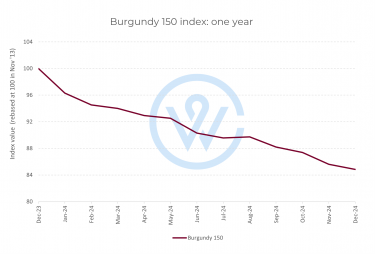
  • In the secondary market, Burgundy prices have fallen 15.2% in the last year.

The Burgundy En Primeur 2023 campaign brings a vintage full of potential and expectations: potential due to the quality but mostly quantity of the vintage in a region defined by scarcity, and expectations for reduced pricing given producers’ desire to sell.

The campaign arrives at a pivotal moment for the region. Following years defined by scarcity, rising prices, and intense demand, Burgundy now presents a markedly different proposition: a large-volume vintage released into a softening market.

The 2023 Burgundy vintage is widely described as bountiful but heterogeneous. Production volumes exceeded the regional average by approximately 30%, offering a level of availability rarely seen in Burgundy. Yet quality varies significantly by site, grape variety, and producer, making careful selection essential.

This article explores the 2023 Burgundy En Primeur vintage, comparing reds and whites, assessing critical perspectives, and placing the campaign within its broader market context. For collectors and investors alike, the campaign presents both opportunity and complexity.

A bountiful but heterogeneous Burgundy vintage

The defining feature of the 2023 Burgundy vintage is quantity. After consecutive years of frost, hail, and drought-induced scarcity, growers welcomed yields well above average. However, volume alone does not define quality in Burgundy.

Weather conditions throughout the growing season were challenging. Episodes of heat, drought, and localized flooding tested vineyard management skills, and outcomes varied sharply depending on producer decisions.

As Sarah Marsh MW summarised:

“The 2023 Burgundy was a bounteous but heterogeneous vintage in which the white wines outshone the reds.”

This assessment has been echoed across early tastings and reports from critics including Jasper Morris MW and Neal Martin (Vinous).

Climatic conditions and alcohol levels in 2023

A key moment in the 2023 growing season was a late-season heat spike, which accelerated ripening across much of the Côte d’Or.

  • Chardonnay benefited from earlier harvests, preserving acidity and freshness before the most intense heat.

  • Pinot Noir, while generally successful, required precise yield control to avoid dilution and over-ripeness.

Alcohol levels across the vintage typically fall between 13% and 13.5%, reflecting healthy ripeness without excessive warmth. Where growers managed canopy and yields carefully, wines show clarity and balance rather than heaviness.

Reds vs whites: where the vintage excels

White wines: the clear winners of 2023

Across tastings, white wines consistently outperform reds in the 2023 vintage. Chardonnay handled the climatic challenges with greater resilience, producing wines marked by:

  • Fresh acidity

  • Mineral tension

  • Precise fruit expression

Cooler, high-quality sites performed particularly well. Standout appellations include:

  • Puligny-Montrachet Caillerets

  • Meursault Perrières

  • Chassagne-Montrachet higher-altitude parcels

Producers such as Jean Chartron, Violot-Guillemard, and Comte de Vogüé have received strong early praise for whites that combine structure with approachability.

Red wines: quality depends on discipline

The Pinot Noir wines of 2023 are more variable. Where yields were controlled and harvest timing was precise, reds show transparency and charm. However, less disciplined viticulture resulted in wines that lack concentration.

Critics note that the best reds favour elegance over power, making careful producer selection essential.

Notable successes include:

  • Bonnes Mares, noted for opulence and structure

  • Strong examples from Domaine Dujac and Domaine de la Vougeraie

Comparing 2022 vs 2023 Burgundy

Comparisons between the 2022 and 2023 Burgundy vintages are inevitable.

  • 2022: Riper, more consistent, immediately impressive, smaller volumes

  • 2023: Larger quantities, greater variability, more precision-driven wines

Several growers and critics have likened the 2022/23 pairing to classic contrasts such as 2015/16 or 2009/10 – where one vintage delivers power and the next refinement.

For buyers, this means 2023 should be approached selectively, rather than broadly.

Burgundy 2023 in market context

The Burgundy En Primeur 2023 campaign unfolds against a markedly different market backdrop than previous releases.

  • Burgundy prices have fallen 15.2% over the past year, the steepest decline among major fine wine regions.

  • Seven Burgundy brands dropped out of the Top 100 Most Powerful Wine Brands in 2024.

  • At the same time, Burgundy retains a 25–30% share of the global fine wine market, underlining its enduring importance.

In short, Burgundy remains a powerhouse – but no longer an automatic buy at any price.

Burgundy 150 index

Pricing strategies and producer behaviour

Recognising market conditions, many producers are adjusting their approach to pricing in 2023.

Key dynamics include:

  • Stable or reduced release prices from several domaines

  • A desire to maintain cash flow amid rising production costs

  • Awareness that buyers are comparing new releases with older vintages now available at lower prices

The large 2023 yields contrast sharply with expectations for significantly smaller 2024 harvests, reinforcing the value proposition of the current campaign.

Competition from the secondary market

A critical factor shaping the Burgundy En Primeur 2023 campaign is competition from the secondary market.

As prices have softened, older, well-stored Burgundy wines from strong vintages have re-emerged at attractive levels. For buyers, this creates a choice:

  • Purchase 2023 En Primeur at adjusted pricing

  • Acquire proven older vintages with established track records

This dynamic increases pressure on producers to price realistically and rewards buyers willing to compare value across vintages.

How buyers should approach Burgundy En Primeur 2023

The 2023 campaign is not one for indiscriminate buying. Instead, success depends on selectivity and discipline.

Key considerations include:

  • Producer reputation and vineyard management

  • Performance of specific sites rather than appellations alone

  • Quality of whites versus reds

  • Pricing relative to older vintages

  • Long-term positioning rather than short-term hype

For collectors, the vintage offers opportunities to secure high-quality white Burgundy and select red wines at more accessible price points than seen in recent years.

Burgundy’s long-term position in fine wine

Despite short-term market adjustments, Burgundy’s long-term fundamentals remain intact:

  • Unmatched vineyard specificity

  • Strong global demand for top domaines

  • Cultural and historical prestige

  • Continued scarcity at the very top end

The Burgundy En Primeur 2023 campaign reflects a region in transition, adapting to climatic realities and market forces while retaining its core appeal.

Final thoughts on Burgundy En Primeur 2023

The 2023 Burgundy vintage offers a rare combination of volume, selective quality, and evolving pricing strategies. While the wines are not uniformly great, the best examples – particularly among the whites – deliver precision, energy, and strong value relative to recent campaigns.

For informed buyers, the current market environment creates a strategic window to engage with Burgundy thoughtfully, balancing new releases against opportunities in the secondary market.

As Burgundy continues to navigate climatic and economic challenges, its enduring prestige remains undiminished but success now depends more than ever on careful selection.

WineCap’s independent market analysis showcases the value of portfolio diversification and the stability offered by investing in wine. Speak to one of our wine investment experts and start building your portfolio. Schedule your free consultation today

Categories
News

The best of Bordeaux En Primeur 2023

  • The best Bordeaux En Primeur releases offered a combination of quality and value. 
  • These are wines with high potential for future price appreciation.
  • Some châteaux have followed the En Primeur golden rule that the new release is the cheapest you can get. 

As this year’s Bordeaux En Primeur campaign draws to an end, we evaluate the best 2023 releases. These wines not only boast high quality, as measured by critic scores, but also offer value when compared to previous vintages. Below are our highlights from an investment perspective. 

Beychevelle 

Chateau Beychevelle En Primeur 2023

In the words of Château Beychevelle’s Philippe Blanc, ‘our golden rule is the En Primeur price is the cheapest you can get’. 

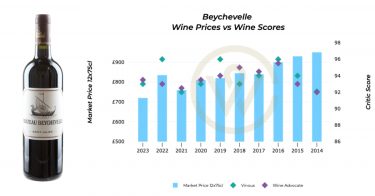
The rule was observed this year, with the 2023 representing the best priced vintage on the market today. 

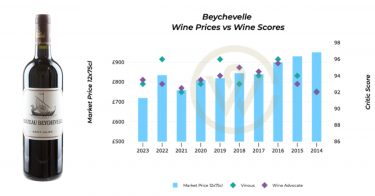
The wine received 94-96 points from Antonio Galloni (Vinous), who said: ‘Beychevelle remains one of the most distinctive wines in all of Bordeaux. It is especially classy in this edition.’ 

Meanwhile, the Wine Advocate’s William Kelley (93-94 points) noted that ‘the 2023 Beychevelle has turned out especially well this year, exhibiting a more integrated, seductive style than recent vintages’.

Lafite Rothschild & Carruades de Lafite

Lafite Rothschild Bordeaux En Primeur 2023

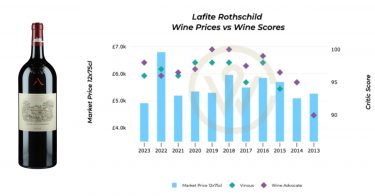
For William Kelley, Lafite Rothschild appeared to be ‘the finest of the first growths this year’. The critic awarded it 97-99 points. The wine was launched at an impressive 32% discount on last year, making the new release the most affordable on the market today. Shortly after release, the wine found its way into the secondary market.

Carruades Lafite Bordeaux 2023 En Primeur

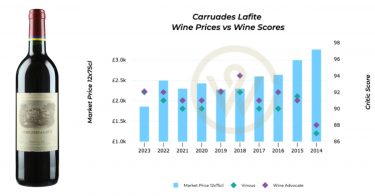
Its second wine also presented an enticing prospect to investors. As well as being the cheapest vintage, the wine was awarded a score of 91-93 from Neal Martin (Vinous), surpassing the 2022, 2016, and 2010. The critic remarked that this is ‘surely one of the best Carruades I have tasted at this stage’.

Mouton Rothschild & Petit Mouton

Mouton Rothschild Bordeaux 2023 En Primeur

In much the same vein as Lafite Rothschild, the 2023 Mouton Rothschild is the most affordable vintage available on the market today. Antonio Galloni gave it 96-99 points and declared that it ‘is shaping up to be one of the best wines of the vintage on the Left Bank’.

With 96-98 points from Neal Martin, its score looks set to match the 2022, 2020, 2019, and 2018. Only the 100-point 2016 has the upper hand but comes at a hefty 40% premium. 

Petit Mouton Bordeaux 2023 En Primeur

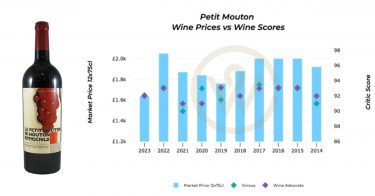
Once again, there is outstanding value to be found in the second wine. Petit Mouton 2023 is the best priced vintage available today by a healthy margin. And, according to Galloni, ‘it could easy be a Grand Vin at another address’.

Margaux

Chateau Margaux Bordeaux 2023 En Primeur

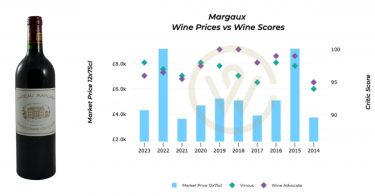
The highest-scoring Bordeaux 2023 wine across major critics, Margaux presented great value.

Galloni awarded it a potentially perfect score of 97-100 points, calling it ‘fabulous, sensual, silky and exceptionally polished’. 

Meanwhile, Martin described it as a ‘quintessential Margaux’, awarding it a score of 97-99 points.

Cheval Blanc

Chateau Cheval Blanc Bordeaux 2023 En Primeur

There are few wines that transcend the vintage in 2023, and Cheval Blanc is certainly one of them. 

There were few wines capable of transcending the vintage in 2023, but Cheval Blanc was certainly one of them.

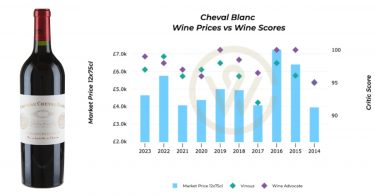
It is the second-highest-scoring Bordeaux 2023 wine across 12 leading critics. Winemaker Pierre-Olivier Clouet even goes so far as to say that it is superior to the 2022, as does the Wine Advocate’s William Kelley. 

Adding to its appeal is the value it offers. The 2023 is the most affordable option among top vintages. This is one of only two unambiguously ‘prime’ Cheval Blanc vintages available under £5,000 a case.

As these highlights show, there is value to be found during En Primeur with the right analysis tools. 

WineCap’s independent market analysis showcases the value of portfolio diversification and the stability offered by investing in wine. Speak to one of our wine investment experts and start building your portfolio. Schedule your free consultation today.

Categories
Learn

Bordeaux En Primeur 2023: under pressure

  • Bordeaux 2023 largely met trade expectations for reduced pricing but only some releases have stood out as offering fantastic value. 
  • Price cuts slowed towards the end of the campaign, from 27.4% average discount in week one, to 23.3% in week four.  
  • Bordeaux’s ability to adapt does not only matter for its short-term sales but also for its long-term relevance in a highly competitive market.

Over the last month, our news coverage centered around the ongoing Bordeaux 2023 En Primeur campaign, examining critic scores and the investment potential of the new releases. 

Prior to the start of the campaign, Bordeaux châteaux faced considerable pressure from the trade to reduce release prices. Price cuts of around 30% were expected. In some cases, these expectations were met, with reductions of up to 40%. 

Now that the campaign is coming to a close, we weigh its success, considering the current state of Bordeaux’s investment market. 

En Primeur 2023 – back in vogue?

Critics of En Primeur contend that the system no longer meets buyer expectations, and the 2023 vintage wanted to rise to the challenge of defying the norm.

Partially it did. Wines like Lafite Rothschild, Carruades de Lafite, Mouton Rothschild, Petit Mouton, Beychevelle, Cheval Blanc and Haut-Brion delivered value and were met with high demand. 

Liv-ex reported immediate trades on its exchange for some of the releases. A developing secondary market is a positive sign for investors, although both Lafite Rothschild and Mouton Rothschild 2023 changed hands below their opening levels. 

According to Liv-ex, ‘it is clear there continues to be a market for Bordeaux En Primeur at the right price. What that price is, is perhaps less clear and will not always be agreed upon’.

The En Primeur golden rule  

For investors, an En Primeur release needs to be the most affordable wine among vintages with comparable scores to make sense. Where that isn’t the case, one should be cautious when buying. 

‘Our golden rule is the En Primeur price is the cheapest you can get. You can’t get anything cheaper. Generally speaking, it’s reasonably successful, not to say 100% successful, and then the price goes up.’ – Philippe Blanc, Château Beychevelle

En Primeur should be forever the lowest price you can find in your bottle. If you purchase later, it’s going to be more difficult to find and it’s going to be more expensive.’ – Pierre-Olivier Clouet, Château Cheval Blanc

The price decrease trajectory

The average price reduction among the top wines released in the first week of the campaign was 27.4%, going as low as 40% discount on the previous year.

In the fourth week of the campaign, this trajectory of offers slowed down. The average discount was reduced to 23.2%, the most significant being Château La Fleur-Pétrus 2023, down 33.6%, and the least significant, Beychevelle (-11.1%).

However, even though Beychevelle has seen one of the smallest discounts, it has still been one of the best value releases this campaign.

Beychevelle En Primeur 2023 Prices

The Bordeaux market slowdown

The pressure to reduce release pricing was largely owing to the current market environment. 

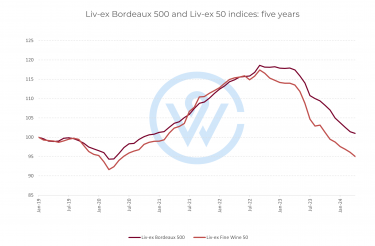
Over the past two years, Bordeaux prices are down 12%. Over the past five years, Bordeaux is one of the slowest growing markets, up 2.1%, considerably lagging behind Burgundy (25.2%), Italy (31.2%) and Champagne (45.5%). 

The market for top Bordeaux has suffered the most. First Growth prices are down 17.3% in the last two years, and 3.7% in the last five years.

Bordeaux En Primeur 2023 Prices

The region is also losing market share to its contenders. In 2023, Bordeaux accounted for 40% of the trade by value on Liv-ex compared to 60% in 2018.

This is further exacerbated by slowing demand. Liv-ex noted that today ‘there is more than three times as much Bordeaux for sale than the fine wine market is looking to absorb’.

The need to adapt

The 2023 En Primeur campaign has unfolded under the shadow of mounting pressure for Bordeaux to realign with market demands. The campaign highlighted the critical balance Bordeaux must maintain: offering wines at attractive prices for everyone in the chain. 

Successful examples from this year’s campaign, where price cuts coincided with high demand, underscore the potential for Bordeaux to adapt. However, the slower reduction rates towards the campaign’s end and varied responses from buyers reflect the ongoing debate about the optimal pricing strategy.

Ultimately, as Bordeaux grapples with these challenges, the 2023 En Primeur has underscored the importance of responsiveness to market dynamics. The region’s ability to adjust will not only determine its short-term sales but also its long-term relevance in a highly competitive and ever-evolving global wine market.

WineCap’s independent market analysis showcases the value of portfolio diversification and the stability offered by investing in wine. Speak to one of our wine investment experts and start building your portfolio. Schedule your free consultation today. 

Categories
News

Jeb Dunnuck on Bordeaux 2023 En Primeur

  • According to Jeb Dunnuck, ‘2023 is a good to very good, but not a great year for Bordeaux’.
  • He described most wines as ‘ripe yet not massive with more focused, linear profiles on the palate’.
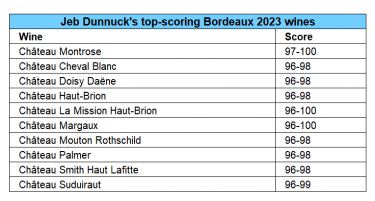
  • Château Montrose received his highest barrel range of 97-100 points.

According to Jeb Dunnuck, ‘2023 is a good to very good, but not a great year for Bordeaux’. In his latest report, the critic delves into the growing season that shaped the vintage, comparisons with previous years, the En Primeur tastings and the current market for buying the new releases. Below we summarise his key findings. 

A heterogeneous vintage

An erratic growing season led to a divergence of styles between sub-regions and even neighbouring châteaux. Bordeaux 2023 witnessed ‘an incredibly successful flowering, huge mildew pressure in the spring, a slightly uninspiring summer that lacked sunlight, sporadic and very localised storms, and a heatwave at the end of August and September that sped up ripening and, according to many, saved the vintage’.

In terms of vintage comparisons, ‘some of the wines have a certain 2019-like sunny, easygoing style, while others can have a cooler, more structured, almost austere profile similar to 2020’. The common themes, according to the critic, are the ‘fully ripe aromatics and more focused, linear profiles on the palate’.

A Left Bank vintage?

Jeb Dunnuck pointed out that ‘at a high level, the Merlot is much riper and more opulent, and the Cabernets are slightly fresher and vibrant’. He suggested that the Left Bank had the upper hand in 2023, saying that ‘while there are unquestionably impressive wines from the Right Bank, the top Médoc and Graves seem to have another level of harmony and overall balance’.

In terms of overall quality and style, Dunnuck argued that Bordeaux 2023 ‘surpasses 2014, 2017, and 2021 yet is a solid step back from the incredible trio of 2018 through 2020, and most likely will be surpassed by 2022 as well’.

Jeb Dunnuck’s favourite Bordeaux 2023 wines

Dunnuck found potential for perfection in three wines, awarding a barrel range of up to 100 points. Château Montrose got his highest score (97-100), and he noted that ‘it has some similarities to the 2010 (or 2016?) and might end up being the wine of the vintage’.

Among the First Growths, only Château Margaux came close to perfection, with the critic saying that ‘it is clearly one of the greats in the vintage, and it actually reminds me a touch of the 1996, if not better’.

Regarding the 2023 Château La Mission Haut-Brion, Dunnuck remarked that ‘the overall balance paired with opulence here is something to behold, and it’s incredible to find this level of quality in the vintage’.

Jeb Dunnuck Bordeaux 2023

Should you buy Bordeaux 2023 En Primeur?

Dunnuck outlines four main reasons why you should buy a vintage En Primeur: ‘1) If it is a great vintage; 2) If the wines are expected to increase in price; 3) If quantities are limited; and 4) If you are buying wines in formats other than 750-milliliter bottles’.

He defined 2023 as a ‘a borderline case’. While ‘it’s not a truly great vintage […] there are a handful of gems in the vintage that will rival the best from 2016, 2018, 2019, and 2020,’ the critic said.

In terms of pricing, he observed that it seemed to ‘be coming back to 2019 levels’, still he reckoned that ‘the time of substantial early gains from purchasing En Primeur has largely sailed’.

Our En Primeur offers only highlight wines that present great value for money in the context of the market prices for vintages currently available on the market. These are wines that hold significant potential for future price appreciation, and where the scores match the price. 

WineCap’s independent market analysis showcases the value of portfolio diversification and the stability offered by investing in wine. Speak to one of our wine investment experts and start building your portfolio. Schedule your free consultation today.

Categories
News

Neal Martin’s top-scoring Bordeaux 2023 wines

  • According to Neal Martin (Vinous), Bordeaux 2023 is a heterogeneous vintage riddled with paradoxes.
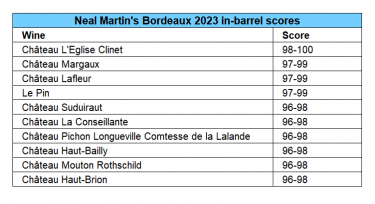
  • Only one wine achieved his highest score of 98-100 points – L’Eglise Clinet.
  • Martin suggested that ‘deep [price] cuts’ are needed for the campaign to work.

 Now that the En Primeur campaign has kicked off, critics have started releasing their Bordeaux 2023 in-barrel scores. Vinous recently published Neal Martin’s assessment of this ‘Dalmatian’ vintage, characterised by ‘spots of astounding quality’ but also ‘all manner of shortcomings’ – even in some of the region’s most famous names.

Bordeaux 2023 vintage overview

‘A season riddled with paradoxes,’ Neal Martin described Bordeaux 2023 as a heterogeneous vintage. According to him, it ‘would sit uncomfortably on a mantelpiece alongside 2016, 2020 and 2022’. However, the critic acknowledged that ‘some châteaux pulled out magical wines from their top hat, surpassing those aforementioned years in one or two cases’.

The keyword that defined 2023 is ‘classicism’, meaning ‘lower alcohol levels in the 13-something range,’ without the opulence of previous vintages.

Martin further noted that ‘the 2023s are relatively more tannic than we’ve become accustomed to, more linear and vertical, though endowed with greater fruit concentration than the 2021s’. He continued: ‘The best wines embrace these traits while maintaining sufficient fruit and grip, occasionally harking back to the kind of barrel samples encountered in the early days of my career, and I mean that in a good sense’.

Overall, Martin claimed that ‘despite the disparity in quality, it cannot be denied that it is bejewelled with a clutch of spellbinding wines’.

Top-scoring Bordeaux 2023 wines

Neal Martin’s top-scoring Bordeaux 2023 wines can be seen in the table below. Only one wine achieved the maximum barrel range of 98-100 points – the 2023 L’Eglise Clinet. Martin said that ‘it’s very harmonious and fans out brilliantly on the finish’.

Three wines received a barrel range of 97-99 points: Margaux, Lafleur and Le Pin. In his tasting note, Martin called the First Growth a ‘quintessential Château Margaux’ but noted that it ‘will require ten years in bottle to really show what it is capable of’.

Regarding Lafleur, he said it was ‘one of the few profound wines this vintage’. He described Le Pin as ‘so pure and refined, it seems to embrace and gently hug the senses’.

En Primeur and the global market

Despite the virtues of the vintage, the question of whether it will present value is pertinent in the current economic climate. For Martin, the ‘newborn wines blink open their eyes to survey a bleak economic landscape and finger-pointing between various factions as to who’s to blame’. He said that ‘deep cuts, not gestures, are the only thing that will open wallets’.

This week’s first releases have seen discounts of up to 40% on last year. However, back vintages of similar quality that remain available for less continue to challenge the En Primeur tradition.

Stay tuned for our analysis of the best value releases.

WineCap’s independent market analysis showcases the value of portfolio diversification and the stability offered by investing in wine. Speak to one of our wine investment experts and start building your portfolio. Schedule your free consultation today.

Categories
Learn

What is En Primeur? A short guide for wine investors

  • En Primeur is a three-tier system, involving châteaux, négociants, and courtiers.
  • It allows buyers to purchase wines early, while they are still in barrel.
  • It provides an opportunity to secure allocations of highly sought-after wines that might appreciate in value when bottled.

En Primeur, also known as ‘wine futures’, is a practice rooted deeply in the traditions of the French wine market, particularly prominent in Bordeaux. This unique system allows investors and wine enthusiasts to purchase wines early, while they are still in the barrel, well before they are bottled and released on the general market. This method not only provides a fascinating glimpse into the future of wine investment but also plays a critical role in the financial ecosystem of wine production.

How the three-tier system works

The En Primeur market operates through a chain of châteaux, courtiers, and négociants:

  • Châteaux make the wine and decide how much to release during the campaign.

  • Courtiers act as intermediaries, matching supply and demand and helping to set opening prices.

  • Négociants purchase the wine from the châteaux and then offer it on to merchants around the world.

The sale of wines purchased en primeur therefore happens in stages. The château does not usually sell directly to private investors. Instead, your access comes via merchants who receive an allocation of En Primeur offers from négociants. For investors, understanding this chain helps explain why certain wines are extremely limited – and why getting onto a merchant’s offer list can be so important.

Historical context

The concept of selling wine while still in barrel dates back over 60 years and has its origins in the post-World War II landscape. During this period, French wine producers faced significant financial challenges. To alleviate these pressures, influential wine merchants, known as négociants, began purchasing wine while it was still maturing in barrels. This arrangement allowed them to lock in supplies at a potentially lower cost and gave the châteaux much-needed cash flow to continue operations.

The En Primeur Campaign

The annual campaign typically begins in spring following the harvest – meaning, for example, that tastings and early pricing for Bordeaux 2025 occur in the spring of 2026. Merchants, journalists, and critics taste unfinished wines, assessing quality and determining potential market value.

These early prices can be influenced by:

  • Vintage conditions

  • Critical scores

  • Brand reputation

  • Overall market climate

  • Comparisons with previous years’ demand and pricing

For private clients, buying wine en primeur usually looks like this:

  1. Your merchant sends out En Primeur offers for a specific vintage.

  2. You select wines and formats (for example a case of 6 or 12 x 75cl bottles, or larger formats such as magnums).

  3. You pay the En Primeur price, which is typically quoted in-bond, excluding duty and UK VAT.

  4. The wine continues ageing at the château in barrel, often for around 18 months before bottling.

  5. When the wine is bottled and released, it is shipped to a professional bonded warehouse.

Once bottled – usually 18–24 months later – the wine is shipped to the buyer’s chosen storage facility. At that stage, additional duty and VAT costs apply for those planning to take physical delivery rather than store the wine in-bond.

Storage, bonded warehouses, and when the wine arrives

Most investors choose to keep their wines in a regulated bonded warehouse. These facilities are designed for long-term storage and preserve the chain of provenance, which is crucial if you later decide to sell.

When your wine arrives in bond:

  • You receive a confirmation that your cases have been purchased en primeur and are now held in your name.

  • If you keep them in bond, you avoid paying UK VAT and duty until you choose to withdraw them.

  • If you decide to take physical delivery, duty and VAT become payable at the prevailing rates.

For investors who intend to trade rather than drink their purchases, leaving wines in-bond usually offers greater flexibility and lower frictional costs.

Advantages for investors

Purchasing futures can provide guaranteed access to highly sought-after wines with limited production. For collectors who seek structured allocations year after year, the system offers a reliable entry point and can help build long-term relationships with merchants and châteaux.

The advantage of buying early can also be financial. Some vintages have shown strong long-term appreciation – such as the 2008s, which have risen approximately 79% on average since release. These price movements are a major reason why many investors choose buying wine futures over purchasing later on the physical market.

Other benefits of buying wines en primeur include:

  • The ability to target a specific vintage that aligns with your investment thesis or personal milestones.

  • Choice of bottle size and original wooden cases, which can enhance desirability on the secondary market.

  • Clear provenance from château to bonded warehouse, helping protect value at eventual resale.

Risks and considerations

As with any investment, buying at release (or rather pre-release) is not without risks. Market performance varies, and recent campaigns – such as 2017 and 2020 – have experienced declines relative to their initial released prices once they reached the open market.

Other factors include:

  • Market volatility

  • Changing consumer preferences

  • Unfavourable critic assessments

  • Global economic slowdowns

  • Upfront capital commitments with no guaranteed return

Additionally, buying by the case and storing wine long-term can increase the overall cost of participation. Storage (in-bond or otherwise), insurance, and eventual duty and VAT charges must be factored into the total investment cost.

Comparing En Primeur with buying physical stock

It’s also worth comparing buying wine futures with purchasing physical stock later:

  • En Primeur can offer lower initial pricing and more choice, but requires patience and ties up capital for at least 18–24 months.

  • Buying mature wines on the secondary market means you can taste reviews of the finished wine and see a clearer track record of performance, but prices may already reflect that success.

For many collectors, a mix of En Primeur purchases and back-vintage opportunities provides a balanced approach.

The global influence of Bordeaux En Primeur

Despite mixed market performance in recent years, Bordeaux’s spring campaign still commands global attention in a way that no other region currently matches. This success has inspired similar approaches in Burgundy, the Rhône, Italy, Spain, and select New World regions, each adapting the model to suit local market expectations and the exclusivity of their wines.

For investors, understanding the nuances of each region’s system – as well as vintage variation, critic sentiment, and long-term demand – is essential to making informed buying decisions.

Concluding thoughts

The En Primeur system remains a defining feature of the Bordeaux wine trade. While it offers unique advantages – particularly access and early pricing – it also requires careful analysis, risk awareness, and strategic planning. Whether evaluating the latest vintage campaign, navigating release schedules, or comparing the dynamics of Bordeaux vs Burgundy, investors should approach wine futures with informed caution and professional guidance.

WineCap’s independent market analysis showcases the value of portfolio diversification and the stability offered by investing in wine. Speak to one of our wine investment experts and start building your portfolio. Schedule your free consultation today.