Categories
News

Bordeaux wine labels: role in wine investment?

Alongside ‘provenance’, ‘scarcity’, and ‘vintage’, another key influence on wine investment potential is ‘producer and brand reputation’. These words encompass tradition, track record, trust, and market recognition, and there’s little that more instantly communicates these features than a wine label.

WineCap spoke with prestigious Bordeaux châteaux and learned about the importance of connection to heritage behind the vast array of wine labels found in the leading wine investment region.

  • Classic châteaux images inspire confidence with age-old legacy.
  • Colour is a strong signal of recognisable brand association.
  • Historic tales showcase links to the region’s heritage.

Classic Left-bank style: Château Margaux, First Growth

One label that has barely altered over time is that of Château Margaux. Displaying an image of the house’s legendary neo-classical château, after rebranding in recent years, the label’s font harks back to the style used by the estate in the late 1800s

Philippe Bascaules, managing director, commented to WineCap on the pedigree of the overall design and the value of immediate recognition. ‘The label of the bottle of Château Margaux is very old. It was designed at the beginning of the 19th century. It’s just the image of the château, which became our logo. I think it’s probably one of the most famous wine labels.’

Regal opulence, eastern allure: Château Ducru-Beaucaillou, Second Growth

Combining Western and Eastern finesse, the label of Château Ducru-Beaucaillou displays an oblique line illustration of the majestic estate set against a luxuriant golden-hued backdrop.

‘This label was created by the Johnstons, who owned the estate at the end of the 19th century, and, except for only slight changes, it has never changed,’ Bruno Borie, co-owner and manager of the Sant-Julien château, told WineCap. ‘It has always been this beautiful yellow, orange, and gold. I think the inspiration was the Venetian Palladian palaces that were painted in this beautiful yellow colour. Also, the late 19th-century Nathaniel Johnston married Princess Mary of Caradja from Istanbul, and she was a princess from a Greek family installed in Turkey who were very close to the sultan. Mary probably introduced this beautiful yellow colour, which was eastern – Orientalism was a style that was very fashionable at the end of the 19th century.’

Borie added that the label’s hue was possibly also influenced by contemporary trade with the Far East. “I don’t know if it was the intention, but I think that they were already shipping to Asia in those days, and gold was the colour of the Chinese Emperor.”

Borie noted the prominence of the house labelling. ‘When you are in front of a shelf or when you are in a restaurant, you immediately recognise that Ducru-Beaucaillou label. It’s a unique label that you need probably half a second to find.’

On the secondary market, the wine’s value has risen 50% over the last decade.

Historic story: Château Beychevelle, Fourth Growth

Breaking from the tradition of displaying a grand Bordeaux estate on the label, Château Beychevelle features an arresting black-and-white illustration of a vessel on a river. The boat is adorned with a griffon-like figurehead that looks ahead confidently as it floats on the calm river waters. Its sail is lowered and bears a cluster of grapes, while a pennant flag flutters gracefully from the mast.

The depiction honours the estate’s 17th-century foundations, when the first Duke of Épernon – a renowned and admired French admiral – owned the Gironde River château. His presence commanded such high regard that ships sailing by on the river would lower their sails in respect. This historic tale inspired both the estate’s emblem and name Beychevelle, from the Gascon phrase ‘Bêcha vêla,’ translating as ‘lower the sails’.

‘You don’t see a building, you don’t see a chateau or a gate, which is very common on wine labels,’ managing director of the Saint-Julien house, Philippe Blanc, told WineCap. ‘You’ve got this white corner cut label with a boat, which is quite rare and is very definitely recognisable as Beychevelle. Some people think the boat is a Viking boat, but it’s not. It’s a local boat going along the River Gironde and lowering its sail to show respect to the Duke.’

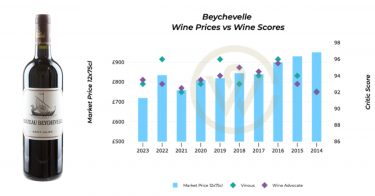
Over the past 12 months, the average case price of Chateau Beychevelle has dipped in value by 7%, but in the past 10 years, it has increased by 55%.

Bold and colourful: Château Lafon-Rochet, Fourth Growth

When Saint-Estèphe producer Château Lafon-Rochet transformed the appearance of its buildings from muted grey to vivid colour, the influence extended beyond its premises to its label.

Today, featuring a striking mustard-yellow backdrop, the house’s label displays a front-facing illustration of the elegant château, with diagonal vineyard lines in the foreground adding a sense of dynamism.

‘The label’s colour was inspired by my father,’ said general manager Basile Tesseron. ‘He disliked the grey façade and experimented with painting the château yellow, green, and red – one colour per year.’

In the end, yellow came out on top. ‘In 2000, he decided that if the château would stay yellow, the label should match. It may be bold, but now it’s unmistakably ours.’

The wine investment performance of Lafon-Rochet has been equally unmistakable – up 65% over the last decade, outperforming all the First Growths.

Dignity and blossoms: Château La Conseillante

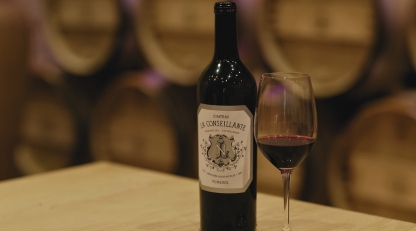
The elegant grayscale label of Pomeral house, Château La Conseillante, quietly communicates family prestige. It features a shield-shaped emblem carrying the letters “L” and “N” for founder Louis Nicolas, which is framed by intricate, stylised berries and florals.

‘The inspiration is very simple – it’s the original logo of Louis Nicolas,’ general manager Marielle Cazaux told WineCap. ‘In French, we call it the ‘armoirée’.’

The classic design of the label is further enhanced by the bottle’s violet neck foil, which, as Cazaux said, subtly mirrors the floral violet notes often found in wine’s aromas and flavours.

Château La Conseillante prices have seen an increase of 81% over the last ten years.

See also our Bordeaux I Regional Report

WineCap’s independent market analysis showcases the value of portfolio diversification and the stability offered by investing in wine. Speak to one of our wine investment experts and start building your portfolio. Schedule your free consultation today.

Categories
News

The best of Bordeaux En Primeur 2023

  • The best Bordeaux En Primeur releases offered a combination of quality and value. 
  • These are wines with high potential for future price appreciation.
  • Some châteaux have followed the En Primeur golden rule that the new release is the cheapest you can get. 

As this year’s Bordeaux En Primeur campaign draws to an end, we evaluate the best 2023 releases. These wines not only boast high quality, as measured by critic scores, but also offer value when compared to previous vintages. Below are our highlights from an investment perspective. 

Beychevelle 

Chateau Beychevelle En Primeur 2023

In the words of Château Beychevelle’s Philippe Blanc, ‘our golden rule is the En Primeur price is the cheapest you can get’. 

The rule was observed this year, with the 2023 representing the best priced vintage on the market today. 

The wine received 94-96 points from Antonio Galloni (Vinous), who said: ‘Beychevelle remains one of the most distinctive wines in all of Bordeaux. It is especially classy in this edition.’ 

Meanwhile, the Wine Advocate’s William Kelley (93-94 points) noted that ‘the 2023 Beychevelle has turned out especially well this year, exhibiting a more integrated, seductive style than recent vintages’.

Lafite Rothschild & Carruades de Lafite

Lafite Rothschild Bordeaux En Primeur 2023

For William Kelley, Lafite Rothschild appeared to be ‘the finest of the first growths this year’. The critic awarded it 97-99 points. The wine was launched at an impressive 32% discount on last year, making the new release the most affordable on the market today. Shortly after release, the wine found its way into the secondary market.

Carruades Lafite Bordeaux 2023 En Primeur

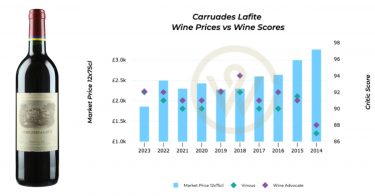
Its second wine also presented an enticing prospect to investors. As well as being the cheapest vintage, the wine was awarded a score of 91-93 from Neal Martin (Vinous), surpassing the 2022, 2016, and 2010. The critic remarked that this is ‘surely one of the best Carruades I have tasted at this stage’.

Mouton Rothschild & Petit Mouton

Mouton Rothschild Bordeaux 2023 En Primeur

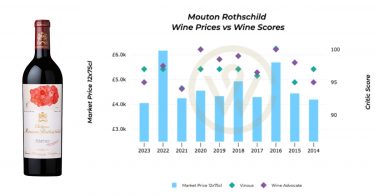
In much the same vein as Lafite Rothschild, the 2023 Mouton Rothschild is the most affordable vintage available on the market today. Antonio Galloni gave it 96-99 points and declared that it ‘is shaping up to be one of the best wines of the vintage on the Left Bank’.

With 96-98 points from Neal Martin, its score looks set to match the 2022, 2020, 2019, and 2018. Only the 100-point 2016 has the upper hand but comes at a hefty 40% premium. 

Petit Mouton Bordeaux 2023 En Primeur

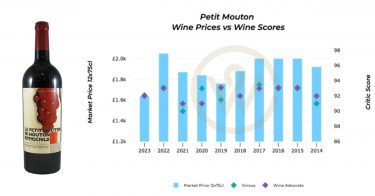
Once again, there is outstanding value to be found in the second wine. Petit Mouton 2023 is the best priced vintage available today by a healthy margin. And, according to Galloni, ‘it could easy be a Grand Vin at another address’.

Margaux

Chateau Margaux Bordeaux 2023 En Primeur

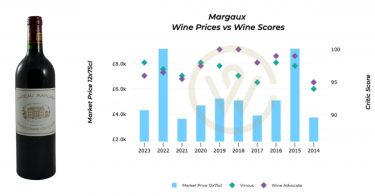
The highest-scoring Bordeaux 2023 wine across major critics, Margaux presented great value.

Galloni awarded it a potentially perfect score of 97-100 points, calling it ‘fabulous, sensual, silky and exceptionally polished’. 

Meanwhile, Martin described it as a ‘quintessential Margaux’, awarding it a score of 97-99 points.

Cheval Blanc

Chateau Cheval Blanc Bordeaux 2023 En Primeur

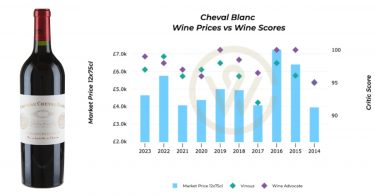
There are few wines that transcend the vintage in 2023, and Cheval Blanc is certainly one of them. 

There were few wines capable of transcending the vintage in 2023, but Cheval Blanc was certainly one of them.

It is the second-highest-scoring Bordeaux 2023 wine across 12 leading critics. Winemaker Pierre-Olivier Clouet even goes so far as to say that it is superior to the 2022, as does the Wine Advocate’s William Kelley. 

Adding to its appeal is the value it offers. The 2023 is the most affordable option among top vintages. This is one of only two unambiguously ‘prime’ Cheval Blanc vintages available under £5,000 a case.

As these highlights show, there is value to be found during En Primeur with the right analysis tools. 

WineCap’s independent market analysis showcases the value of portfolio diversification and the stability offered by investing in wine. Speak to one of our wine investment experts and start building your portfolio. Schedule your free consultation today.

Categories
News

Neal Martin’s top-scoring Bordeaux 2023 wines

  • According to Neal Martin (Vinous), Bordeaux 2023 is a heterogeneous vintage riddled with paradoxes.
  • Only one wine achieved his highest score of 98-100 points – L’Eglise Clinet.
  • Martin suggested that ‘deep [price] cuts’ are needed for the campaign to work.

 Now that the En Primeur campaign has kicked off, critics have started releasing their Bordeaux 2023 in-barrel scores. Vinous recently published Neal Martin’s assessment of this ‘Dalmatian’ vintage, characterised by ‘spots of astounding quality’ but also ‘all manner of shortcomings’ – even in some of the region’s most famous names.

Bordeaux 2023 vintage overview

‘A season riddled with paradoxes,’ Neal Martin described Bordeaux 2023 as a heterogeneous vintage. According to him, it ‘would sit uncomfortably on a mantelpiece alongside 2016, 2020 and 2022’. However, the critic acknowledged that ‘some châteaux pulled out magical wines from their top hat, surpassing those aforementioned years in one or two cases’.

The keyword that defined 2023 is ‘classicism’, meaning ‘lower alcohol levels in the 13-something range,’ without the opulence of previous vintages.

Martin further noted that ‘the 2023s are relatively more tannic than we’ve become accustomed to, more linear and vertical, though endowed with greater fruit concentration than the 2021s’. He continued: ‘The best wines embrace these traits while maintaining sufficient fruit and grip, occasionally harking back to the kind of barrel samples encountered in the early days of my career, and I mean that in a good sense’.

Overall, Martin claimed that ‘despite the disparity in quality, it cannot be denied that it is bejewelled with a clutch of spellbinding wines’.

Top-scoring Bordeaux 2023 wines

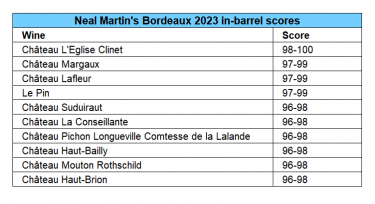
Neal Martin’s top-scoring Bordeaux 2023 wines can be seen in the table below. Only one wine achieved the maximum barrel range of 98-100 points – the 2023 L’Eglise Clinet. Martin said that ‘it’s very harmonious and fans out brilliantly on the finish’.

Three wines received a barrel range of 97-99 points: Margaux, Lafleur and Le Pin. In his tasting note, Martin called the First Growth a ‘quintessential Château Margaux’ but noted that it ‘will require ten years in bottle to really show what it is capable of’.

Regarding Lafleur, he said it was ‘one of the few profound wines this vintage’. He described Le Pin as ‘so pure and refined, it seems to embrace and gently hug the senses’.

En Primeur and the global market

Despite the virtues of the vintage, the question of whether it will present value is pertinent in the current economic climate. For Martin, the ‘newborn wines blink open their eyes to survey a bleak economic landscape and finger-pointing between various factions as to who’s to blame’. He said that ‘deep cuts, not gestures, are the only thing that will open wallets’.

This week’s first releases have seen discounts of up to 40% on last year. However, back vintages of similar quality that remain available for less continue to challenge the En Primeur tradition.

Stay tuned for our analysis of the best value releases.

WineCap’s independent market analysis showcases the value of portfolio diversification and the stability offered by investing in wine. Speak to one of our wine investment experts and start building your portfolio. Schedule your free consultation today.

Categories
News

Finding value in the Bordeaux second wines

  • The average First Growth case price is £5,300, while second wines come in at £1,941.
  • Le Clarence de Haut-Brion is the most affordable second wine.
  • Le Petit Mouton has been the best performer over the last decade.

Following our article last week, which examined the performance and value of the Bordeaux First Growths, we take a look at the data behind their second wines.

What are second wines?

Most Bordeaux châteaux produce more than one wine each vintage, and some might make three or four. Each château’s second wine draws on the expertise and knowledge that goes into the Grand Vin. Generally, second wines are made with fruit from younger vines, or vines and parcels that are not quite up to the quality of the Grand Vin in any given year.

However, they are often produced using grapes from the same vineyards as the flagship wines, receiving the same technical treatment in both vineyard and winery. Considerably less expensive than their siblings,  second wines represent a particularly attractive and accessible option for investors.

Second wines – at what price?

Second wines prices and scores

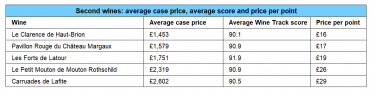
White the average First Growth case price is £5,300, second wines come in at less than half the price (£1,941).

Interestingly, prices of the first and the second wine are not always rising in unison. For instance, Château Latour is the second most expensive Grand Vin after Château Lafite Rothschild. Les Forts de Latour, however, sits directly in the middle, with Le Petit Mouton and Carruades de Lafite being pricier.

When it comes to value for money, Le Clarence de Haut-Brion has the lowest price per point of £16, similar to its Grand Vin. As examined last week, Château Haut-Brion is the most affordable of the First Growths, while also boasting the highest average Wine Track score. Yet while Le Clarence is also the most affordable of the second wines, its Wine Track score is lower.

But looking purely at scores is not the best indicator of value when it comes to the second wines. Second wines differ from the Grand Vins, as the dominant relationship is between price and age, not price and quality. As time passes, their value rises, following the traditional wine investment dynamic.

Moreover, this group of wines is often bought by collectors and investors as they present access to a brand. Though suitable for aging, these wines are built for earlier consumption, offering an alternative to opening bottles of the Grand Vin as soon as they are delivered.

Performance of the second wines

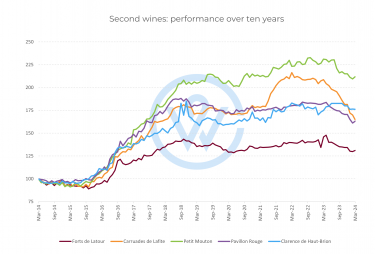
In the last decade, Le Petit Mouton de Mouton Rothschild has been the best-performing second wine, up 111.9%.

The most affordable, Le Clarence de Haut-Brion, has delivered the second-best returns of 76.2%. It has been followed by Carruades de Lafite (64.7%) and Pavillon Rouge (63.1%).

Second wines performance

WineCap’s independent market analysis showcases the value of portfolio diversification and the stability offered by investing in wine. Speak to one of our wine investment experts and start building your portfolio. Schedule your free consultation today.

Categories
News

Which Bordeaux First Growth has the lowest price per point?

  • The price-per-point metric allows for a comparison of wines based on their market price and perceived quality.
  • This article examines the prices per point of the most liquid group of wines – the Bordeaux First Growths.
  • It also looks at their historic market performances.

The price-per-point metric offers a powerful way to compare wines based on their market price relative to critic quality scores. By dividing the average case price by the average critic score, collectors and investors can identify which wines offer the best value, regardless of prestige or brand strength. This approach is especially insightful when analysing the First Growth Bordeaux châteaux, the most liquid and historically significant group within the wines of Bordeaux.

The First Growths – Château Lafite Rothschild, Château Mouton Rothschild, Château Margaux, Château Haut-Brion, and Château Latour – were formalised in the official Classification of 1855, a system that still shapes global perceptions of quality today. These estates sit at the top of the Bordeaux hierarchy, alongside the region’s premier cru properties, commanding some of the highest prices in the fine wine market. Despite belonging to the same classification, their relative value differs substantially when measured through price per point.

First Growth Bordeaux – price per point

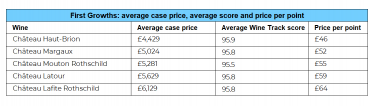
An average case price of £4,429 makes Château Haut-Brion the most affordable of the First Growths. Meanwhile, it has the highest average Wine Track score of 95.9 points. While there is divergence in prices and scores on a vintage-specific level, Château Haut-Brion has the lowest price per point among the First Growths overall.

First Growths average prices and scores

At the other end of the spectrum, Château Lafite Rothschild has the highest price per point of £64, owing to the highest average case price of £6,129 and a Wine Track score of 95.8.

Château Margaux, Château Latour, and Château Mouton Rothschild sit between these two extremes. Each offers exceptional critic scores and historic vintages, though their price-per-point efficiency varies depending on market cycles, En Primeur release prices, and vintage-specific trading volumes. Investors often compare these cru classé wines not only by absolute cost but by consistency of score relative to long-term performance.

What does this mean for the First Growths’ performance?

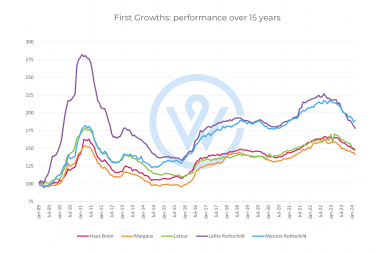
Historically, all First Growths have followed similar trajectories in terms of market highs and lows.
Key patterns include:

  • A dramatic surge during the China-led bull market (H1 2011)

  • A deep pullback in the years following

  • A recovery after the Brexit referendum, stabilising at higher levels

  • A recent decline in line with broader fine wine indices

The Liv-ex 50, which tracks the First Growths, is down 15.3% over the past year, mirroring the performance of the broader Liv-ex 1000 index.

Among the individual estates:

  • Lafite Rothschild saw the sharpest rise during the 2011 peak

  • It has also seen the largest recent fall (-19%)

  • Haut-Brion, despite never reaching the same peaks, has been more stable – dipping only 10% in the last year

This relative stability reinforces Haut-Brion’s status as a high-value First Growth brand. Its lower price per point and historically steadier performance make it appealing to collectors seeking reduced volatility without sacrificing Bordeaux pedigree.

First Growths performance

First Growth wines that offer value perform the best

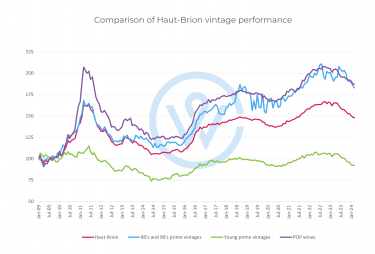
In the case of Haut-Brion, value plays an important role in market performance. POP wines (those with a lower price per point) have outperformed the rest over 15 years. These include vintages 2002, 2004, 2006, 2007, 2008, 2011, 2012, 2013, 2014, 2017 and 2019 (the only prime vintage among the POP wines).

The second-best-performing index comprises older ‘prime’ vintages – wines with high scores pre-2000. However, this index has shown higher volatility due to the limited availability and trading volumes of these wines.

The index comprising younger ‘on’ vintages like 2015, 2016, 2018 and 2020 has underperformed the rest of the pack. However, these wines have also had less time in the market and their evolution is yet to be seen.

Haut-Brion vintage performance

Historically, Bordeaux prime vintages often show accelerated growth after 10–15 years in bottle, meaning these more recent releases could see substantial performance shifts as they move further from their en primeur release period.

In conclusion, price per point offers an effective way to assess both value and quality, helping buyers look beyond brand prestige to uncover genuine opportunities. However, investors should also consider:

  • long-term market behaviour

  • storage and provenance

  • volatility of older vintages

  • the impact of global economic cycles

When combined with historical performance analysis, price per point becomes a powerful tool for building a balanced fine wine portfolio – identifying stable performers like Haut-Brion, premium prestige wines like Lafite Rothschild, and long-term growth opportunities across the First Growth category.

WineCap’s independent market analysis showcases the value of portfolio diversification and the stability offered by investing in wine. Speak to one of our wine investment experts and start building your portfolio. Schedule your free consultation today.

Categories
Learn

The place of the Bordeaux First Growths in a changing fine wine market

  • Once the dominant force in the fine wine market, the Bordeaux First Growths have lost market share due to its broadening.
  • In the last decade, Château Mouton Rothschild has been the best price performer, up 43.2%.
  • Château Haut-Brion offers the best value, with the highest average critic score and the lowest average price per case.

The Bordeaux First Growths in a broadening market

The Bordeaux First Growths have long been the cornerstone of the fine wine investment market. Back in 2010, they made up close to 90% of all Bordeaux trade by value – at a time, when Bordeaux’s share of the total market stood at 96%.

With the broadening of the market, their share has decreased and they now regularly account for around 30% of all Bordeaux secondary market trade (which itself has fallen below 35% annual average).

This trend was also reflected in the 2022 Power 100 list, which offered a snapshot of the ever-changing landscape of the secondary market. For the first time ever, no Bordeaux wines featured among the top ten most powerful fine wine labels.

Even if trade for these brands remains consistent or increases, the First Growths are facing greater competition. Still, they are among the wines with the greatest liquidity, attracting regular demand and high praise from critics year after year.

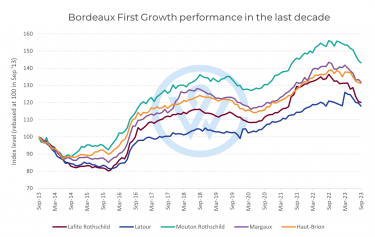
First Growths’ price performance

In terms of price performance, the five First Growths have followed a similar trajectory (i.e. rising post-Covid and dipping in the last year in line with the current market reality). The relative outcast has been Château Latour, whose performance was impacted by the decision to leave the En Primeur system in 2012. The wine has been the worst-performing First Growth, up just 17.9% in the last decade.

The best performer has been Château Mouton Rothschild, with an increase of 43.2%. Recent releases have elevated the performance of the brand, like the 2020 vintage, which boasts 100-points from The Wine Advocate’s William Kelley, 99-100 from James Suckling, 98-100 from Jeff Leve and 99 from Antonio Galloni (Vinous). ‘Off’ vintages like 2011, 2013 and 2014, which have greater room to rise, have also fared well over the last five years.

The second-best performer has been Château Margaux, which is also the second most affordable First Growth. Similarly, its biggest price risers have been 2014, 2011 and 2013. Less classical years reveal the strength of these brands, as demand for the First Growths remains consistently high regardless of the vintage.

First Growths’ price and score comparison

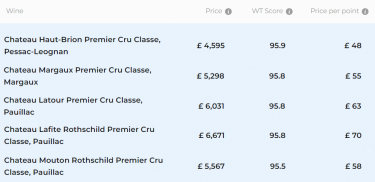
The table below shows the average price per case and critic score of the First Growths for vintages since 2000.

Château Haut-Brion tops the list with the highest average score (95.9) and the lowest average price per case (£4,595). With a price per point of £48, the wine seems to offer the best value among the First Growths. Vintages that have received 100-points from The Wine Advocate include 2018 (LPB), 2016 (LPB), 2015 (LPB), 2009 (LPB) and 2005 (RP).

Looking at the average prices, Château Lafite Rothschild stands out as the most expensive of the First Growths. The wine has achieved 100-points from The Wine Advocate for its 2019 (WK), 2018 (LPB), 2010 (LPB) and 2003 (RP) vintages.

In conclusion, the First Growths remain an important part of the changing secondary market, offering brand strength, consistently high quality and stable growth.

WineCap’s independent market analysis showcases the value of portfolio diversification and the stability offered by investing in wine. Speak to one of our wine investment experts and start building your portfolio. Schedule your free consultation today.

Categories
News

US Buyer Acquires Bordeaux’s Château Lascombes

The US buyer whose recent purchase of Château Lascombes – that topped the list as the most expensive acquisition in the Médoc ever – has been revealed as Lawrence Family Wine Estates.

This is the US investor’s first acquisition in Bordeaux and, indeed, its first ever purchase in Europe. The family’s existing portfolio of brands include sought-after Napa names such as Heitz Cellars, Burgess and Stony Hill Vineyard.

While the full details of the sale haven’t been disclosed, it is a strategic and important one. Château Lascombes is a leading Second Growth located in the Margaux appellation. This top estate rubs shoulders with the four other leading Margaux châteaux including, Châteaux Rauzan-Ségla, Rauzan-Gassies, Brane Cantenac and Durfort-Vivens. What sets Lascombes apart is its size: the estate is the largest in the appellation and spans just over 110 hectares with an additional 10 hectares in neighbouring Haut-Médoc.

The French press reported the acquisition as the largest sole financial transaction in the Médoc’s history. However, what is interesting from the Lawrence Family Wine Estates’ press release is that, and there is little detail, a minority stake in Château Lascombes is to continue to be held by its previous owners, Mutuelle d’Assurance du Corps de Santé Français (MACSF)

Since its foundation in the 17th Century, the estate has changed hands a number of times. Most recently, in 2001, the USA’s Colony Capital bought it for $67 million and then sold it in 2011 to MACSF for an estimated €200 million.

Commenting on its recent acquisition, Gaylon Lawrence, owner of Lawrence Family Wine Estates’, said: ‘We are honoured to become the new stewards of such a historical estate. This Château has some of the greatest vineyards in Margaux and our family looks forward to caring for Château Lascombes for many generations to come’.

Currently, Lascombes represents great value when compared to other Second Growths. Its average price on Wine Track is £689, compared to Château Cos d’Estournel at £1,580, Château Montrose at £1,300 and Château Léoville las Cases at £1,980. Could this new purchase and the recent investment in new winemaking facilities be the beginning of a change in its price point, just like the ones we’ve seen in recent years at Châteaux Figeac and Canon?

Discover the other high profile acquisitions in the world of fine wine in our recent article

Categories
News

Top 10 most expensive wines in the world

Wine has captivated collectors for centuries – not just for its flavour and artistry, but for its extraordinary ability to increase in quality and value over time. For many enthusiasts, this appreciation has made fine wine one of the most compelling collectible assets in the world.

In recent years, fine wine has also evolved into a global luxury asset. Record-breaking sales at Sotheby’s and Christie’s, particularly from Burgundy and Bordeaux, have drawn the attention of collectors across Europe, the United States, and Asia. The fine wine market has proven remarkably resilient, consistently outperforming traditional investment sectors during periods of volatility. As more investors and collectors explore alternative assets, interest in understanding what drives the value of the world’s rarest bottles has grown rapidly.

But what is the most expensive wine on earth? And why are some bottles worth more than luxury cars or even homes? In this guide, we explore the top 10 most expensive wines in the world, breaking down their prices, regions, rarity, and what makes a single bottle so valuable.

Ten of the world’s most expensive wines

The wines featured below have achieved legendary status in the world of fine wine, not only due to their craftsmanship but also because of the unique stories and circumstances that have shaped their value. From minuscule production levels to historic vintages and iconic vineyard sites, each bottle reflects centuries of winemaking heritage and a global appetite for rarity.

Domaine Georges & Christophe Roumier, Musigny Grand Cru

Producer: Domaine Georges & Christophe Roumier

Average price: £13,595

Wine type: Red

Grape: Pinot Noir

Region: Burgundy, France

Domaine Roumier is one of Burgundy’s most revered wineries, producing some of the most expensive wines in the world. Its Musigny Grand Cru – grown on exceptional limestone soils in the Côte de Nuits – offers remarkable finesse and longevity. As a Grand Cru, Burgundy’s highest classification, this wine is treasured for its age-worthiness, rarity, and ability to command high auction prices.

Production levels from Musigny are extremely limited, and the vineyard’s old vines contribute to the wine’s intensity and depth. Collectors value Roumier for its consistency across vintages and for the estate’s meticulous approach to viticulture, which further drives demand and premium pricing.

Château Margaux

Producer: Château Margaux

Price: $225,000 (gained by insurance reimbursement in America)

Wine type: Red

Grape: Bordeaux blend

Region: Bordeaux, France

A bottle of this wine, created in 1787, was said to be a part of Thomas Jefferson’s personal collection.

A wine trader called William Sokolin later acquired it and took it to a dinner in Bordeaux, where the waiter knocked it off the table and smashed the bottle. Sokolin was later reimbursed with $225,000 by his insurance company, but the bottle was originally thought to be worth $500,000. Château Margaux is also a consistent producer of top-performing Cabernet Sauvignon-led blends, making it a pillar of fine wine investment.

Classified as a First Growth in the historic 1855 Classification, Château Margaux’s reputation spans centuries. Pre-phylloxera bottles such as the 1787 are exceptionally rare, making them prized artefacts of wine history. Provenance plays a major role in the value of such wines, and Jefferson-linked bottles remain some of the most sought-after in the world.

Domaine Leroy, Musigny Grand Cru

Producer: Domaine Leroy

Average price: £31,691

Wine type: Red

Grape: Pinot Noir

Region: Burgundy, France

Founded in 1868 by wine merchant François Leroy, the Domaine (vineyard) is now owned by Lalou Bize-Leroy, who also owns Domaine d’Auvenay.

This dry red wine is produced from Pinot Noir grapes and is the by-product of biodynamic farming. This ethical approach to farming provides nutrients to the plants by using their own composting measures, as opposed to using chemical fertilisers. Although more labour intensive, this method produces high-quality crops and is better for the environment.

Domaine Leroy’s wines are often considered on par with, or even superior to, those of Domaine de la Romanée-Conti. Micro-production levels mean only a few barrels are produced each year, resulting in extremely limited global availability. This scarcity, combined with critical acclaim, contributes significantly to its exceptionally high market value.

Krug Vintage Brut Champagne

Producer: Krug

Price: Sold for £14,800

Wine type: Sparking wine

Grape: Champagne

Region: Champagne, France

Krug is known for being one of the renowned houses in the Champagne region, making their wines some of the most sought-after and expensive in the area.

At a Hong Kong wine auction in 2009, the 1928 Krug Vintage Brut set a record as the most expensive Champagne ever sold at the time. Its combination of rarity, craftsmanship, and historical prestige make it a pinnacle of sparkling wine collecting.

Older Champagne vintages like 1928 are incredibly rare because sparkling wine is typically consumed young. Bottles that survive nearly a century in pristine condition gain immense value. Krug’s long ageing process on lees, combined with its dedication to complexity and structure, makes its older vintages particularly collectible.

Screaming Eagle Sauvignon Blanc

Producer: Screaming Eagle

Average price: £4,610

Wine type: White

Grape: Sauvignon Blanc

Region: Oakville, USA

Although not the most expensive wine on the list, this is one of the most expensive white wines from the North Coast of the United States.

As one of Napa Valley’s original “cult wines,” Screaming Eagle produces extremely limited quantities – often fewer than 1,000 cases per year. While known primarily for its Cabernet Sauvignon, its Sauvignon Blanc has become one of the most expensive white wines in the world, driven by rarity and intense demand.

Screaming Eagle’s allocation list is famously difficult to join, with waiting lists spanning years. This exclusivity fuels secondary-market prices, as collectors compete for the winery’s rarest bottles. Napa Valley’s rise as a luxury wine region has further elevated Screaming Eagle’s iconic status.

Domaine Leflaive, Montrachet Grand Cru

Producer: Domaine Leflaive

Average price: £12,430

Wine type: White

Grape: Chardonnay

Region: Burgundy, France

Montrachet is considered the best white wine vineyard in the world, with bottles often dominating top 10 most expensive wine lists. Domaine Leflaive’s Grand Cru Chardonnay – barrel-fermented and known for citrus, hazelnut, and buttery richness – remains a benchmark of Burgundy craftsmanship.

Leflaive’s plots in Montrachet sit on prime limestone-rich soils, offering exceptional drainage and mineral expression. With only a very small portion of the already tiny Montrachet vineyard under its control, Leflaive produces minuscule quantities of this wine each year, contributing significantly to its rarity.

Liber Pater

Producer: Liber Pater

Average price: The 2015 variety had an average price of £27,500

Wine type: Red

Grape: Bordeaux blend

Region: Bordeaux, France

Liber Pater produces some of the most expensive wines on earth. This vintage wine was created in 2015, and due to its very low production numbers and the use of grapes from ungrafted vines, it has become a true collector’s item.

Liber Pater aims to recreate the taste of pre-phylloxera Bordeaux by using nearly extinct grape varieties and traditional winemaking techniques. The estate produced just 550 bottles in 2015, making it one of the lowest-production wines in Europe. Its experimental approach attract collectors looking for something truly singular.

Château d’Yquem

Producer: Château d’Yquem

Price: Sold for £75,000

Wine type: Dessert

Grape: Semillon & Sauvignon Blanc

Region: Sauternes, France

As the only Premier Cru Supérieur in the 1855 Classification, Château d’Yquem has no rivals in the world of sweet wine. The 1811 vintage – one of its most celebrated – sold for £75,000 and was recognised by Guinness World Records as the most expensive standard bottle of white wine ever sold at auction. The wine bottle is said to be on display in Mr Vanneque’s restaurant in Bali, protected by bulletproof glass.

Château d’Yquem benefits from a unique microclimate that encourages the development of noble rot, allowing the estate to produce extraordinarily concentrated and long-lived wines. Many vintages of Yquem can age for over a century, which further enhances its allure among collectors.

Domaine Leroy, d’Auvenay Chevalier-Montrachet Grand Cru

Producer: Domaine d’Auvenay (part of Domaine Leroy)

Average Price: £23,439

Wine Type: White

Grape: Chardonnay

Region: Burgundy, France

Another masterpiece from Lalou Bize-Leroy, this ultra-rare Grand Cru comes from a tiny four-acre estate. Minuscule yields and perfect craftsmanship make it one of the top 10 most expensive wines in the world.

In certain vintages, only one or two barrels of this wine are produced, placing it among the most limited-production white wines in existence. The combination of terroir precision, strict biodynamic principles, and extremely low output fuels exceptionally high prices.

Egon Müller, Scharzhofberger Riesling Trockenbeerenauslese

Producer: Egon Müller

Average Price: £12,147

Wine Type: Dessert

Grape: Riesling

Region: Mosel, Germany

Egon Müller is synonymous with world-class Riesling. Their Trockenbeerenauslese – made from individually selected botrytised berries – is among the most expensive dessert wines globally, often achieving record prices at international wine auctions.

TBAs are among the rarest and most labour-intensive wines to produce, requiring hand-picking berry by berry. Egon Müller consistently commands the highest Riesling prices in the world, with some vintages selling for tens of thousands of pounds on release.

What makes wine so expensive?

When exploring the most expensive wine in the world, several factors consistently influence both rarity and price:

1. Reputation and provenance

Producers like Domaine de la Romanée-Conti, Lafite Rothschild, and Krug have global reputations for exceptional quality. Strong brand prestige pushes demand upward – especially when paired with historical significance.

2. Critical acclaim

Fine wine critics such as Robert Parker and major publications like Wine Spectator influence global pricing. High scores often trigger strong interest at wine auctions, driving prices even higher.

3. Ageing potential

Investment-grade wines improve dramatically with age. A wine built for long-term cellaring – such as Bordeaux blends or Grand Cru Burgundy – will usually appreciate in value.

4. Scarcity

Rarity is the backbone of luxury pricing. Limited-production wines, low-yield vineyards, or single-parcel bottlings make wines more exclusive. When only a single bottle or a few hundred bottles exist, demand can skyrocket.

5. Historical or cultural importance

Bottles owned by notable figures (e.g., Thomas Jefferson) or from legendary vintages often become priceless artifacts.

Valuation is also influenced by condition and storage history. Wines stored in professional, temperature-controlled cellars command higher prices, while bottles with damaged labels, signs of leakage, or poor provenance may lose significant value. Auction houses play a major role in establishing price benchmarks, and the presence of original wooden cases, wax seals, or château documentation can increase a bottle’s desirability.

Why invest in fine wine?

Fine wine is a powerful alternative investment because:

  • it has low correlation with global stock markets

  • values tend to rise steadily over time

  • supply naturally decreases as bottles are consumed

  • the category remains more stable than gold or real estate

  • prestige wines retain global demand regardless of economic cycles

Fine wine is also considered tax-efficient in several regions, further increasing its appeal for investors seeking long-term growth without excessive tax burdens. Its global nature – traded actively in London, New York, Hong Kong, and Singapore –provides a diverse base of demand. Historically, fine wine has demonstrated resilience during economic downturns, making it an attractive hedge against inflation and uncertainty.

For collectors, investing also provides the joy of building a cellar filled with some of the most extraordinary wines ever created.

Your wine investment journey starts here

WineCap gives you access to the top investible wine allocations. Once we have discovered your preferences, you will have access to a vast portfolio of the most investable wines stored in secure government bonds.

We don’t charge a management fee and our brokerage charges are very low, so you have access to rare wines at a fair price.

Whether you are looking to begin your portfolio with classic investment wines like First Growth Bordeaux or are exploring ultra-rare bottles such as Domaine Leroy, WineCap provides expert guidance at every stage. Our team can help ensure proper storage, verify provenance, and identify the strongest long-term performers in the market, giving you confidence as you build your wine investment portfolio.

To start your wine investment journey, schedule a consultation with one of our experts.