Categories
News

Pockets of growth: Where the fine wine market is starting to turn

  • Market confidence is returning, with fine wine prices posting their first quarterly gain since the downturn began.
  • Selective regions are leading the rebound, with Champagne, Tuscany, and California showing the strongest signs of growth.
  • Stabilisation signals a turning point, as price declines slow and demand strengthens.

After two years of subdued performance, the fine wine market may finally be entering a new phase. Signs of stabilisation are emerging across key benchmarks, and selective pockets of growth suggest that investor confidence is beginning to return. While the broader market remains uneven, improving bid activity, regional resilience, and a shift in sentiment all point to a turning point — one that could lay the foundation for the next cycle of fine wine appreciation.

Confidence returns: Benchmark momentum

One of the clearest signals of renewed optimism comes from the bid:offer ratio — a measure of market confidence based on the proportion of active bids to offers on the secondary market. This ratio has been steadily rising, reflecting stronger buying interest and a more balanced trading environment. The shift is also visible in performance indices: the Liv-ex 100, which tracks the world’s most sought-after investment-grade wines, rose by 1.1% in September, offsetting earlier summer losses and delivering its first quarterly gain since the downturn began.

This rebound was mirrored across broader indicators. The Liv-ex 1000, which captures a wider cross-section of the market, slipped 0.5% over the quarter but also gained 0.4% in September — a sign that the market’s base may be firming. Even the First Growths Index, a bellwether for Bordeaux’s top estates, recorded a 0.7% gain in September. Though it remained slightly down for the quarter, the performance underscores a market that is recalibrating.

Where growth is emerging: key regional categories

The nascent recovery is not evenly distributed. Instead, certain regions and categories are emerging as clear leaders — offering clues about where value-seeking investors are positioning their capital.

Champagne: Resilience meets renewed demand

Champagne has once again proved its resilience. The region held near-flat over Q3 and remains one of the strongest performers of 2025, buoyed by rising demand from Asia and the US. This sustained appetite reflects Champagne’s unique position in the market: a luxury category with strong brand recognition, limited supply, and consistent global demand. For investors seeking stability and long-term performance, Champagne continues to justify its reputation as a defensive yet rewarding allocation.

Italy: Tuscany outpaces Piedmont

Italian fine wine remains a story of two regions. Tuscany has seen the most notable improvement, with the Italy 100 index climbing as buyers return to iconic Super Tuscans and Brunello producers. Piedmont, by contrast, still faces a softer bid environment, suggesting that investors are prioritising wines with immediate liquidity and strong global followings. The divergence illustrates a broader theme in today’s market: capital is flowing toward estates with established demand and clear brand equity.

California: Opus One leads a rebound

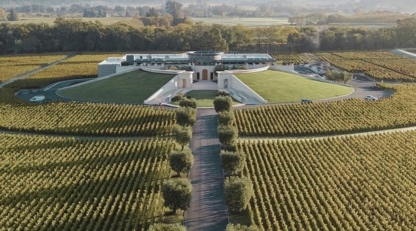
California has also been a bright spot. Opus One — one of the region’s most recognisable labels — has seen its strongest bid activity since January 2024. Over recent weeks, Liv-ex reported a surge in demand, with the US accounting for 40% of bid volume, closely followed by Asia at 39%. The UK and EU trail at 14% and 7% respectively, but this transatlantic interest highlights growing enthusiasm for top-tier Californian wines. As collectors seek quality and scarcity beyond Europe, California’s flagship estates are once again capturing attention.

Sector performance: Signs of a bottom forming

While some areas continue to lag, the broader data suggests that the worst of the correction may be behind us. Regional indices delivered a mixed performance in Q3, but declines moderated significantly, and September brought widespread gains.

Bordeaux remains the weakest performer in aggregate — the Bordeaux 500 fell 1.7% — but even here, signs of improvement are visible. Half of the region’s sub-indices gained in September, including those tracking First Growths, Second Wines, and leading Right Bank labels. Burgundy, too, was only marginally lower (-0.2%), with top domaines maintaining impressive resilience despite broader headwinds.
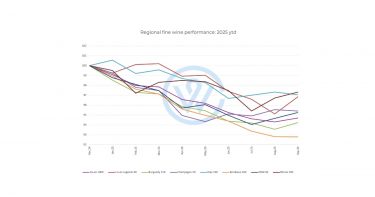
Regional fine wine performance 2025

Together, these indicators suggest a market that may be finding its floor. Price declines have slowed, buyers are becoming more active, and selective demand is driving performance in certain regions and producers. This kind of stabilisation typically precedes a period of gradual re-pricing — and potentially, recovery.

The next phase: Selectivity, scarcity, and strategy

The third quarter of 2025 was a transitional one for fine wine. With mainstream assets recovering and investor sentiment stabilising, the asset class is beginning to reassert itself as a reliable store of value and a portfolio diversifier. The coming quarters are likely to be defined by three key drivers:

  • Scarcity: Limited-production wines from renowned estates continue to attract demand, particularly as global supply chains tighten and yields remain historically low.
  • Selectivity: Investors are becoming more discerning, focusing on regions and producers with strong fundamentals rather than chasing broader market exposure.
  • Reputation: Brand equity and consistent critical acclaim remain decisive factors, with top names enjoying disproportionate interest as confidence returns.

While the pace of recovery will vary by region and price tier, the data points to a market that is stabilising and, in some segments, already turning higher. For investors with a medium- to long-term horizon, the current environment offers attractive entry points into historically strong-performing categories.

Looking for more? Read our latest quarterly report: Q3 Fine Wine Report

WineCap’s independent market analysis showcases the value of portfolio diversification and the stability offered by investing in wine. Speak to one of our wine investment experts and start building your portfolio. Schedule your free consultation today.
Categories
News

The best-performing wines of H1 2025: the bright spots in a soft market

  • Fine wine prices continued to decline in H1 2025 against a challenging global economic backdrop. 
  • A small group of wines outpaced the broader market by a wide margin, with the best-performing wine rising over 36%.
  • In a recalibrating market, scarcity, selectivity, and substance will continue to define success.

The global fine wine market continued its cautious descent through the first half of 2025, extending a downward trend that began in earnest in late 2022. From Champagne to California, regional indices recorded further losses – a sobering contrast to the post-pandemic surge that peaked in September 2022. What followed has been nearly 18 months of persistent price softening.

Yet even in this declining market environment, select wines showed resilience and in some cases, delivered double-digit growth. A small group of wines outpaced the broader market by a wide margin, with the best-performing wine rising over 36% in H1 alone. These rare outliers were not driven by hype or thematic rotation, but by a return to fundamentals: scarcity, maturity, critical acclaim, and name recognition. In a soft market, selectivity became strategy, and quality, its own form of currency.

The macroeconomic backdrop: volatility returns

H1 2025 unfolded against a challenging global economic backdrop, with fine wine caught in the crosscurrents of:

Reignited trade tensions

The surprise announcement of 200% US tariffs on EU wine imports in March rattled the industry. While the final figure was scaled back to 20% and implementation delayed by 90 days, the initial shock had an immediate effect. US demand plummeted initially, and confidence took time to recover – despite evidence of resilient buying behaviour by Q2.

Subdued Asian demand 

In Asia, sentiment remained quiet. Many buyers – particularly in Hong Kong and mainland China – adopted a wait-and-see posture, citing political and market uncertainty. The result was lower volume and thinner trading conditions for key regions like Burgundy, Bordeaux, and Champagne.

Monetary pressures impact

Persistent interest rate pressure globally has reduced the appeal of illiquid assets such as wine. With safer yields available in cash or bonds, some collectors have hesitated to commit fresh capital or have chosen to sell.

A tepid Bordeaux En Primeur campaign

The Bordeaux 2024 En Primeur campaign, already burdened by a slow market and a hesitant consumer base, failed to inspire broad demand. Pricing fatigue, underwhelming back-vintage performance, and merchant overstocking created difficult conditions even for well-scored wines.

Liv-ex indices reflected the climate:

    • Liv-ex 50 (tracking First Growth performance): -6% in H1, now back to 2016 levels.
    • Liv-ex 100 (Liv-ex benchmark index): -4.9% in H1, now back to 2020 levels.
    • Liv-ex 1000 (broadest market measure): -4.7% in H1, now back to 2020 levels.

Amid these headwinds, investment allocations required precise selection more than ever.

Regional performance – H1 2025

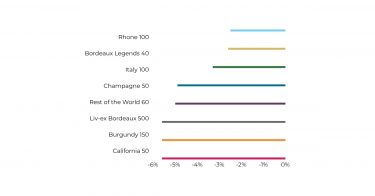
Though every major region ended H1 in negative territory, the magnitude of decline varied, offering insight into what categories still command investor attention and which ones may face longer-term repositioning.

best performing wine regions half 1 2025

The best-performing region: the Rhône

The Rhône 100 index emerged as the most defensive performer in H1, down just 2.5%. This may come as a surprise, given Rhône’s traditionally lower liquidity compared to Bordeaux or Burgundy. Yet in periods of risk aversion, the region’s combination of world-class producers (e.g. Jean Louis Chave, Guigal), lower pricing, critical appraisal, and hence good value for money have made it an increasingly attractive hunting ground for value-driven buyers.

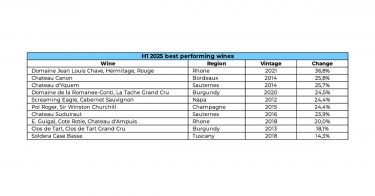
Several Rhône wines appeared in the H1 top 10 performance list, including Chave’s Hermitage Rouge 2021 (+36.8%) and Guigal’s Côte Rôtie Château d’Ampuis 2018 (+20.0%) – reinforcing Rhône’s reputation as a quiet outperformer in challenging times.

The worst-performing regions: Bordeaux, Burgundy and California

Three major regions – California, Burgundy, and the broader Bordeaux 500 – each fell 5.6%, making them the weakest performers year to date.

  • Burgundy’s fall reflects an overdue correction after its dramatic run-up in 2021–2022. Though top-tier names (like DRC and Clos de Tart) remain in demand, the broader category has struggled under inflated pricing and speculative fatigue.
  • Similar to Burgundy, California, particularly its cult Cabernet segment, has suffered from reduced international demand.
  • Bordeaux’s broader weakness may be attributed to the underperformance of back vintages. However, its Legends 40 sub-index, focused on top estates with market longevity, proved more resilient (-2.6%).

H1 2025 top performers: the outliers that defied the trend

While most indices slipped, a handful of wines delivered double-digit returns.

best performing wines half 1 2025

Insights from the standouts

The Rhône leads with Chave’s Hermitage

Despite the Rhône 100 index declining 2.5%, Jean Louis Chave’s 2021 Hermitage Rouge rose 36.8% – a stark outperformance driven by limited availability and increased global recognition of its collectible status.

Sweet wines surged

Both Château d’Yquem 2014 and Château Suduiraut 2016 featured in the top ten, defying the quiet backdrop for Sauternes. This suggests renewed collector interest in undervalued dessert wines, particularly when linked to exceptional vintages.

US cult wines hold their own

Screaming Eagle 2012 proved resilient, with a 24.4% rise in value since the start of the year. Despite the California 50 index falling 5.6%, high-end Napa commands global attention in top-tier vintages.

Champagne’s prestige cuvées still sparkle

While the Champagne 50 index fell 4.9%, Pol Roger Sir Winston Churchill 2015 bucked the trend with +24.4%, showing how top releases can outperform broader categories when aged and ready to drink.

Key takeaways for investors

Market-wide corrections are not uniform. Even in downturns, well-selected wines can deliver strong returns.

Rarity and recognisability drive results. Names like DRC, Yquem, Chave, and Screaming Eagle continue to act as safe harbours.

Blue-chip vintage selection matters. Wines from ‘off’ vintages like Canon 2014 offered some of the best entry points and upside surprises.

Sweet wines are staging a quiet comeback. This suggests contrarian plays may have room to run in H2.

Selectivity as the strategy for H2 2025

The first half of 2025 has confirmed what seasoned collectors already know: not all wines move with the market. Even as regional indices declined across the board, a handful of exceptional bottles bucked the trend, delivering standout returns through a combination of rarity, critical reputation, and maturity.

In today’s climate, the challenge isn’t access to wine but making the right decisions. Broad market exposure has offered little protection. Instead, performance has come from targeted allocations, where deep knowledge of producers, vintages, and release histories gives investors the edge.

Looking ahead to H2, the outlook is cautiously constructive. While macroeconomic headwinds remain – from tariffs and interest rates to uneven global demand – opportunities still exist for those willing to look beyond the indices.

In a recalibrating market, scarcity, selectivity, and substance will continue to define success.

WineCap’s independent market analysis showcases the value of portfolio diversification and the stability offered by investing in wine. Speak to one of our wine investment experts and start building your portfolio. Schedule your free consultation today.
Categories
Learn

Understanding Burgundy’s quality and ownership divisions

Following on from our guide on Burgundy’s sub-regions, we turn our focus to the region’s quality and ownership divisions, which are equally integral to understanding what makes Burgundy’s wines so exceptional.

Quality divisions

Grand Cru
At the pinnacle of Burgundy’s wine hierarchy are the 33 Grand Crus, which represent around 2% of total production. These wines are the epitome of excellence, with yields restricted to a maximum of 35 hectolitres per hectare (hl/ha) and often far lower. Revered for their age-worthiness, these wines generally require five to seven years to begin showing their potential, with many capable of aging for decades. Grand Cru wines are among the most prestigious and collectible in the world.

Premier Cru
Premier Cru wines, comprising 12% of Burgundy’s production, are crafted from 640 officially recognized superior vineyard sites. With permitted yields of up to 45 hl/ha, these wines showcase the terroir’s expressive character. They typically require three to five years of aging but can develop even greater complexity with extended cellaring. These wines are highly regarded by connoisseurs for their balance of quality and accessibility.

Village Wines
Village wines account for 36% of Burgundy’s production and are produced under 44 communal appellations. These wines can be blends from various vineyards within a village or from single, unclassified plots. With a yield allowance of 50 hl/ha, Village wines offer excellent value for money and are known for their approachable nature. While they are often enjoyed young, many can be aged for two to four years or more, depending on their origin and vintage.

Regional Appellations
Regional appellations, collectively known as Vin de Bourgogne, make up nearly half of Burgundy’s total production. With yields of up to 70 hl/ha for reds and 75 hl/ha for whites, these wines are ideal for everyday enjoyment. While they lack the investment potential of higher classifications, they offer an accessible introduction to the region’s styles and are valued for their straightforward appeal.

Ownership Divisions

Monopoles
Monopoles are vineyards with a single owner, a rarity in Burgundy where fragmented ownership is the norm. There are fewer than 50 monopoles in the entire region, and many are associated with some of the most iconic wines. Examples include Domaine de la Romanée-Conti’s Romanée-Conti, Domaine du Comte Liger-Belair’s La Romanée, and Domaine du Clos de Tart’s Clos de Tart. These monopoles exist across Grand Cru, Premier Cru, and Village levels, and their exclusivity adds to their allure.

Domaine Wines
A domaine refers to an estate that grows its own grapes and produces its wine in-house. This approach allows the producer complete control over viticulture and winemaking, ensuring consistency and quality. Domaine wines are highly esteemed for their reflection of the estate’s unique terroir and meticulous craftsmanship. These wines are considered benchmarks of Burgundy’s artisanal winemaking tradition.

Négoce Wines
A négociant is a merchant who sources grapes, juice, or finished wine from growers and produces wine under their own label. While some perceive négociant wines as inferior, many are of exceptional quality due to the long-standing relationships between négociants and growers. This collaborative model enables access to fruit from top-tier vineyards, allowing skilled winemakers to craft extraordinary wines. Prestigious négoce producers, such as Maison Leroy, often rival their domaine counterparts in quality and acclaim.

Looking for more? Read our Burgundy Regional Report, which delves into the fundamentals of this fascinating region and the development of its investment market.

Categories
Learn

A guide to Burgundy wine regions

Burgundy is one of the world’s most revered and historically significant wine regions. For centuries, it has captivated collectors and wine lovers with its ability to express terroir more precisely than almost anywhere else on earth. Understanding the regions in Burgundy is essential to understanding why it produces some of the most sought-after fine wines in the world.

Unlike larger wine regions defined by broad styles or dominant producers, Burgundy is a mosaic of tiny appellations, historic villages, and meticulously delineated vineyard parcels. Here, value, quality, and reputation are shaped not by château names, but by vineyard location, soil composition, and microclimate. This is a region where a few metres of land can dramatically change a wine’s character – and its price.

At the heart of Burgundy’s complexity lies its regional structure. While thousands of climats and individual vineyards exist, the region is fundamentally organised into five core Burgundy wine regions, each contributing something distinct to Burgundy’s identity. From the cool, mineral-driven whites of Chablis to the warmer, expressive wines of the Mâconnais, these regions together form one of the most intricate wine landscapes in the world.

Regions in Burgundy: structure

Geographically, Burgundy forms a long, narrow corridor of vineyards running from north to south through eastern France. It is divided into four contiguous regions and one satellite region, each with its own climate, soils, and stylistic identity.

Although Beaujolais is sometimes associated with Burgundy through tradition and grape variety, administratively it belongs to the Rhône and is not considered part of Burgundy’s official wine regions.

Burgundy’s vineyard area totals approximately 30,000 hectares, with more than 80% classified under the AOC system. Despite producing only around a quarter of Bordeaux’s volume, Burgundy’s influence on the fine wine market is disproportionately large. Its emphasis on scarcity, site specificity, and classification has made it a benchmark for quality worldwide.

Chablis (Satellite)

Located just two hours southeast of Paris, Chablis is Burgundy’s northernmost outpost and one of the world’s great sources of white wine. Unlike the rest of Burgundy, Chablis sits geographically apart from the Côte d’Or, forming a satellite region with a distinct climate and geological identity.

Chablis produces wines exclusively from Chardonnay grapes, yet its style is markedly different from the richer whites of the south. This is largely due to its Kimmeridgian limestone soils, formed from an ancient seabed rich in fossilised marine life.

Characteristics of Chablis wines

Chablis wines are renowned for their:

  • purity and tension

  • minimal oak influence

  • pronounced chalky minerality

  • long ageing potential at Premier Cru and Grand Cru levels

Cool continental temperatures preserve acidity, giving Chablis its linear structure and precise expression.

Appellations of Chablis

Chablis is divided into four hierarchical appellations:

  • Petit Chablis

  • Chablis

  • Chablis Premier Cru

  • Chablis Grand Cru

The Grand Cru vineyards – just seven climats clustered along the Serein River – represent one of Burgundy’s smallest and most prestigious fine wine zones. Premier Cru sites such as Vaillons, Montmains, Fourchaume and Vaulorent also play a crucial role in defining Chablis’ quality hierarchy.

Côte de Nuits: the heart of Pinot Noir

The Côte de Nuits forms the northern half of the Côte d’Or and is widely regarded as the spiritual home of the world’s greatest Pinot Noir. This narrow strip of east-facing limestone slopes produces some of the most expensive and sought-after red wines on earth.

Key villages include Gevrey-Chambertin, Morey Saint-Denis, Vosne-Romanée, Chambolle-Musigny, and Nuits-Saint-Georges. The region is also home to the most iconic Burgundy estate of all: Domaine de la Romanée-Conti.

Monastic origins and vineyard classification

Viticulture in the Côte de Nuits dates back to Roman times, but it was Benedictine and Cistercian monks who laid the foundations of Burgundy’s modern vineyard system during the Middle Ages. Through centuries of observation, they identified which vineyard parcels consistently produced superior wines, giving rise to the concept of climats and, eventually, grand cru vineyards.

Côte de Nuits Grand Crus

Some of the world’s most revered grand crus are located here, including:

  • Chambertin

  • Clos Saint-Denis

  • Clos de Vougeot

  • Échézeaux

  • Richebourg

  • Romanée-Conti

  • La Tâche

These wines command extraordinary prices due to their rarity, tiny production levels, and global demand. Even in weaker market cycles, Côte de Nuits grand crus remain among the most liquid assets in fine wine.

The Côte de Nuits forms the northern half of the Côte d’Or and is the spiritual home of the world’s greatest Pinot Noir. This narrow strip of hillside produces some of Burgundy’s most celebrated bottles – home to legendary appellations like Gevrey-Chambertin, Morey Saint-Denis, Vosne-Romanée, and the most iconic estate of all, Domaine de la Romanée-Conti.

Côte de Beaune: elegance, balance and great white wines

The Côte de Beaune forms the southern half of the Côte d’Or and is centred around the historic town of Beaune, the commercial heart of Burgundy. This region is unique in producing both exceptional red and white wines, with a stronger emphasis on Chardonnay than its northern neighbour.

A region of diversity

Before the introduction of the AOC system in 1936, wines from this area were broadly referred to as “Beaune wines.” Today, the Côte de Beaune encompasses a complex patchwork of villages, Premier Cru climats, and celebrated grand cru sites.

Iconic appellations include Puligny-Montrachet, Chassagne-Montrachet, Meursault, and Aloxe-Corton. White wines from grand cru vineyards such as Corton-Charlemagne and Montrachet are widely considered among the finest Chardonnay expressions in the world.

The Côte de Beaune contains more than 40 Premier Cru climats, producing wines prized for their balance, structure, and ageing potential.

Côte Chalonnaise: value and tradition

Situated south of the Côte de Beaune, the Côte Chalonnaise is often overlooked yet it plays a vital role in Burgundy’s ecosystem. The region produces high-quality wines from Pinot Noir, Chardonnay, and Aligoté, often at more accessible price points than the Côte d’Or.

Notable appellations of the Côte Chalonnaise

Key villages include:

  • Mercurey

  • Givry

  • Rully

  • Montagny

These appellations offer excellent value while maintaining Burgundian character. Historically, the Côte Chalonnaise also played a key role in the development of Crémant de Bourgogne, with early sparkling wine production centred around Rully and Mercurey.

Mâcconais: warmth, fruit and approachability

The Mâconnais is Burgundy’s southernmost wine region, defined by rolling hills, warmer temperatures, and dramatic limestone formations. Monastic orders, particularly the Abbey of Cluny, were instrumental in establishing viticulture here as early as the 10th century.

Wine styles and grape varieties

Around 80% of vineyards are planted to Chardonnay, producing wines that are generally riper and more fruit-forward than those of northern Burgundy. The region also grows Gamay and smaller amounts of Pinot Noir.

Notable regional appellations include:

  • Pouilly-Fuissé

  • Pouilly-Vinzelles

  • Saint-Véran

  • Viré-Clessé

These wines consistently offer strong quality and value, making the Mâconnais an increasingly important region for collectors seeking Burgundy character without Côte d’Or pricing.

Final thoughts on Burgundy wine regions

Burgundy’s complexity is not a barrier – it is its greatest strength. From the steely minerality of Chablis to the haunting depth of Vosne-Romanée and the crystalline precision of Puligny-Montrachet, each region offers its own interpretation of Pinot Noir and Chardonnay.

Together, these Burgundy wine regions form one of the most intellectually rewarding and historically rich wine landscapes in the world. Defined by centuries of observation, monastic influence, and an unparalleled focus on terroir, Burgundy continues to set the global benchmark for fine wine – captivating collectors, investors, and wine lovers alike.

Looking for more? Read our Burgundy Regional Report, which delves into the fundamentals of this fascinating region and the development of its investment market.