Categories
Learn

2024’s big investment themes

  • AI integration has been a significant driver of market activity in 2024.
  • US dollar surged following President Donald Trump’s re-election, but subsequent tariff announcements led to market volatility. 
  • Fine wine solidified its status as the most popular collectible asset in 2024.

The global investment landscape in 2024 has been shaped by the interplay of technological innovation, geopolitical shifts, and a growing appetite for alternative assets. From the rapid integration of AI and rising interest in collectibles to the continued emphasis on sustainability and diversification, investors have navigated an evolving landscape with a focus on innovation, stability, and resilience. Below we examined the big investment themes that defined the year that was. 

AI adoption and mergers and acquisitions

The rapid adoption of AI has been a significant driver of market activity in 2024. Major corporations across various sectors have invested heavily in AI infrastructure to enhance operational efficiency and innovation. This surge in AI integration has led to increased capital expenditures, with leading tech firms projected to spend over $200 billion on AI-related infrastructure, doubling their 2021 spending. 

The growing demand for AI expertise has spurred a wave of mergers and acquisitions among asset managers. A survey by PwC revealed that 81% of global asset managers and institutional investors are considering strategic partnerships or acquisitions of AI-capable businesses by 2028. 

Sports investing gains momentum

Investing in sports has emerged as an attractive avenue, with major leagues’ valuations outpacing the S&P 500 by up to five times. Relaxed ownership rules and the rapid growth in valuations have drawn interest from top firms. Investment options include equity ownership in teams or franchises and credit through loans or structured equity for team or stadium development. However, the sector’s illiquidity and lack of extensive historical performance data require higher return expectations and a thorough understanding of investment projections. 

Currency volatility amid political developments

The U.S. dollar exhibited notable volatility throughout the year, influenced by political developments and economic policies. Following President Donald Trump’s re-election, the dollar initially strengthened against major currencies, driven by investor optimism over proposed tax cuts and infrastructure spending. However, subsequent announcements of tariffs on imports from Canada, Mexico, and China led to market jitters, causing fluctuations in the dollar’s value. 

Global market adjustments

Trump’s policies, including tax cuts and increased tariffs, impacted global markets. U.S. Treasury 10-year bonds surged in yield, anticipating higher budget deficits and inflation, potentially decreasing the likelihood of Federal Reserve rate cuts. Sectors like defense, mining, and international firms earning in dollars were poised to benefit from the currency strength, while renewable energy companies and the automotive industry have faced challenges. 

Emphasis on diversification and alternative investments

In response to market uncertainties, there has been a heightened focus on diversification and alternative investments. Strategies such as incorporating real assets like real estate, commodities, and infrastructure into portfolios have been recommended to hedge against inflation. Additionally, interest in private credit has surged due to its attractive returns, with institutional investors seeking to capture higher yields and diversify portfolios with liquid alternatives and hedge funds. 

Fine wine – the most popular collectible

Fine wine has solidified its status as the most popular collectible asset in 2024, driven by its unique blend of stability, sustainability, and market appeal. A remarkable 92% of wealth managers anticipate demand for fine wine to increase over the next year, reflecting its growing allure.

Several factors have contributed to fine wine’s investment appeal including supply and demand, and tax efficiency. Investor confidence in the market’s liquidity has also surged by 32% in 2024, bolstered by advanced technologies that improve trading experiences and ensure security. Fine wine is increasingly viewed as a socially and environmentally conscious investment, with 68% of wealth managers citing sustainability as a key motivation for their clients to invest in this asset. Finally, fine wine continues to offer a stable alternative amid economic volatility. These attributes position fine wine as a cornerstone in the broader trend toward alternative investments. 

Environmental, social, and governance (ESG) considerations

Sustainable investment considerations have remained a focal point, with changing regulatory disclosures and a growing emphasis on ESG factors. The EU continues to lead in the sustainable funds market, accounting for 84% of global assets in this sector. However, amid allegations of greenwashing and stricter regulations, there has been a notable decrease in funds incorporating ESG-related terms into their names, particularly in the United States. 

In summary, 2024 has been characterized by technological advancements, strategic corporate activities, and a cautious yet opportunistic investment approach amid political and economic uncertainties. 

See also: Special report – 2023’s big investment themes: fine wine and beyond

WineCap’s independent market analysis showcases the value of portfolio diversification and the stability offered by investing in wine. Speak to one of our wine investment experts and start building your portfolio. Schedule your free consultation today.
Categories
News

Older vintages dominate 2024’s best-performing wines

  • The biggest price risers in 2024 reveal a strong preference for older vintages.
  • The best-performing wine came from the Rhône, having risen 80.5% in value year-to-date.
  • Tuscany, Ribera del Duero, Bordeaux and Sauternes also featured in the rankings.

The biggest price risers in 2024 reveal a strong preference for older vintages, underlining the importance of time in achieving wine investment returns.  

The Rhône leads performance

Although Rhône prices declined 9.9% on average this year, the region gave rise to some of the best-performing wines.

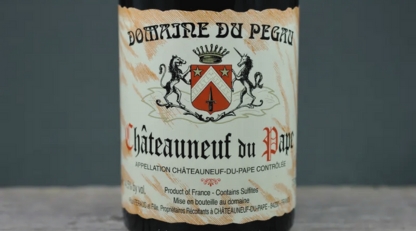
Domaine Pegau Châteauneuf-du-Pape Cuvée Réservée Rouge 2013 led the charge with an impressive 80.5% rise. Other regional standouts, including Clos des Papes Châteauneuf-du-Pape Rouge 2014 (61.2%) and Château de Beaucastel Rouge 2013 (31.1%), highlighted the enduring demand for Châteauneuf-du-Pape from highly rated mature vintages.

Highlights from Spain and Italy

While the Rhône claims several top spots, other regions also showcase the profitability of mature vintages. From Spain, the 2010 Vega Sicilia Unico achieved a notable 24.9% increase. Known for its high quality and limited production, Vega Sicilia continues to represent Spanish winemaking at its finest, cementing its status as a blue-chip investment wine.

Italy made a strong appearance with the 2014 Fontodi Flaccianello delle Pieve, which has risen 6.8% in value. This Tuscan gem, crafted from 100% Sangiovese, reflects the growing international appeal of Italy’s finest wines. Collectors are increasingly drawn to Italy not only for its iconic producers but also for its remarkable balance of accessibility and age-worthiness.

Top performing wines of 2024

Bordeaux’s resilience

No fine wine discussion is complete without Bordeaux, and 2024 is no exception. While price growth among Bordeaux wines in this dataset may be more modest, the region’s consistency remains its hallmark. The 2013 Ducru-Beaucaillou saw a solid 19.2% increase, while the 2012 Chateau L’Eglise-Clinet also featured among the top performers. 

Two Château Rieussec vintages, the 2015 and 2014, reflected Sauternes’ consistent market performance, although the category is often overlooked.

The allure of maturity

The unifying thread across these top-performing wines is their maturity. Each wine has benefited from time in the bottle, allowing its market value to increase. Mature vintages offer an enticing combination of drinking pleasure and investment potential, a dual appeal that drives demand among collectors and investors alike.

This preference for older wines reflects a broader trend within the fine wine market: a growing appreciation for provenance and readiness to drink. As global markets for fine wine continue to mature, buyers are prioritising wines with a proven track record, both in terms of quality and price appreciation.

What this means for investors

The list of the best-performing wines of 2024 shows the importance of patience and long-term approach when it comes to investing. Additionally, diversification across regions and styles can help mitigate risk and enhance returns.

The performance of these wines provides a clear takeaway: older vintages remain at the forefront of the fine wine market. 

For more read our latest report “Opportunities in uncertainty: the 2024 fine wine market and 2025 outlook”.

WineCap’s independent market analysis showcases the value of portfolio diversification and the stability offered by investing in wine. Speak to one of our wine investment experts and start building your portfolio. Schedule your free consultation today.
Categories
Report

Report – Opportunities in uncertainty: the 2024 fine wine market and 2025 outlook

Executive summary

  • Q4 was marked by political developments, changing economic policies, and geopolitical events, including the re-election of President Trump.
  • The strengthened US dollar boosted fine wine demand across the pond.
  • Fine wine prices fell 11% across major regions in 2024, reflecting a continued market correction. 
  • Italy was the most resilient fine wine region, while Burgundy experienced the biggest adjustment.
  • Rhône wines dominated the list of the best performing wines in 2024, with Domaine Pegau Cuvée Réservée Rouge 2013 leading (80.5%).
  • Older vintages (2010-2014) performed well, reflecting the market’s preference for mature, proven wines, while new releases struggled when not priced correctly.
  • Optimism for market recovery is focused on premium regions like Piedmont, Champagne, and Burgundy.
  • Economic uncertainties and mixed performance in Bordeaux are expected to persist, but continued interest in fine wine signals resilience and potential for long-term growth.

Q4 in context: political and economic drivers

Q4 was shaped by significant political and economic developments, most notably the re-election of President Donald Trump in November. Global markets reacted swiftly, with US equities rising on expectations of business-friendly policies and potential fiscal stimulus, particularly benefiting manufacturing and technology.

At the same time, renewed concerns over tariffs created uncertainty for multinational companies. Rising US Treasury yields attracted capital inflows, strengthening the US dollar but also raising fears around higher borrowing costs and a potential drag on global growth. Emerging market currencies came under pressure amid concerns about capital outflows and trade restrictions.

Geopolitical risks eased slightly toward the end of November following a US–France-brokered ceasefire between Israel and Hezbollah. While the agreement reduced immediate tensions after more than a year of hostilities, markets remained cautious, aware that stability in the region remained fragile.

Markets in 2024: the year that was

Risk assets performed strongly in 2024. Bitcoin captured headlines by surpassing $100,000 for the first time, peaking at $104,000 on Coinbase. The rally was driven by optimism surrounding a more favourable regulatory environment under President-elect Trump, reinforced by pro-crypto policy signals and key appointments.

Equity markets also enjoyed a robust year. A resilient US economy, easing inflationary pressures, and a pause in aggressive interest rate hikes supported investor confidence. Strong corporate earnings — particularly in technology and AI — propelled the S&P 500 to another stellar performance.

Energy markets were more volatile. Concerns over slowing global growth, driven by weak demand from China and other developed economies, weighed on crude oil prices. While OPEC production cuts provided some support, they were insufficient to fully offset declining demand.

Gold once again reaffirmed its role as a safe-haven asset. Persistent geopolitical tensions, inflation concerns, and financial market volatility supported demand, underpinning gold’s strong performance throughout the year.

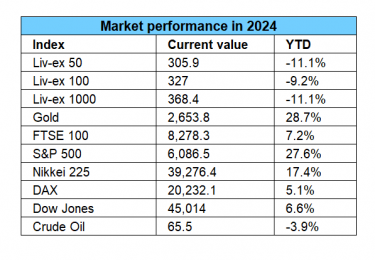
Market performance in 2024

*Current values: 06/12/2024

The fine wine market in 2024

The fine wine market extended its downward trajectory in 2024, following declines seen in 2023. The Liv-ex 100 fell 9.2% year-to-date, while the Liv-ex 50, which tracks First Growth Bordeaux, declined 10.9%.

However, these headline declines masked important regional differences and emerging opportunities. Italy stood out as a pillar of resilience, while previously overheated regions — most notably Burgundy — underwent a necessary recalibration.

Crucially, falling prices were not driven by declining demand. Market activity remained strong, with the number of fine wine trades in 2024 exceeding 2023 levels by 7.9%, highlighting continued liquidity and engagement among buyers.

Regional fine wine performance

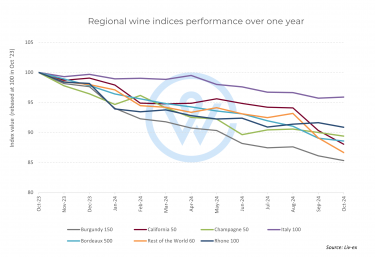
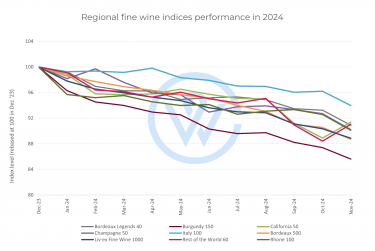
Regional fine wine indices performance in 2024

The fine wine market displayed mixed regional performance as the year drew to a close.

Italy was the most resilient major region, with prices falling just 6%, compared to an 11.1% decline in the Liv-ex 1000 index. High-scoring releases supported secondary market demand, while the country’s breadth was reflected in strong performers such as Antinori Brunello di Montalcino Vigna Ferrovia Riserva (+38%). Italy’s growing influence was further underlined by its 22 entries in the 2024 Power 100 — nine more than last year — narrowing the gap with Burgundy and Bordeaux.

Burgundy experienced the most significant adjustment, with prices declining 14.4% year-to-date. After years of exceptional growth, the correction reflects a market recalibration rather than a loss of relevance. Importantly, the pullback has reopened opportunities to acquire rare and prestigious labels at more accessible price levels, reinforcing Burgundy’s long-term appeal as a cornerstone investment region.

Champagne faced a challenging year, with prices down 9.8%, though signs of stabilisation emerged toward year-end. Older vintages led the recovery, with wines such as Taittinger Brut Millésimé (+29%) highlighting enduring demand for high-quality, mature Champagne.

Bordeaux, the largest and most liquid fine wine region, declined 11.3%. While liquidity remains a key strength, it no longer guarantees downside protection. Recent vintages struggled in particular, with many trading below release prices, reinforcing the market’s growing selectivity.

California wines fell 8.6%, but momentum improved in November. Rising interest in producers such as Dominus, Joseph Phelps, and Promontory continued to strengthen California’s position within the fine wine investment landscape.

Spain benefitted from strong US demand, with Vega Sicilia Único ranked as the most powerful fine wine brand of 2024. The inclusion of Dominio de Pingus and R. López de Heredia in the rankings further highlighted Spain’s growing investment credibility.

The best-performing wines in 2024

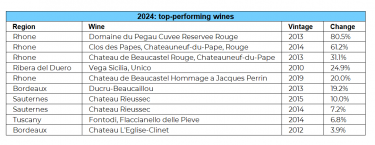
Top-performing wines of 2024

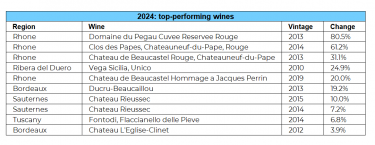
The Rhône dominated the list of top-performing wines in 2024, claiming four of the top ten positions. Domaine de Pegau Cuvée Réservée Rouge 2013 led the field with an exceptional 80.5% rise, supported by strong performances from Clos des Papes Châteauneuf-du-Pape Rouge 2014 (+61.2%) and Château de Beaucastel Rouge 2013 (+31.1%).

Beyond the Rhône, Spain’s Vega Sicilia Único 2010 (+24.9%) demonstrated the growing strength of Ribera del Duero as a serious player in the wine investment market. Vega Sicilia’s position as the most powerful wine brand in the 2024 Power 100 reinforced this trend.

Bordeaux and Sauternes also featured among the top performers. Château Rieussec secured two spots with its 2015 (+10%) and 2014 (+7.2%) vintages, while Ducru-Beaucaillou 2013 (+19.2%) and Château L’Église-Clinet 2012 (+3.9%) showed that established Bordeaux names continue to attract interest where value is evident.

A clear theme emerged: older vintages outperformed. Wines from 2010 to 2014 dominated the rankings, with only two younger vintages — 2015 and 2019 — making an appearance, and no new releases. This reflects a strong market preference for mature wines with proven track records and immediate drinkability.

2024 takeaways

  • The market correction reopened access to rare and prestigious wines, creating compelling entry points for long-term investors.

  • Established, older vintages consistently outperformed newer releases, reinforcing the value of provenance and track record.

  • Bordeaux’s liquidity remains vital, but value is increasingly selective rather than region-wide.

  • 2024 proved a strategic buying year for investors willing to look beyond short-term volatility.

Bordeaux En Primeur continued to struggle, with the 2023 vintage failing to attract widespread interest — particularly where older, proven vintages offered superior value. Economic uncertainty further reinforced the appeal of classic wines.

Iconic Bordeaux vintages such as 2000, 2005 and 2009, alongside Italy’s Super Tuscans, stood out as stable portfolio anchors. Declining prices also brought previously inaccessible wines back into circulation, allowing for strategic acquisitions at attractive levels.

Beneath the surface of falling prices, 2024 emerged as a pivotal buying year, whether for investors entering the market or enhancing existing portfolios.

2025 market outlook

The outlook for the fine wine market in 2025 is cautiously positive, with optimism focused on premium regions including Piedmont, Champagne and Burgundy. Insights from the 2024 Golden Vines Report show that 64% of industry professionals expect market growth, particularly for high-end Italian wines such as Barolo and Barbaresco, which are increasingly viewed as alternatives to Burgundy.

Sustainability and terroir-driven wines are expected to play a growing role in investment decisions. Piedmont leads growth expectations (20%), followed by Champagne (17%), Burgundy (14%) and Tuscany (12%). Bordeaux faces more mixed prospects, with 27% of respondents anticipating further declines.

While economic and geopolitical uncertainties remain, sustained global interest in fine wine underscores its resilience as a long-term asset class. Celebrated for its diversification benefits, sustainability credentials, and ability to perform across market cycles, fine wine remains the most popular collectible with a unique position within alternative investments.

See also – WineCap Wealth Report 2024: UK Edition

WineCap’s independent market analysis showcases the value of portfolio diversification and the stability offered by investing in wine. Speak to one of our wine investment experts and start building your portfolio. Schedule your free consultation today.

Categories
News

Mouton Rothschild: 2022 label and market performance

  • The 2022 Mouton Rothschild label has been revealed. 
  • Mouton Rothschild is the best performing First Growth over the last decade. 
  • The wine has also outperformed the Liv-ex 100 and Bordeaux 500 indices.

Unveiling the 2022 label

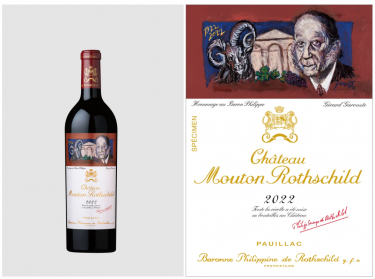
Bordeaux First Growth Château Mouton Rothschild revealed its 2022 label design on December 1st.  Created by French artist Gérard Garouste, the original artwork commemorates the 100th anniversary of Baron Philippe de Rothschild’s leadership at the family estate. 

The label showcases the château’s iconic front wall and a grapevine, elegantly framed by a portrait of Philippe de Rothschild and a ram, his signature emblem.

The tradition of artist-designed labels began in 1945, when Baron Philippe de Rothschild marked the end of World War II with a special artwork featuring a ‘V’ for victory, designed by Philippe Jullian.

As previously explored, this practice has significantly enhanced Mouton Rothschild’s collectability, and the wine’s value has typically risen in the month following the label reveal. 

Mouton Rothschild 2022 wine bottle label

Mouton Rothschild: ahead of the pack

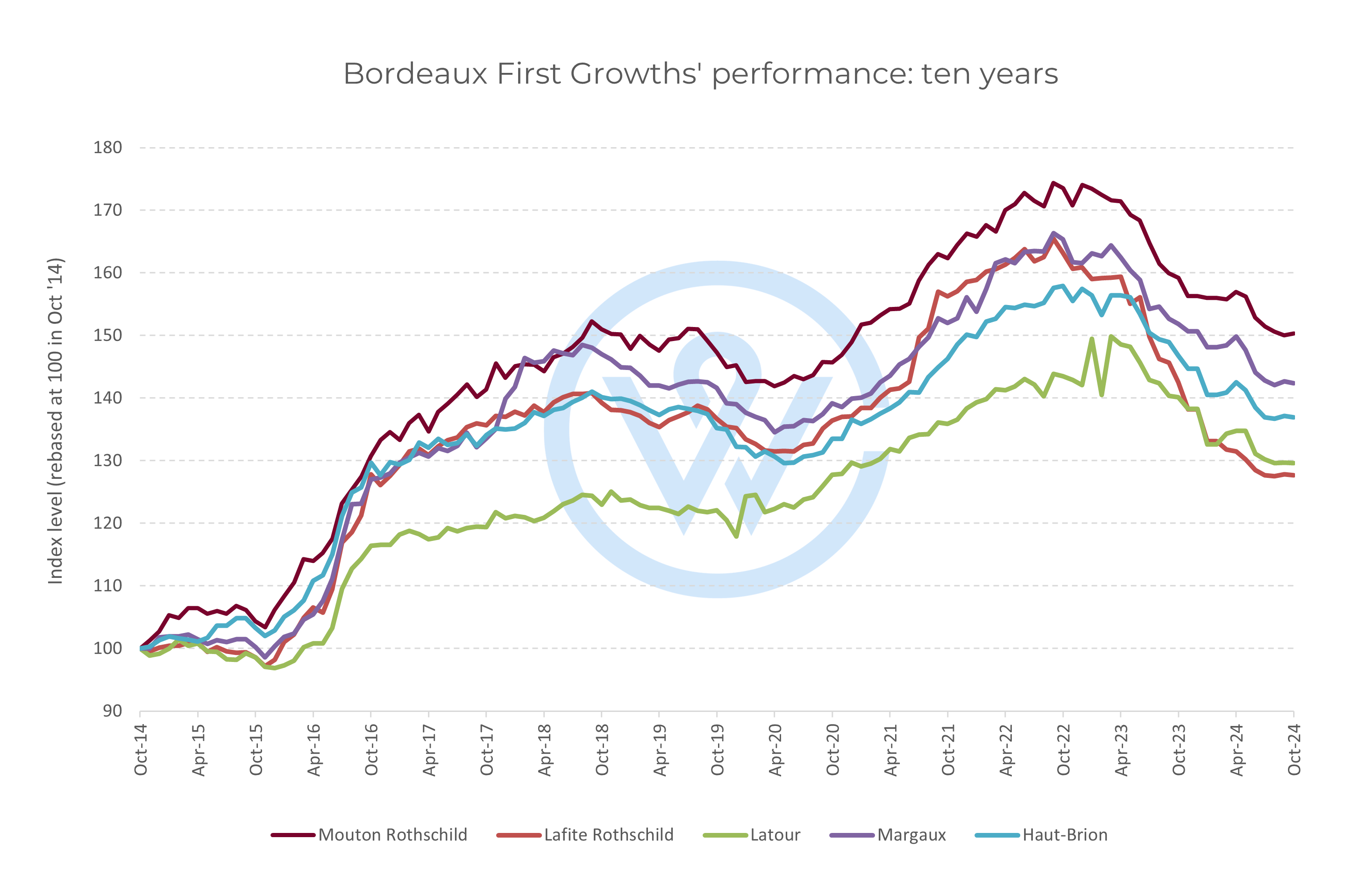
While the artist designed labels alone are not the key drivers of Mouton Rothschild’s investment performance, the wine does lead the way among its peers. It is the best performing First Growth over the last decade. 

Mouton Rothschild prices have risen 50.3%, compared to 42.3% for Margaux and 36.9% for Haut-Brion. Both Lafite Rothschild and Latour have increased by close to 30% over the same period.

Bordeaux First Growths Wine chart

From the market’s low in June 2014 to its peak in September 2022, Mouton Rothschild recorded a 76% increase. It was the first First Growth to recover from the correction following the China-driven wine boom. 

During the recent market downturn, Mouton Rothschild has exhibited relative resilience. Prices have fallen 13.8% since its peak. Only Haut-Brion has seen a smaller decline of 13.1%. The biggest faller has been Lafite Rothschild, down 22.8% since September 2022. 

Mouton Rothschild and the broader market

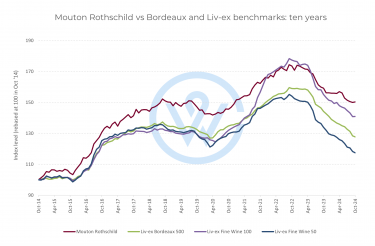
Mouton Rothschild is also nicely positioned in the broader wine investment market. It has outperformed the industry benchmark, the Liv-ex 100 index, which is up 40.9% over ten years. It has also fared better than the Liv-ex 50 (17.5%), which tracks the price movements of the First Growths, and the broader Bordeaux 500 index (27.8%).

Mouton Rothschild performance

Mouton Rothschild has demonstrated consistent strength in the fine wine market, supported by its established history and strategic positioning. The estate’s practice of commissioning artist-designed labels has enhanced its collectability, strengthened by its reputation for quality.

The release of the 2022 label marks another milestone in the estate’s history. Mouton Rothschild’s performance, both in terms of relative resilience during market downturns and long-term growth, highlights its role as a reliable component in a well-diversified wine investment portfolio.

WineCap’s independent market analysis showcases the value of portfolio diversification and the stability offered by investing in wine. Speak to one of our wine investment experts and start building your portfolio. Schedule your free consultation today.
Categories
Learn

The best wine investment regions in 2024

  • Italy’s market performance has been the most resilient across all fine wine regions.
  • Burgundy prices have fallen the most in the last year. 
  • Champagne is showing consistent signs of recovery.  

The market downturn has affected all fine wine regions, arguably making it a great time to invest while prices are low. Today we take a deep dive into the performance of individual regions – identifying the most resilient markets, the best opportunities, and the regions offering the greatest value.

Italy: the most resilient market

Prices for Italian wine have fallen 4.1% in the past year – less than all other fine wine regions. By comparison, fine wine prices have fallen 11.6% on average, according to the Liv-ex 1000 index. 

Italy’s secondary market has been stimulated by high-scoring releases, like Sassicaia and Ornellaia 2021. Beyond the Super Tuscans, which are some of the most liquid wines, the country continues to offer diversity, stable performance and relative value. 

Some of the best-performing wine brands in the last year are Italian – all with an average price under £1,300 per 12×75, like Antinori Brunello di Montalcino Vigna Ferrovia Riserva (£1,267, +38%).

Other examples under £1,000 per case include Le Chiuse Brunello di Montalcino (+28%), Gaja Rossj-Bass (+27%), and Speri Amarone della Valpolicella Classico Monte Sant Urbano (+25%).

Regional wine indices chart

Burgundy takes a hit

Burgundy’s meteoric rise over the past two decades made it a beacon for collectors, but its steep growth left it vulnerable to corrections. In the past year, Burgundy prices have fallen 14.7%, making it the hardest-hit region. This downturn has released more stock into the market, creating opportunities for investors to access wines in a region often defined by scarcity and exclusivity.

Wines experiencing the largest declines include include Domaine Jacques Prieur Meursault Santenots Premier Cru (-41%), Domaine Arnoux-Lachaux Nuits-Saint-Georges (-35%), and Domaine Rene Engel Clos de Vougeot Grand Cru (-28%). For new entrants, these price drops offer a rare chance to acquire prestigious labels at relatively lower costs.

Champagne: on the road to recovery

Champagne has changed its trajectory over the last year: from a fast faller like Burgundy to more consistency and stability. While prices are down 10.6% on average, the dips over the last few months have been smaller than 0.6%. The index also rose in February and August this year, driven by steady demand. 

Some of the region’s most popular labels have become more accessible for buyers like Dom Perignon Rose (-14%), Philipponnat Clos des Goisses (-13%) and Krug Clos du Mesnil (-12%).

Meanwhile, the best performers have been Taittinger Brut Millesime (+29%) and Ruinart Dom Ruinart Blanc de Blancs (+28%), which has largely been driven by older vintages such as the 1995, 1996 and 1998.

The fine wine market in 2024 reflects a unique moment of transition. Italy’s resilience, Burgundy’s price corrections, and Champagne’s recovery illustrate a diverse set of opportunities for investors. With prices across the board at lower levels, this could be an ideal time to diversify portfolios with high-quality wines from these regions, anticipating long-term growth as the market stabilises.

WineCap’s independent market analysis showcases the value of portfolio diversification and the stability offered by investing in wine. Speak to one of our wine investment experts and start building your portfolio. Schedule your free consultation today.
 

Categories
News

Neal Martin’s top-scoring Bordeaux 2020 wines from the Southwold tasting

  • Vinous published Neal Martin’s assessment of Bordeaux 2020 from the annual Southwold tasting.
  • Martin placed the 2020 vintage ahead of the 2018 but behind 2019 and 2022.
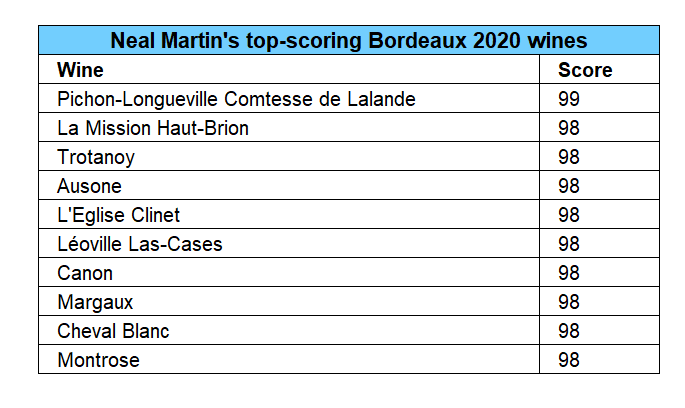
  • With 99 points, Pichon-Longueville Comtesse de Lalande was Martin’s top-scoring wine. 

The annual Southwold tasting presents major critics with the opportunity to blind taste a Bordeaux vintage four years on in peer groups, mostly within appellations. 

Last week, Vinous published Neal Martin’s assessment of Bordeaux 2020 – a vintage ‘born in a tumultuous world,’ due to the onset of the Covid-19 pandemic. Despite the challenges, the critic argued that it bestowed ‘Bordeaux-lovers with a bevy of outstanding wines that should stand the test of time.’ 

Neal Martin’s thoughts on Bordeaux 2020

Martin described the dry whites as a ‘little hit-and-miss’ and the Sauternes as ‘very good rather than excellent.’ When it comes to the reds, however, the critic said that they ‘are going to give a great deal of pleasure.’

In terms of vintage comparisons, Martin placed 2020 ahead of 2018 but behind 2019 and 2022, which were more ‘crammed with legends in the making’. He wrote: ‘Perhaps 2020 doesn’t quite possess the vaulting ambition of those two vintages, though in some cases, it surpasses the best of both.’

His favourite appellation was Saint-Julien, which ‘raised the bar with a cluster of outstanding wines.’ The critic argued that this flight ‘solidified 2020 as a bona fide great vintage on the Left Bank.’ He described Margaux as ‘solid,’ with the ‘real superstar’ being the First Growth.

From Saint-Estèphe, Martin highlighted Montrose as ‘the standout of the appellation,’ with the biggest surprise being the 2020 Phélan Ségur, ‘one of the best values given its reasonable price.’

Neal Martin’s top-scoring Bordeaux 2020 wines

Due to the nature of the Southwold blind tasting – wines grouped by appellation – Martin’s scores were ‘a little lower than when [he] encountered these wines at the end of 2022’.

His top-scoring wine, Pichon-Longueville Comtesse de Lalande, received 99 points. He described it as ‘a fabulous Pauillac that flirts with perfection.’ 

The rest of the wines in the top ten received 98 points. The highest-scored First Growth was Margaux, which the critic claimed was ‘among the greatest wines of the 2020 vintage.’ The ‘captivating’ and ‘mesmerising’ Cheval Blanc also scored among the best wines from the vintage. So did Trotanoy (‘an outstanding Pomerol’), and Canon (‘God made wine so it can taste as good as this’).

Investing in Bordeaux 2020

All of Martin’s top 2020 wines have fallen in value since release, apart from Trotanoy. 

This is partly because of the overall market direction in the last two years, but also due to the availability of older and in some cases higher-rated vintages available at a discount.

As Martin rightly noted, ‘the top wines in this report not only compete against each other, but also with themselves in terms of alternative available vintages.’

The lower-than-average prices at the moment, however, present great buying opportunities, especially for brands with a positive long-term performance. 

WineCap’s independent market analysis showcases the value of portfolio diversification and the stability offered by investing in wine. Speak to one of our wine investment experts and start building your portfolio. Schedule your free consultation today.
Categories
Learn

The impact of trade wars and tariffs on fine wine investment

  • As an internationally traded asset, fine wine is affected by economic and political factors including trade wars and tariffs.
  • Demand for certain wines and regions can shift as tariffs directly impact pricing, availability and liquidity.
  • Diversification and strategic investment are key to navigating the fine wine market amid trade wars and tariffs.

Over the past two decades, fine wine has transitioned from a luxury product to a well-established internationally traded investment asset. Like any asset enjoying global demand, fine wine is subject to the economic and political forces that shape international trade. 

Legislative decisions, such as changes in taxation and import duties, can directly impact its pricing and accessibility. Trade wars, tariffs, and protectionist policies further add layers of complexity, affecting demand, market stability, and ultimately, investment returns. This article explores how these trade factors influence the fine wine investment market and what investors need to consider.

How trade wars affect wine demand and pricing

Trade wars often involve the imposition of tariffs or import duties on goods traded between countries, which can create a ripple effect across industries and markets. When tariffs are imposed on wine, they can create price volatility, limit access to certain markets, and reduce liquidity, which can impact the investment performance of the affected wines and regions.

For example, in the ongoing trade tensions between the United States and the European Union, wine has frequently been a target for tariffs. In 2019, the USA imposed a 25% tariff on certain European wines in response to a dispute over aircraft subsidies. This tariff included wines under 14% alcohol, impacting popular wine-producing regions such as France, Spain, and Germany, but excluded Champagne and Italy. As a result, Champagne and Italy took an increased market share in the US; when the tariffs were lifted, Bordeaux and Burgundy enjoyed an immediate uptick.  

Market impact of the 2019 US tariffs on European wine: In 2019, Bordeaux accounted for 48% of the US fine wine market on average, according to Liv-ex. From October 2019 to the end of 2020, Bordeaux’s average share of US buying fell to 33%. Burgundy’s share also declined – from 13% before the tariffs to 8%. Conversely, demand for regions exempt from the tariffs rose significantly during this time. Champagne rose from 10% to 14%, Italy from 18% to 25% and the Rest of the World from 4% to 10%. Regions exempt from the 25% US tariffs also saw the biggest price appreciation in 2020. For the first time on an annual basis, Champagne outperformed all other fine wine regions. This led to its global surge. 

Market impact of the 2020 Chinese tariffs on Australian wine: In 2020, China imposed tariffs on Australian wine amid a series of blows to Australian exports, which had a profound impact on Australia’s budding secondary market. Since the tariff introduction, prices for some of the top wines dipped, creating pockets of opportunity. For instance, the average price of Henschke Hill of Grace fell 4%, while Penfolds Bin 707 went down 9%. Since the tariff suspension earlier this year, Australian wine is coming back into the spotlight. 

When it comes to pricing, tariffs can drive up the end cost of imported wine, particularly impacting markets where fine wine demand is driven by consumers with limited domestic alternatives. When tariffs make imported wines prohibitively expensive, consumers may turn to other regions or domestic products. 

From an investment perspective, the unpredictability of trade policies requires a strategic approach that accounts for potential regulatory changes in key markets.

Strategic wine hubs in tariff-influenced markets

In response to tariffs, some regions have positioned themselves as strategic wine trading hubs by offering tariff-free or reduced-tariff environments for wine trade. Hong Kong, for example, abolished its wine import duty in 2008, aiming to become the “wine trading hub” of East Asia. 

This decision has proven instrumental for the fine wine market in Asia, as investors from mainland China and other countries can access European wines without the additional costs that would apply if purchased domestically. As a result, Hong Kong has emerged as a leading location for wine auctions and a key destination for collectors and investors in Asia.

The role of trade agreements

For regions with established wine industries, trade agreements and economic alliances play a significant role in shaping wine tariffs and market access. The European Union, for instance, has trade agreements with multiple countries, allowing for reduced tariffs on wines imported from places like Australia and Chile. However, Brexit has introduced new complexities, as the United Kingdom – one of the largest fine wine markets – now operates independently from the EU. 

For investors navigating the fine wine market amid trade wars and tariffs, diversification and strategic storage are essential. Diversifying across different wine regions and vintages can help minimize exposure to trade barriers affecting specific countries. 

Additionally, storing wine in bonded warehouses can mitigate the risk of sudden tariff impositions on wine imports, preserving the asset’s value. Monitoring geopolitical developments is also crucial, as policy shifts can happen quickly and have immediate effects on wine prices. 

While trade wars and tariffs present complexities, they also create opportunities in the fine wine investment market. In a politically charged landscape, understanding the influence of trade policies on wine markets is critical. By staying agile and responsive to policy changes, investors can better navigate the complexities of wine investment in a globalised yet fragmented market.

Want to learn more about fine wine investment? Download our free guide.


Categories
News

James Suckling’s top 100 wines of 2024

  • James Suckling’s top 100 wines of 2024 list has been released.
  • His wine of the year is Bertani Amarone della Valpolicella Classico 2015. 
  • Italy dominates the rankings followed by France and the US.

American critic James Suckling has released his top 100 wines of 2024 list, along with his wine of the year. Based on tens of thousands of bottles tasted and rated over the year, the list highlights wines that combine exceptional quality, character, and accessibility.

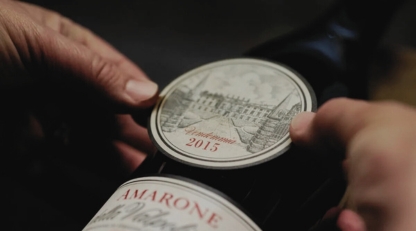
For 2024, Suckling’s Wine of the Year is Bertani Amarone della Valpolicella Classico 2015, awarded a perfect 100-point score. Italy dominates the rankings overall, followed by France and the United States, reflecting both traditional strongholds and evolving global demand.

This article breaks down the James Suckling Top 100, explains how the list is compiled, explores regional performance, and highlights what collectors and investors can learn from the 2024 results.

How the James Suckling Top 100 is compiled

James Suckling’s rankings are underpinned by scale and consistency. Over the past year, Suckling and his international tasting team reviewed more than 40,000 wines, producing detailed tasting reports, vintage analyses, and regional breakdowns.

Unlike many critics, Suckling’s approach is deliberately broad. The bottles tasted and rated span:

  • Everyday wines priced below $20

  • Estate wines from leading regions such as Bordeaux, Burgundy, and Napa Valley

  • Limited-production cuvées from small, high-quality producers

The Top 100 list is then selected from this vast dataset, based on more than just numerical scores.

Criteria for inclusion in the Top 100

To qualify for the James Suckling Top 100, wines must meet several key criteria:

  • Minimum production of approximately 5,000 bottles

  • Median release price below $500 (£385)

  • A score typically between 97 and 100 points

  • What Suckling describes as a “wow factor” – an emotional impact that elevates a wine beyond technical excellence

This ensures the final list balances prestige with real-world availability, creating a list of wines that is both aspirational and practical for collectors.

A record year of tasting: More than 40,000 wines reviewed

The scale of Suckling’s tasting operation is unmatched. In 2024 alone:

  • More than 40,000 bottles tasted and rated

  • Hundreds of tasting reports published

  • Wines assessed across all major regions and styles

Each wine is evaluated blind where possible, with scores reflecting overall quality, balance, structure, and ageing potential. These tasting notes form the backbone of the final Top 100 ranking.

Regional overview: Italy leads the James Suckling top 100

Italy once again emerged as the strongest-performing country in the 2024 rankings.

Total wines reviewed in 2024

The countries with the largest representation included:

  • Italy – 9,100 wines

  • France – 9,000 wines

  • United States – 6,800 wines

  • Spain – 3,800 wines

  • Argentina – 2,300 wines

  • Germany – 2,000 wines

  • Australia – 1,700 wines

  • Chile – 1,550 wines

Additional tastings included wines from Greece, Hungary, Canada, Uruguay, and China, highlighting the increasingly global scope of Suckling’s work.

Countries featured in the James Suckling Top 100

Despite intense competition, Italy secured 26 places in the Top 100 – more than any other country. These wines span a wide range of styles and regions, including:

  • Amarone della Valpolicella

  • Barolo

  • Brunello di Montalcino

  • Alto Adige whites

  • Super Tuscan blends

France followed with 18 wines, led by Bordeaux, Champagne, and the Rhône Valley. Burgundy Grand Crus and structured Rhône reds continue to perform strongly, reinforcing France’s long-standing reputation for producing great wine.

The United States placed 15 wines on the list, driven largely by Napa Valley Cabernet Sauvignon and Oregon Pinot Noir. This confirms the continued global appeal of top-tier American producers.

Germany delivered 12 wines, a standout performance that underscores the growing recognition of dry Riesling as one of the world’s most precise and age-worthy styles.

Chile, Australia, Argentina, and Spain also featured, while China made a notable appearance with Ao Yun Shangri-La 2020, reflecting its rising status in the fine wine market.

Wine of the Year 2024: Bertani Amarone della Valpolicella Classico 2015

At the top of the ranking is Bertani Amarone della Valpolicella Classico 2015, which received a perfect 100-point score.

James Suckling describes the wine as a benchmark expression of Amarone, praising its balance between power and elegance. His tasting notes highlight:

  • Full-bodied structure

  • Filigree, refined tannins

  • Bright, persistent acidity

  • A long, savoury, and complex finish

Suckling calls it a wine that expresses “the greatness of time and place”, emphasising its ability to age gracefully while remaining compelling today.

The selection of an Amarone as Wine of the Year is particularly significant. It reflects growing international appreciation for Italy’s traditional red wines beyond the established icons of Barolo and Brunello.

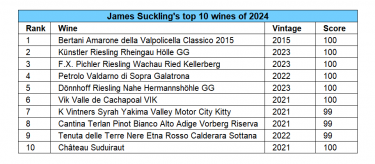
James Suckling top wine scores 2024

Value and accessibility: a defining theme of 2024

One of the most striking aspects of the James Suckling Top 100 Wines of 2024 is its focus on accessibility.

According to Suckling:

  • Nine wines in the Top 100 are priced between $30 and $60

  • Many highly rated white wines remain attractively priced

  • The second-ranked wine on the list retails for around $65 (£50)

This emphasis on value reflects changing market dynamics, where consumers and collectors alike are seeking great wine without excessive price inflation.

Notable regional highlights

Germany’s breakthrough year

Germany’s strong showing confirms the exceptional quality of recent vintages, particularly for dry Riesling. Wines such as Künstler Riesling Rheingau Hölle GG 2023 demonstrate precision, minerality, and ageing potential.

Austria’s continued rise

Austria continues to build momentum, especially with wines from Wachau. These bottlings offer clarity of terroir and consistency across vintages.

China’s growing presence

The inclusion of Ao Yun Shangri-La 2020 marks a milestone for Chinese wine. Produced at high altitude in the Himalayan foothills, it showcases craftsmanship, innovation, and a distinct regional identity.

What collectors can learn from the James Suckling Top 100

The Top 100 is a snapshot of the global fine wine landscape.

For collectors and investors, it highlights:

  • Shifting stylistic preferences

  • Regions delivering strong value

  • Wines with long-term ageing potential

  • Emerging regions beyond traditional powerhouses

Whether searching alphabetically by winery, sorting by vintage score, or exploring tasting reports, the list offers a curated starting point for building a diverse and forward-looking cellar.

Final thoughts

The James Suckling Top 100 Wines of 2024 reflects a wine world in transition which values authenticity, balance, and accessibility alongside technical excellence.

From Amarone in Veneto to Riesling in Germany and Cabernet Sauvignon in Napa Valley, the list captures the diversity and excitement of today’s fine wine market. For collectors, it provides a reliable guide to wines that deliver both immediate pleasure and long-term promise.

WineCap’s independent market analysis showcases the value of portfolio diversification and the stability offered by investing in wine. Speak to one of our wine investment experts and start building your portfolio. Schedule your free consultation today.

Categories
Learn

How to build a diversified fine wine portfolio

  • A diversified wine portfolio spreads the risk across different wines and regions.
  • Each wine region has its own unique characteristics, and its performance is largely influenced by its own market dynamics.
  • Investors can also diversify their portfolio by vintages, including older wines for stability and new releases for growth potential. 

Fine wine is a popular investment for those seeking diversification and long-term growth. However, like any investment, building a successful fine wine portfolio requires strategic planning and a thorough understanding of the market.

This article explores key strategies for creating a balanced, diversified fine wine portfolio, and why it is important to include a variety of regions, brands and vintages.

Why diversification is key

As renowned economist Harry Markowitz put it, ‘diversification is the only free lunch in finance’. 

Diversification is fundamental to risk management in any portfolio, and fine wine investment is no exception. A diversified wine portfolio helps to reduce the impact of volatility, allowing investors to maximise returns by spreading risk.

While some wines may deliver higher returns, others can contribute to portfolio stability, as different regions tend to perform in cycles. This is why building a balanced fine wine portfolio requires selecting wines from a variety of regions, vintages, and holding periods. 

Diversifying by regions

Wine regions around the world offer unique characteristics, each with its own market dynamics. Including wines from multiple regions can help balance and strengthen an investment portfolio. 

Some primary regions to consider include:

Bordeaux: Bordeaux is undoubtedly the leader in the fine wine investment landscape, taking close to 40% of the market by value. The First Growths are its most liquid wines. In general, the classified growths are a staple in investment portfolios due to their established reputation and consistent performance.

Burgundy: Burgundy, driven by scarcity and rarity, is an investors’ paradise that has been trending in the last decade. Prices for its top Pinot Noir and Chardonnay have reached stratospheric highs and the region consistently breaks auction records.

Champagne: A market that attracts both drinkers and collectors, Champagne has enjoyed rising popularity as an investment in the last five years, thanks to strong brand recognition, liquidity and stable performance.

Italy: Italy continues to provide a mix of value, growth potential, and great quality. Its two pillars, Tuscany and Piedmont, are often included in investment portfolios for their balancing act – if Tuscany provides stability, top Barolo and Barbaresco tend to deliver impressive returns. 

California: Top Napa wines are among the most expensive in the market, while also boasting some of the highest critic scores, particularly from the New World. 

Emerging investment regions: As the market broadens, wines from other well-established regions are gaining traction in the investment world. Germany, Australia, and South America are some of the countries bringing a new level of diversity that can sometimes lead to higher returns.

Choosing vintages strategically

A well-diversified investment portfolio focuses on a range of vintages, as well as labels.

While older vintages offer stability and a more predictable market performance, younger vintages have a greater growth potential as they mature.

Older prime vintages: ‘On’ vintages, specific to each region, like Bordeaux’s 2000 or 2005, tend to have stable pricing due to their high quality and reputation. Including these in your portfolio can provide a foundation of reliability.

Younger vintages: Wines from recent years with high-quality (such as Bordeaux 2019) can offer growth potential over the long-term. As these wines age, their value often appreciates, providing long-term returns for investors willing to hold them.

Off-vintages: Investing in lesser-known or ‘off’ vintages can be worthwhile, particularly if the producer has a strong reputation. These wines are often priced lower but can perform well over time. Typically though not always they have a shorter holding period.

At the end, it is always a question of quality and value for money. 

Balancing short-term and long-term holdings

Fine wines vary in their optimal holding periods. Some wines reach peak quality and market value sooner, while others require decades of ageing. Creating a mix of wines with different holding periods allows for both short-term liquidity and long-term growth.

Short-term hold wines: These are typically wines from lesser-known producers, high-demand recent vintages or off vintages bought during periods of market correction.  These wines can be sold within a few years for a quick return.

Long-term hold wines: Wines from top producers, especially those known for longevity, are best held for 10+ years. For example, a Château Lafite Rothschild or Domaine de la Romanée-Conti can offer three figure returns if held over decades.

Active management for maximising portfolio success

Diversification is just one piece of the puzzle. Regular monitoring and occassional adjustments are essential for maximising returns in a fine wine portfolio.

Market conditions and wine values change over time, so staying informed and making adjustments ensures your portfolio remains aligned with your financial goals. Using tools like Wine Track or consulting with a wine investment advisor can provide valuable insights for rebalancing and enhancing your investment strategy.

WineCap’s independent market analysis showcases the value of portfolio diversification and the stability offered by investing in wine. Speak to one of our wine investment experts and start building your portfolio. Schedule your free consultation today.
Categories
News

Bordeaux correction: top wines 20% below their peak

  • Top Bordeaux labels are now approximately 20% below their peaks achieved during the last decade.
  • Lafite Rothschild has been the hardest hit, driven lower by classic vintages such as 2018, 2009 and 2000. 
  • The recent fall in prices has brought many labels back to levels not seen in years.

As recently explored, the fine wine market has been on a downward trend, but what does this mean for individual labels? Today, we turn to Bordeaux’s top names, examining the recent performance of some of the most investable wines in the world.

Bordeaux after the peak

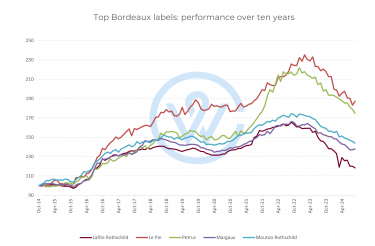
Top Bordeaux labels are now approximately 20% below their peaks, achieved during the last decade. 

Bordeaux wine indices

The First Growths, which often serve as the barometers of the fine wine market, had been riding high, with September 2022 marking a peak in pricing for Lafite Rothschild, Mouton Rothschild and Margaux. 

However, since then, the landscape has changed dramatically. Lafite Rothschild, once the shining star, has fallen by 28.6%, the most severe decline among the top names. Margaux and Mouton Rothschild have also taken significant hits, falling by 17.1% and 17.5%, respectively.

On the Right Bank, the situation is no different. Petrus, which peaked in December 2022, has since dropped by 21.4%, while Le Pin, which reached its high in February 2023, has declined by 20.3%. These losses have brought prices to levels last seen several years ago.

First Growths peaked in September 2022, since then:

  • Lafite is down 28.6% 
  • Mouton is down 17.5% 
  • Margaux is down 17.1% 

On the Right Bank:

  • Petrus is down 21.4% since its December 2022 peak
  • Le Pin is down 20.3% since its February 2023 peak

The Lafite fall: a deep dive

Lafite Rothschild – the second most-searched-for wine on Wine-Searcher – has seen the steepest decline since its peak, with prices plummeting 28.6% on average.

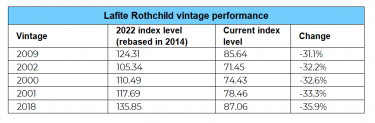
Which vintages have contributed to its fall over the last two years? The 2018 (WA 100 points) has been the hardest hit, down 35.9%. The wine was originally released at levels akin to the brand’s bull years, due to high critic scores, but failed to offer the best investment value. The recent price adjustment has made it a more attractive proposition. 

Older vintages that have had more time to grow have similarly fallen in value by over 30%. The classic 2009 Lafite, which boasts 99+ points from Robert Parker himself, is down 31.1% over the last two years. 

The millenial vintage, with a drinking window that extends well into the 2050s, is currently 32.6% below its peak. 

Lafite Rothschild wine vintages performance

Buying levels: back to the square one

The recent fall in prices has brought many labels back to levels not seen in years. Lafite, for example, has returned to its 2016 pricing levels, while Margaux and Mouton are back to 2020. On the Right Bank, Petrus and Le Pin have both returned to their 2021 levels.

While this might raise concerns on the surface, it presents a compelling opportunity. The scale of the correction suggests that Bordeaux wines, while still highly valued, may have been oversold in the last 18 months. 

For those looking to enter or expand their portfolios, this could represent a chance to acquire top-tier wines at a significant discount before prices start to rise again.

As with previous corrections, price declines are often followed by periods of recovery. For wealth managers and clients with a long-term investment horizon, the current situation may be seen as a momentary blip in an otherwise upward trajectory.

WineCap’s independent market analysis showcases the value of portfolio diversification and the stability offered by investing in wine. Speak to one of our wine investment experts and start building your portfolio. Schedule your free consultation today.