Categories
News

Pockets of growth: Where the fine wine market is starting to turn

  • Market confidence is returning, with fine wine prices posting their first quarterly gain since the downturn began.
  • Selective regions are leading the rebound, with Champagne, Tuscany, and California showing the strongest signs of growth.
  • Stabilisation signals a turning point, as price declines slow and demand strengthens.

After two years of subdued performance, the fine wine market may finally be entering a new phase. Signs of stabilisation are emerging across key benchmarks, and selective pockets of growth suggest that investor confidence is beginning to return. While the broader market remains uneven, improving bid activity, regional resilience, and a shift in sentiment all point to a turning point — one that could lay the foundation for the next cycle of fine wine appreciation.

Confidence returns: Benchmark momentum

One of the clearest signals of renewed optimism comes from the bid:offer ratio — a measure of market confidence based on the proportion of active bids to offers on the secondary market. This ratio has been steadily rising, reflecting stronger buying interest and a more balanced trading environment. The shift is also visible in performance indices: the Liv-ex 100, which tracks the world’s most sought-after investment-grade wines, rose by 1.1% in September, offsetting earlier summer losses and delivering its first quarterly gain since the downturn began.

This rebound was mirrored across broader indicators. The Liv-ex 1000, which captures a wider cross-section of the market, slipped 0.5% over the quarter but also gained 0.4% in September — a sign that the market’s base may be firming. Even the First Growths Index, a bellwether for Bordeaux’s top estates, recorded a 0.7% gain in September. Though it remained slightly down for the quarter, the performance underscores a market that is recalibrating.

Where growth is emerging: key regional categories

The nascent recovery is not evenly distributed. Instead, certain regions and categories are emerging as clear leaders — offering clues about where value-seeking investors are positioning their capital.

Champagne: Resilience meets renewed demand

Champagne has once again proved its resilience. The region held near-flat over Q3 and remains one of the strongest performers of 2025, buoyed by rising demand from Asia and the US. This sustained appetite reflects Champagne’s unique position in the market: a luxury category with strong brand recognition, limited supply, and consistent global demand. For investors seeking stability and long-term performance, Champagne continues to justify its reputation as a defensive yet rewarding allocation.

Italy: Tuscany outpaces Piedmont

Italian fine wine remains a story of two regions. Tuscany has seen the most notable improvement, with the Italy 100 index climbing as buyers return to iconic Super Tuscans and Brunello producers. Piedmont, by contrast, still faces a softer bid environment, suggesting that investors are prioritising wines with immediate liquidity and strong global followings. The divergence illustrates a broader theme in today’s market: capital is flowing toward estates with established demand and clear brand equity.

California: Opus One leads a rebound

California has also been a bright spot. Opus One — one of the region’s most recognisable labels — has seen its strongest bid activity since January 2024. Over recent weeks, Liv-ex reported a surge in demand, with the US accounting for 40% of bid volume, closely followed by Asia at 39%. The UK and EU trail at 14% and 7% respectively, but this transatlantic interest highlights growing enthusiasm for top-tier Californian wines. As collectors seek quality and scarcity beyond Europe, California’s flagship estates are once again capturing attention.

Sector performance: Signs of a bottom forming

While some areas continue to lag, the broader data suggests that the worst of the correction may be behind us. Regional indices delivered a mixed performance in Q3, but declines moderated significantly, and September brought widespread gains.

Bordeaux remains the weakest performer in aggregate — the Bordeaux 500 fell 1.7% — but even here, signs of improvement are visible. Half of the region’s sub-indices gained in September, including those tracking First Growths, Second Wines, and leading Right Bank labels. Burgundy, too, was only marginally lower (-0.2%), with top domaines maintaining impressive resilience despite broader headwinds.
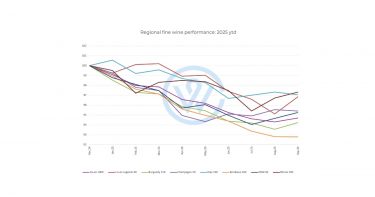
Regional fine wine performance 2025

Together, these indicators suggest a market that may be finding its floor. Price declines have slowed, buyers are becoming more active, and selective demand is driving performance in certain regions and producers. This kind of stabilisation typically precedes a period of gradual re-pricing — and potentially, recovery.

The next phase: Selectivity, scarcity, and strategy

The third quarter of 2025 was a transitional one for fine wine. With mainstream assets recovering and investor sentiment stabilising, the asset class is beginning to reassert itself as a reliable store of value and a portfolio diversifier. The coming quarters are likely to be defined by three key drivers:

  • Scarcity: Limited-production wines from renowned estates continue to attract demand, particularly as global supply chains tighten and yields remain historically low.
  • Selectivity: Investors are becoming more discerning, focusing on regions and producers with strong fundamentals rather than chasing broader market exposure.
  • Reputation: Brand equity and consistent critical acclaim remain decisive factors, with top names enjoying disproportionate interest as confidence returns.

While the pace of recovery will vary by region and price tier, the data points to a market that is stabilising and, in some segments, already turning higher. For investors with a medium- to long-term horizon, the current environment offers attractive entry points into historically strong-performing categories.

Looking for more? Read our latest quarterly report: Q3 Fine Wine Report

WineCap’s independent market analysis showcases the value of portfolio diversification and the stability offered by investing in wine. Speak to one of our wine investment experts and start building your portfolio. Schedule your free consultation today.
Categories
Learn

How UK and US investors react to tariffs

  • Wealth managers in both the UK and US anticipated increased demand for equities, real assets, and alternatives amid shifting trade policy landscapes.
  • US respondents showed stronger confidence in alternative assets, while UK managers leaned more toward traditional equities and property.
  • Fine wine was viewed in both markets as a resilient, inflation-resistant asset with long-term appeal, especially in portfolios seeking diversification.

With President Donald Trump back in the White House, global markets have once again entered a period of trade policy uncertainty. In late May 2025, the administration proposed sweeping 50% tariffs on European Union imports, initially planned for June 1 but now delayed until July 9 following negotiations with European Commission President Ursula von der Leyen. The move echoes earlier policy cycles that disrupted cross-border commerce, and while implementation remains uncertain, it has revived conversations about portfolio resilience and asset class performance under changing geopolitical conditions.

In our Wealth Management survey earlier this year, investors across both sides of the Atlantic were asked to consider how a renewed focus on domestic trade policy and market protectionism might shift capital allocation preferences. Their responses revealed an appetite for assets considered resilient, global, and responsive to consumer growth.

A recalibration of confidence across core and alternative assets

Across both markets, wealth managers projected increased demand for a wide range of asset classes, albeit with slightly different emphases. In the United Kingdom, demand was strongest for traditional equity exposures, particularly US stocks (94%) and emerging markets (90%), reflecting a continued belief in global growth opportunities despite the shifting trade backdrop. Property and non-US developed stocks also garnered attention, as did cash and bonds – indicating a balanced appetite for both growth and defensive positions.

*UK

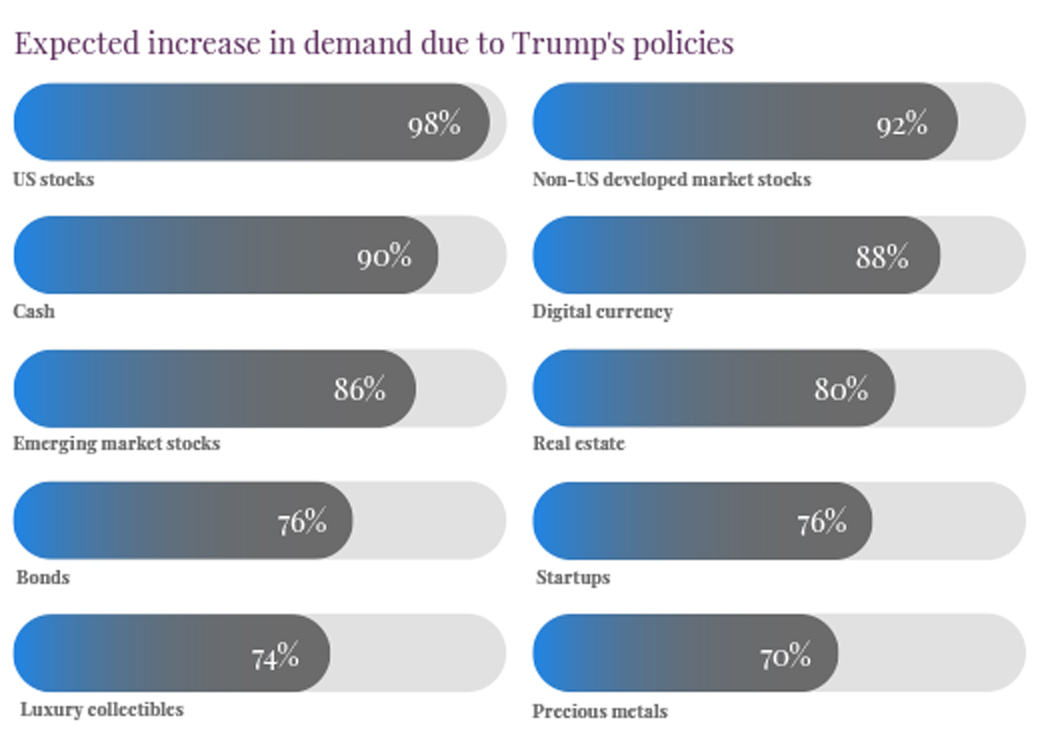
In the US, the tone was more expansive and optimistic. US stocks topped the list at 98%, with similarly high sentiment for non-US developed markets (92%), cash (90%), and emerging market equities (86%). However, American wealth managers also showed a greater inclination toward alternatives – digital currency (88%), real estate (80%), startups (76%), and luxury collectibles (74%) all ranked notably high. This suggests that, even in the face of policy shifts, US investors were inclined to look for opportunity amid change, particularly in sectors with strong long-term narratives or tangible value.

*US

A nuanced position for fine wine and luxury assets

Fine wine and other luxury collectibles were not among the top-tier asset classes in the survey but nevertheless held their own as part of a well-rounded diversification strategy. 

While only 58% of UK respondents expected an increase in demand for luxury collectibles compared to 74% in the US, both figures reflect a belief in the long-term value of tangible, non-correlated assets – especially during periods of policy uncertainty.

Historically, fine wine has performed well in such climates. Its low correlation with traditional financial markets, combined with intrinsic scarcity and global appeal, positions it as an attractive option for wealth preservation. 

US respondents in particular noted that if Trump’s policies were to echo those from his previous term – most notably tax cuts that increased disposable income among high-net-worth individuals – then demand for luxury goods, including fine wine, could grow in tandem with consumer confidence.

Inflation resistance and tangibility remain key themes

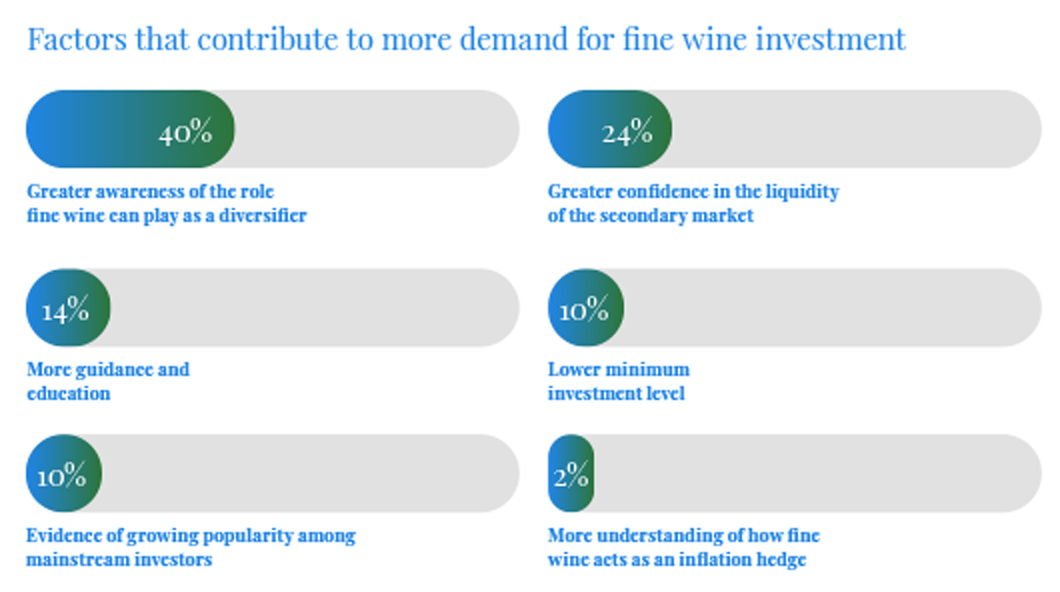
Another through-line in both markets is the recognition that tangible, inflation-resistant assets may offer stability when macroeconomic or policy environments shift. While digital assets and equities continue to dominate discussions, the inclusion of fine wine and real estate in both countries’ top ten expected demand growth areas suggests a common view: that real, finite goods still hold a trusted place in long-term strategies.

This sentiment aligns with broader investment trends of the past five years, during which fine wine has steadily gained credibility as an alternative asset. From a performance standpoint, it has demonstrated resilience through downturns and delivered attractive risk-adjusted returns over the long term. And as more platforms offer increased liquidity and data transparency, fine wine is becoming more accessible to wealth managers seeking both diversification and durability.

Looking ahead

While our survey preceded the most recent tariff developments, the views it captured reflect a broader mindset already taking shape among global investors. As the July 9 tariff deadline approaches, and with the potential for further policy changes, these pre-existing preferences offer a lens into how wealth managers may continue to allocate in an evolving geopolitical environment.

For fine wine in particular, its dual role as both a passion asset and a portfolio stabiliser could prove increasingly valuable. Whether driven by renewed domestic consumption or a search for global, inflation-resistant stores of value, fine wine appears poised to remain a quiet but meaningful part of the wealth management conversation on both sides of the Atlantic.

Looking for more? See also: 

WineCap Wealth Report 2025: UK Edition

WineCap Wealth Report 2025: US Edition

Categories
News

Assessing the Burgundy 2022 En Primeur campaign

  • Burgundy prices continued to spiral downwards in January, falling 3.7%.
  • This created a challenging backdrop for the unfolding Burgundy 2022 campaign, which saw about 10% of producers reduce pricing year-on-year.
  • The current market dynamics offer investors a unique window to enrich their collections with both new gems and proven performers.

Burgundy took the spotlight at the beginning of the year with the unfolding 2022 En Primeur campaign. Already in our Q4 2023 report, we questioned the potential of the new releases to stimulate an otherwise dormant market. On the one hand, there was the excitement of the new mixed with high quality and quantity playing to the campaign’s advantage; on the other, much depended on pricing.

Market conditions and pricing challenges

Burgundy prices continued to spiral downwards in January, with the Liv-ex Burgundy 150 index starting the year with a 3.7% decrease. To say that this created a challenging backdrop for the new releases would be an understatement. Prices at release had to come down.

And partially they did. According to Liv-ex, about 10% of the top producers ‘lowered their prices year-on-year’. However, ‘about 40% raised their prices, even if only modestly’. Thanks to greater quantities, allocations were mostly restored.

Burgundy 2022 – ‘a treasure trove’

As the first releases landed, Burgundy 2022 enjoyed a positive reception from critics and trade. Neal Martin (Vinous) advised that ‘if your favourite growers’ price tags seem fair, then I would not hesitate diving in’. He described the 2022 vintage as ‘Burgundy’s latest trick: a treasure trove of bright ‘n bushy-tailed whites and reds in a season that implied such wines would be impossible, wines predestined to give immense drinking pleasure’.

Investment perspective and older vintages

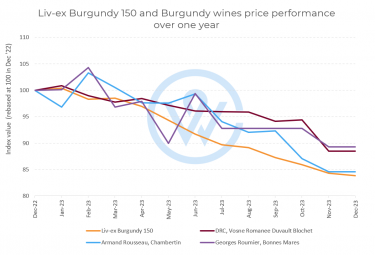
However, prices for older vintages remain under pressure, creating buying opportunities for already physical and readily available wines. For instance, three of Burgundy’s outstanding long-term wine performers have all seen dips between 15% and 10% in the last year. Over the last decade, however, DRC Vosne-Romanée Cuvée Duvault Blochet is up 388%; Georges Roumier Bonnes Mares – 339%, and Armand Rousseau Chambertin – 279% on average.

Burgundy wines performance

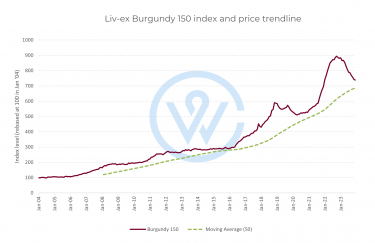
Meanwhile, the Burgundy 150 index has decreased 16% in the last year. Still, the overall long-term index trajectory remains upwards, as the chart below shows.

Burgundy index

Searching for value

The current market dynamics offer investors a unique window to enrich their collections with both new gems and proven performers across older physically available vintages.

When it comes to the latest, the Burgundy 2022 En Primeur campaign presents a complex tapestry of quality, quantity, and pricing amidst challenging market conditions. Despite initial price pressures, the adjustments made by producers and the positive critical reception underscore the potential of the new releases. Neal Martin’s endorsement further elevates the vintage, suggesting that for the discerning buyer, Burgundy 2022 provides not just immediate drinking pleasure but also long-term investment opportunities.

WineCap’s independent market analysis showcases the value of portfolio diversification and the stability offered by investing in wine. Speak to one of our wine investment experts and start building your portfolio. Schedule your free consultation today.