Categories
News

Bordeaux En Primeur 2024: critic scores and best releases

  • There have been some notable releases in a quieter En Primeur campaign. 
  • All of the top releases have represented the best entry point into their respective brands in the last decade. 
  • Critics have emphasised selectivity in a challenging vintage.

One month in since the start of the Bordeaux 2024 En Primeur campaign, which seems to be nearing its end, we look at critic scores and price trends to evaluate the best releases.

What the critics are saying

After the Wine Advocate’s William Kelley called Bordeaux 2024 ‘the weakest vintage of the last decade’, other critics have echoed his concerns with greater nuance. 

For Jane Anson, ‘the vintage was better than expected […] and clearly better than, for example, 2013 – and 2021 in the best cases.’

Meanwhile, Antonio Galloni (Vinous) observed: ‘The 2024s are all over the place in terms of quality and style, so readers will have to be selective. Within that context, the very best wines have a lot to offer.’ His ‘magnificent eight’ were Beychevelle, Clos Puy Arnaud, Cos d’Estournel, Jean Faure, Larcis Ducasse, Lascombes, La Conseillante and Rauzan-Ségla.

Neal Martin concluded his report, arguing that 2024 is ‘the ideal vintage for a reset’. He noted that ‘given the obstacles placed along the growing season, any 2024 that scores above 90 points is a success’. Martin’s highest barrel range was 96-98 points for La Mission Haut-Brion Blanc. Among the reds, his top wines with 95-97 points were Lafite Rothschild, Trotanoy, Lafleur and Vieux Château Certan.

The state of the market

As Bordeaux continues to lose market share to other regions, and fine wine prices overall are in a correction phase, releasing En Primeur has only worked with heavy discounts. We spoke with leading producers on how they determine their release prices, with strategies ranging from consulting négociants  and importers, and weighing in volumes and vintage quality. 

In his report, Martin speaks of the following reality: ‘There is no saviour riding over the horizon, no emerging country of insatiable Bordeaux-lovers, all against a backdrop of a vine-pull scheme […] and the fact that Bordeaux is wrestling with an image crisis.’ 

The solution? He goes back to the beginning of his career, when ‘off-vintages in the mould of 2024 would be discounted, and […] nobody lost face, including the grandest châteaux, and crucially, it kept the primeur system flowing, bottles passing through the distribution chain to the all-important final consumer’.

Within this context, we look at the releases that have worked so far – where pricing has aligned with trade and consumer expectations, and has offered a window for long-term profitability. 

Best En Primeur releases to date

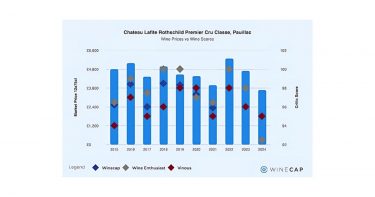
One of the standout releases of the campaign has been First Growth Château Lafite Rothschild.

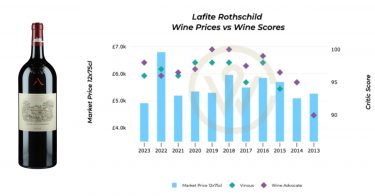
The 2024 vintage emerged as the most attractively priced Lafite in recent memory. In fact, only one other vintage from the past 40 years comes within 25% of its release price. Even lower-rated vintages like 2013 and 2007 – both released before the transformative investments that elevated Lafite’s quality – now trade at considerably higher levels.

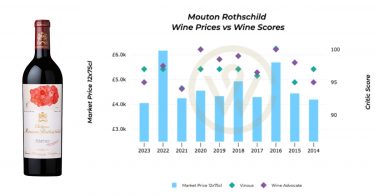
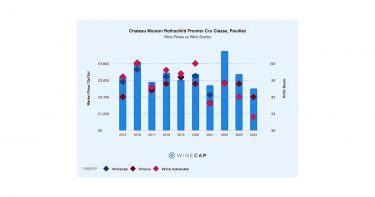
Much like Lafite, the 2024 Mouton Rothschild represents a rare opportunity. It is the best-priced Mouton vintage currently available on the market. Adjusted for inflation, only one other vintage in the last two decades compares in affordability. 

Moreover, Mouton has been the best-performing First Growth over the last five years, while also being Wine-Searcher’s most searched-for wine globally. 

History shows that these ‘less celebrated’ vintages often outperform their more hyped counterparts. For both Lafite and Mouton, vintages such as 2007, 2008, 2013, and 2014 have significantly outpaced the more acclaimed 2009, 2010, or 2016 in price performance.

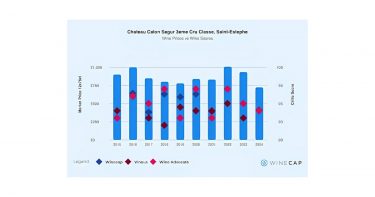
Another notable performer is Calon Ségur. While it may have flown slightly under the radar, its 2024 release represents the best entry point into the brand in over a decade. Calon has built a strong reputation among critics, frequently earning 95+ scores from Wine Advocate and Vinous. 

Its investment credentials are equally impressive: between 2015 and 2023, Calon prices surged more than 80%. Even with recent market dips, our Calon Ségur index remains 75% higher than it was ten years ago – making it one of Bordeaux’s most dynamic performers.

Looking for more? Read our Bordeaux Regional Report.

Categories
News

Mouton Rothschild: 2022 label and market performance

  • The 2022 Mouton Rothschild label has been revealed. 
  • Mouton Rothschild is the best performing First Growth over the last decade. 
  • The wine has also outperformed the Liv-ex 100 and Bordeaux 500 indices.

Unveiling the 2022 label

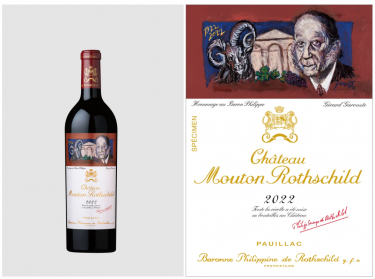
Bordeaux First Growth Château Mouton Rothschild revealed its 2022 label design on December 1st.  Created by French artist Gérard Garouste, the original artwork commemorates the 100th anniversary of Baron Philippe de Rothschild’s leadership at the family estate. 

The label showcases the château’s iconic front wall and a grapevine, elegantly framed by a portrait of Philippe de Rothschild and a ram, his signature emblem.

The tradition of artist-designed labels began in 1945, when Baron Philippe de Rothschild marked the end of World War II with a special artwork featuring a ‘V’ for victory, designed by Philippe Jullian.

As previously explored, this practice has significantly enhanced Mouton Rothschild’s collectability, and the wine’s value has typically risen in the month following the label reveal. 

Mouton Rothschild 2022 wine bottle label

Mouton Rothschild: ahead of the pack

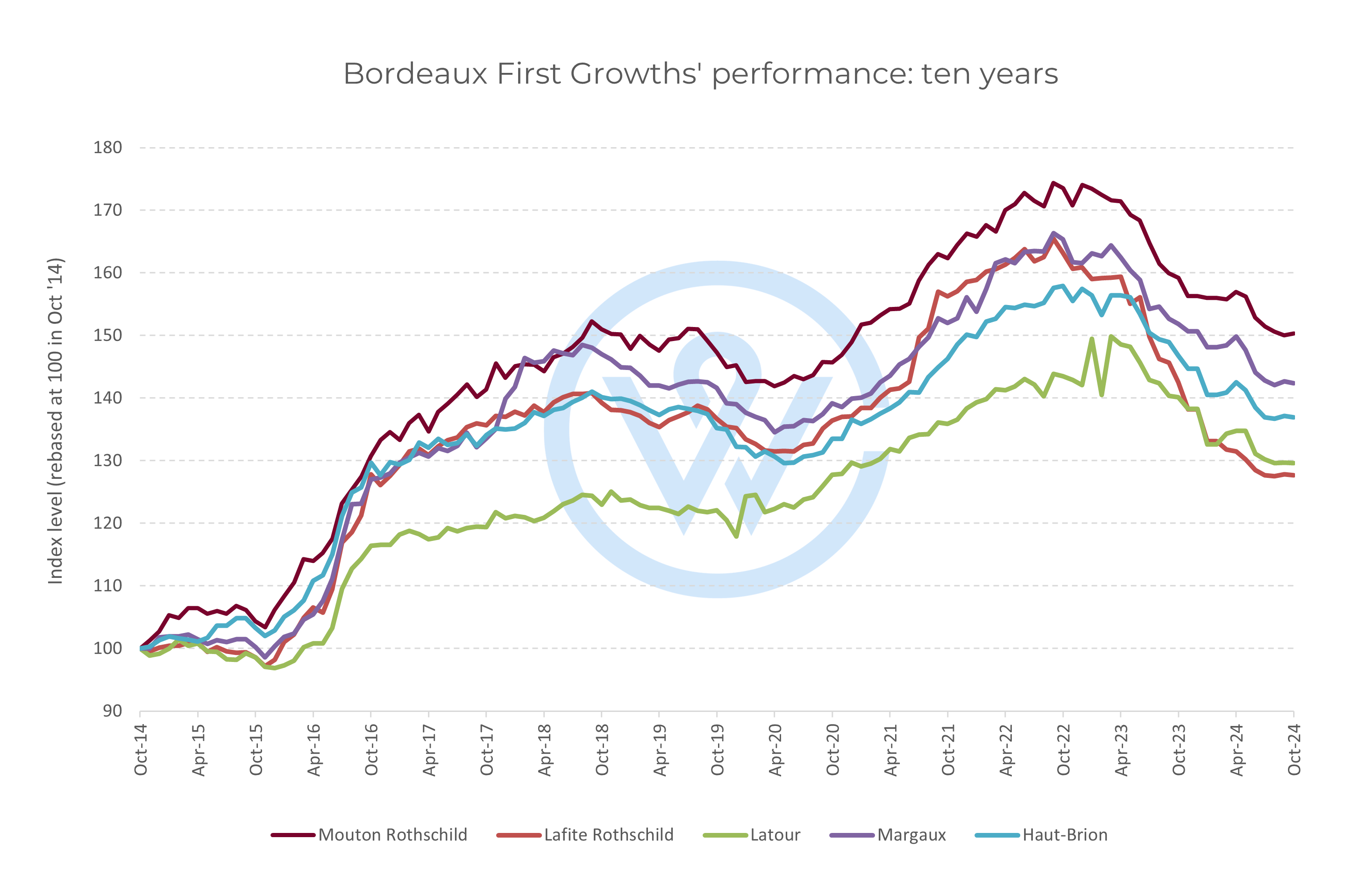
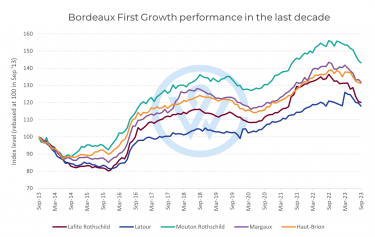
While the artist designed labels alone are not the key drivers of Mouton Rothschild’s investment performance, the wine does lead the way among its peers. It is the best performing First Growth over the last decade. 

Mouton Rothschild prices have risen 50.3%, compared to 42.3% for Margaux and 36.9% for Haut-Brion. Both Lafite Rothschild and Latour have increased by close to 30% over the same period.

Bordeaux First Growths Wine chart

From the market’s low in June 2014 to its peak in September 2022, Mouton Rothschild recorded a 76% increase. It was the first First Growth to recover from the correction following the China-driven wine boom. 

During the recent market downturn, Mouton Rothschild has exhibited relative resilience. Prices have fallen 13.8% since its peak. Only Haut-Brion has seen a smaller decline of 13.1%. The biggest faller has been Lafite Rothschild, down 22.8% since September 2022. 

Mouton Rothschild and the broader market

Mouton Rothschild is also nicely positioned in the broader wine investment market. It has outperformed the industry benchmark, the Liv-ex 100 index, which is up 40.9% over ten years. It has also fared better than the Liv-ex 50 (17.5%), which tracks the price movements of the First Growths, and the broader Bordeaux 500 index (27.8%).

Mouton Rothschild performance

Mouton Rothschild has demonstrated consistent strength in the fine wine market, supported by its established history and strategic positioning. The estate’s practice of commissioning artist-designed labels has enhanced its collectability, strengthened by its reputation for quality.

The release of the 2022 label marks another milestone in the estate’s history. Mouton Rothschild’s performance, both in terms of relative resilience during market downturns and long-term growth, highlights its role as a reliable component in a well-diversified wine investment portfolio.

WineCap’s independent market analysis showcases the value of portfolio diversification and the stability offered by investing in wine. Speak to one of our wine investment experts and start building your portfolio. Schedule your free consultation today.

Categories
News

Bordeaux correction: top wines 20% below their peak

  • Top Bordeaux labels are now approximately 20% below their peaks achieved during the last decade.
  • Lafite Rothschild has been the hardest hit, driven lower by classic vintages such as 2018, 2009 and 2000. 
  • The recent fall in prices has brought many labels back to levels not seen in years.

As recently explored, the fine wine market has been on a downward trend, but what does this mean for individual labels? Today, we turn to Bordeaux’s top names, examining the recent performance of some of the most investable wines in the world.

Bordeaux after the peak

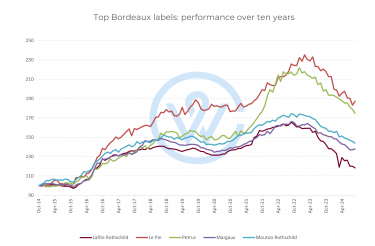
Top Bordeaux labels are now approximately 20% below their peaks, achieved during the last decade. 

Bordeaux wine indices

The First Growths, which often serve as the barometers of the fine wine market, had been riding high, with September 2022 marking a peak in pricing for Lafite Rothschild, Mouton Rothschild and Margaux. 

However, since then, the landscape has changed dramatically. Lafite Rothschild, once the shining star, has fallen by 28.6%, the most severe decline among the top names. Margaux and Mouton Rothschild have also taken significant hits, falling by 17.1% and 17.5%, respectively.

On the Right Bank, the situation is no different. Petrus, which peaked in December 2022, has since dropped by 21.4%, while Le Pin, which reached its high in February 2023, has declined by 20.3%. These losses have brought prices to levels last seen several years ago.

First Growths peaked in September 2022, since then:

  • Lafite is down 28.6% 
  • Mouton is down 17.5% 
  • Margaux is down 17.1% 

On the Right Bank:

  • Petrus is down 21.4% since its December 2022 peak
  • Le Pin is down 20.3% since its February 2023 peak

The Lafite fall: a deep dive

Lafite Rothschild – the second most-searched-for wine on Wine-Searcher – has seen the steepest decline since its peak, with prices plummeting 28.6% on average.

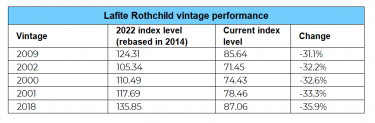
Which vintages have contributed to its fall over the last two years? The 2018 (WA 100 points) has been the hardest hit, down 35.9%. The wine was originally released at levels akin to the brand’s bull years, due to high critic scores, but failed to offer the best investment value. The recent price adjustment has made it a more attractive proposition. 

Older vintages that have had more time to grow have similarly fallen in value by over 30%. The classic 2009 Lafite, which boasts 99+ points from Robert Parker himself, is down 31.1% over the last two years. 

The millenial vintage, with a drinking window that extends well into the 2050s, is currently 32.6% below its peak. 

Lafite Rothschild wine vintages performance

Buying levels: back to the square one

The recent fall in prices has brought many labels back to levels not seen in years. Lafite, for example, has returned to its 2016 pricing levels, while Margaux and Mouton are back to 2020. On the Right Bank, Petrus and Le Pin have both returned to their 2021 levels.

While this might raise concerns on the surface, it presents a compelling opportunity. The scale of the correction suggests that Bordeaux wines, while still highly valued, may have been oversold in the last 18 months. 

For those looking to enter or expand their portfolios, this could represent a chance to acquire top-tier wines at a significant discount before prices start to rise again.

As with previous corrections, price declines are often followed by periods of recovery. For wealth managers and clients with a long-term investment horizon, the current situation may be seen as a momentary blip in an otherwise upward trajectory.

WineCap’s independent market analysis showcases the value of portfolio diversification and the stability offered by investing in wine. Speak to one of our wine investment experts and start building your portfolio. Schedule your free consultation today.

Categories
News

The best of Bordeaux En Primeur 2023

  • The best Bordeaux En Primeur releases offered a combination of quality and value. 
  • These are wines with high potential for future price appreciation.
  • Some châteaux have followed the En Primeur golden rule that the new release is the cheapest you can get. 

As this year’s Bordeaux En Primeur campaign draws to an end, we evaluate the best 2023 releases. These wines not only boast high quality, as measured by critic scores, but also offer value when compared to previous vintages. Below are our highlights from an investment perspective. 

Beychevelle 

Chateau Beychevelle En Primeur 2023

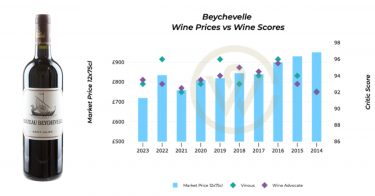
In the words of Château Beychevelle’s Philippe Blanc, ‘our golden rule is the En Primeur price is the cheapest you can get’. 

The rule was observed this year, with the 2023 representing the best priced vintage on the market today. 

The wine received 94-96 points from Antonio Galloni (Vinous), who said: ‘Beychevelle remains one of the most distinctive wines in all of Bordeaux. It is especially classy in this edition.’ 

Meanwhile, the Wine Advocate’s William Kelley (93-94 points) noted that ‘the 2023 Beychevelle has turned out especially well this year, exhibiting a more integrated, seductive style than recent vintages’.

Lafite Rothschild & Carruades de Lafite

Lafite Rothschild Bordeaux En Primeur 2023

For William Kelley, Lafite Rothschild appeared to be ‘the finest of the first growths this year’. The critic awarded it 97-99 points. The wine was launched at an impressive 32% discount on last year, making the new release the most affordable on the market today. Shortly after release, the wine found its way into the secondary market.

Carruades Lafite Bordeaux 2023 En Primeur

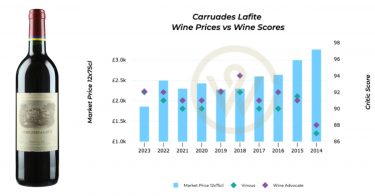
Its second wine also presented an enticing prospect to investors. As well as being the cheapest vintage, the wine was awarded a score of 91-93 from Neal Martin (Vinous), surpassing the 2022, 2016, and 2010. The critic remarked that this is ‘surely one of the best Carruades I have tasted at this stage’.

Mouton Rothschild & Petit Mouton

Mouton Rothschild Bordeaux 2023 En Primeur

In much the same vein as Lafite Rothschild, the 2023 Mouton Rothschild is the most affordable vintage available on the market today. Antonio Galloni gave it 96-99 points and declared that it ‘is shaping up to be one of the best wines of the vintage on the Left Bank’.

With 96-98 points from Neal Martin, its score looks set to match the 2022, 2020, 2019, and 2018. Only the 100-point 2016 has the upper hand but comes at a hefty 40% premium. 

Petit Mouton Bordeaux 2023 En Primeur

Once again, there is outstanding value to be found in the second wine. Petit Mouton 2023 is the best priced vintage available today by a healthy margin. And, according to Galloni, ‘it could easy be a Grand Vin at another address’.

Margaux

Chateau Margaux Bordeaux 2023 En Primeur

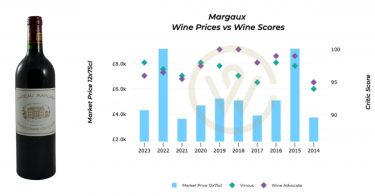
The highest-scoring Bordeaux 2023 wine across major critics, Margaux presented great value.

Galloni awarded it a potentially perfect score of 97-100 points, calling it ‘fabulous, sensual, silky and exceptionally polished’. 

Meanwhile, Martin described it as a ‘quintessential Margaux’, awarding it a score of 97-99 points.

Cheval Blanc

Chateau Cheval Blanc Bordeaux 2023 En Primeur

There are few wines that transcend the vintage in 2023, and Cheval Blanc is certainly one of them. 

There were few wines capable of transcending the vintage in 2023, but Cheval Blanc was certainly one of them.

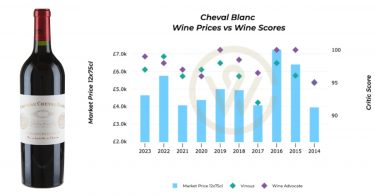
It is the second-highest-scoring Bordeaux 2023 wine across 12 leading critics. Winemaker Pierre-Olivier Clouet even goes so far as to say that it is superior to the 2022, as does the Wine Advocate’s William Kelley. 

Adding to its appeal is the value it offers. The 2023 is the most affordable option among top vintages. This is one of only two unambiguously ‘prime’ Cheval Blanc vintages available under £5,000 a case.

As these highlights show, there is value to be found during En Primeur with the right analysis tools. 

WineCap’s independent market analysis showcases the value of portfolio diversification and the stability offered by investing in wine. Speak to one of our wine investment experts and start building your portfolio. Schedule your free consultation today.

Categories
News

Finding value in the Bordeaux second wines

  • The average First Growth case price is £5,300, while second wines come in at £1,941.
  • Le Clarence de Haut-Brion is the most affordable second wine.
  • Le Petit Mouton has been the best performer over the last decade.

Following our article last week examining the performance and value of the Bordeaux First Growths, we now turn to an important but often overlooked category within Bordeaux wines: second wines. These wines offer investors a compelling balance between brand prestige and affordability, making them increasingly relevant in today’s fine wine market.

This analysis explores what second wines are, how they compare to their Grand Vins, how they are priced, and why their long-term performance makes them attractive within a wine investment portfolio.

What are second wines?

Most leading Bordeaux châteaux – particularly those classified under the 1855 Classification – produce more than one wine per vintage. Alongside the Grand Vin, many estates bottle a second wine (sometimes referred to as a “2nd wine” or “wine or second label”), and a handful may even produce third or fourth wines depending on vineyard size and stylistic goals.

Second wines generally come from:

  • younger vines, which may not yet deliver the depth required for the Grand Vin

  • vineyard parcels that do not fully meet Grand Vin quality in a given year

  • fruit that is stylistically better suited to an earlier-drinking profile

Despite this, second wines often receive the same technical treatment – from vineyard work to vinification – as the flagship label. They may use fruit from the same renowned terroirs, the same cellars, and benefit from the expertise of the same winemaking team.

For investors, this means second wines offer brand access at a significantly lower price, while still carrying the hallmarks of top Bordeaux estates.

Second wines: Pricing and Value Dynamics

Price Comparison: First Growths vs. Second Wines

The average First Growth case price sits around £5,300, reflecting their iconic status within Bordeaux’s hierarchy. In contrast, the average price for a second wine is £1,941 – less than half the price, yet still benefiting from strong brand associations.

This pricing gap offers investors a more approachable entry point to the top tier of growth wines, particularly within Saint-Julien, Pauillac, and Pessac-Léognan, where some of the world’s most admired estates are located.

Where prices diverge

Interestingly, the price hierarchy of the Grand Vin does not always replicate itself in the second-wine market.
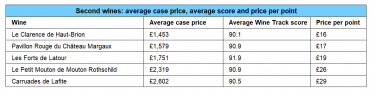
Second wines prices and scores

For example:

  • Château Latour produces one of the most expensive Grand Vins after Lafite Rothschild.

  • Yet its second wine, Les Forts de Latour, sits mid-range in pricing compared with its peers.

  • Meanwhile, Le Petit Mouton (from Mouton Rothschild) and Carruades de Lafite (from Lafite Rothschild) are priced higher, reflecting exceptionally strong brand demand.


Similarly, Le Clarence de Haut-Brion – the second wine of Château Haut-Brion, one of the most historically significant estates in the 1855 classification – remains the most affordable of the second wines despite its pedigree.

This shows that market demand, not just classification, shapes pricing for second wines.

Scores and price-per-point

When examining value for money, score-based metrics offer useful perspective.

  • Le Clarence de Haut-Brion holds the lowest price-per-point (£16) among second wines, mirroring Haut-Brion’s reputation for over-delivering relative to price.

  • However, while Haut-Brion Grand Vin scores very highly on the Wine Track Index, Le Clarence’s score is comparatively lower.

This disconnect illustrates a key point: For second wines, price does not always correlate closely with critical ratings.

Instead, a different dynamic typically governs their appreciation.

Second wines behave differently from the Grand Vin

With Grand Vins, price is strongly driven by quality, scores, and global demand.

For second wines, however, the dominant relationship is between price and age. As bottles are consumed and availability reduces, the scarcity effect naturally lifts prices.

In this way, second wines often follow the traditional wine investment ageing curve, appreciating steadily regardless of whether they score as highly as their Grand Vin counterparts.

They also present:

  • brand access for collectors who may be unwilling to open a £500+ bottle

  • earlier drinking windows, which attract both consumers and restaurants

  • strong demand on release, especially for estates like Mouton Rothschild, Haut-Brion, and Lafite Rothschild

Second wines therefore fulfil both a consumption and investment role, ultimately supporting more stable long-term price performance.

Performance of the Bordeaux second wines

Over the past decade, second wines from the top estates in Saint-Julien, Pauillac, Saint-Estèphe, and Pessac-Léognan have shown strong appreciation.

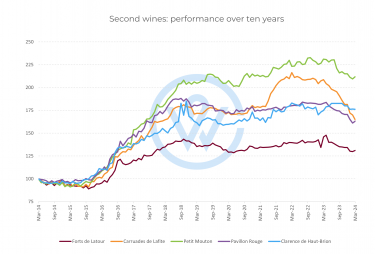
Top performers (10-year performance)

  1. Le Petit Mouton (Mouton Rothschild)
    +111.9% – The strongest performer, reflecting exceptional brand equity and global demand.

  2. Le Clarence de Haut-Brion (Château Haut-Brion)
    +76.2% – Undervalued on release, this wine has delivered impressive mid-term returns.

  3. Carruades de Lafite (Lafite Rothschild)
    +64.7% – One of the most globally recognised second wines, with strong demand across Asia.

  4. Pavillon Rouge du Château Margaux (Margaux)
    +63.1% – A consistently sought-after second label with stable year-on-year appreciation.
Second wines performance

These figures highlight how second wines from Bordeaux’s most prestigious châteaux can generate meaningful returns, often outperforming mid-tier Grand Vins and offering a lower-risk route into blue-chip Bordeaux.

Why Bordeaux second wines matter for investors

Second wines sit at the intersection of:

  • prestige (access to top-tier châteaux)

  • affordability (compared to Grand Vins)

  • liquidity (strong global recognition)

  • age-driven price increases (steady appreciation over time)

For investors building a Bordeaux wine portfolio, second wines provide:

  • diversification across vintages and price points

  • exposure to world-class estates without First Growth pricing

  • earlier consumption windows (driving market demand)

  • long-term stability and predictable growth

In short, second wines are one of the most efficient ways to gain exposure to the upper tier of Bordeaux wines while balancing cost and performance.

Final thoughts

Second wines from Bordeaux – whether Les Forts de Latour, Le Petit Mouton, Pavillon Rouge, Carruades de Lafite, or Le Clarence de Haut-Brion – offer compelling value for both collectors and investors. While they may not always achieve the prestige of their Grand Vins, their strong brand associations, increased affordability, and favourable ageing dynamics make them attractive assets within a diversified wine investment strategy.

As global demand continues to grow, particularly for leading estates in the Médoc and Graves, second growth Bordeaux wines and second labels are likely to remain a highly relevant segment of the fine wine market.

FAQ: Second Wines

What are second wines in Bordeaux?

Second wines are wines made by top Bordeaux châteaux using fruit from younger vines or parcels not selected for the Grand Vin.

Are second wines considered good for wine investment?

Yes. Many second growth Bordeaux wines and second labels have demonstrated strong long-term performance.

How do second wines differ from the Grand Vin?

While they come from the same vineyards and winemaking teams, second wines are generally earlier-drinking and less complex. The key difference is selection – the Grand Vin uses only the highest-quality fruit.

Why are second wines cheaper than First Growths?

Price differences reflect hierarchy, brand prestige, and selection. First Growths such as Lafite Rothschild, Mouton Rothschild, and Haut-Brion command premium pricing due to their status in the 1855 Classification. Their second wines, like Carruades de Lafite or Le Petit Mouton, offer similar pedigree at a fraction of the cost.

Do second wines age well?

Yes, though typically not as long as their Grand Vins. They often reach peak condition earlier, making them attractive for both drinkers and investors.

Which second wines show the best historical performance?

Over the past decade, leading performers include:

  • Le Petit Mouton de Mouton Rothschild

  • Le Clarence de Haut-Brion

  • Carruades de Lafite

  • Pavillon Rouge du Château Margaux

These wines have delivered returns between 63% and 112%, depending on estate and vintage.

Are second wines a good entry point for Bordeaux investment?

Absolutely. They offer affordability, strong brand recognition, and proven liquidity, making them one of the most efficient ways to gain exposure to top-tier Bordeaux wines.

WineCap’s independent market analysis showcases the value of portfolio diversification and the stability offered by investing in wine. Speak to one of our wine investment experts and start building your portfolio. Schedule your free consultation today.
Categories
News

Which Bordeaux First Growth has the lowest price per point?

  • The price-per-point metric allows for a comparison of wines based on their market price and perceived quality.
  • This article examines the prices per point of the most liquid group of wines – the Bordeaux First Growths.
  • It also looks at their historic market performances.

The price-per-point metric offers a powerful way to compare wines based on their market price relative to critic quality scores. By dividing the average case price by the average critic score, collectors and investors can identify which wines offer the best value, regardless of prestige or brand strength. This approach is especially insightful when analysing the First Growth Bordeaux châteaux, the most liquid and historically significant group within the wines of Bordeaux.

The First Growths – Château Lafite Rothschild, Château Mouton Rothschild, Château Margaux, Château Haut-Brion, and Château Latour – were formalised in the official Classification of 1855, a system that still shapes global perceptions of quality today. These estates sit at the top of the Bordeaux hierarchy, alongside the region’s premier cru properties, commanding some of the highest prices in the fine wine market. Despite belonging to the same classification, their relative value differs substantially when measured through price per point.

First Growth Bordeaux – price per point

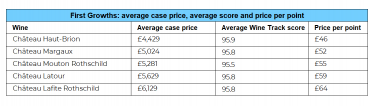
An average case price of £4,429 makes Château Haut-Brion the most affordable of the First Growths. Meanwhile, it has the highest average Wine Track score of 95.9 points. While there is divergence in prices and scores on a vintage-specific level, Château Haut-Brion has the lowest price per point among the First Growths overall.

First Growths average prices and scores

At the other end of the spectrum, Château Lafite Rothschild has the highest price per point of £64, owing to the highest average case price of £6,129 and a Wine Track score of 95.8.

Château Margaux, Château Latour, and Château Mouton Rothschild sit between these two extremes. Each offers exceptional critic scores and historic vintages, though their price-per-point efficiency varies depending on market cycles, En Primeur release prices, and vintage-specific trading volumes. Investors often compare these cru classé wines not only by absolute cost but by consistency of score relative to long-term performance.

What does this mean for the First Growths’ performance?

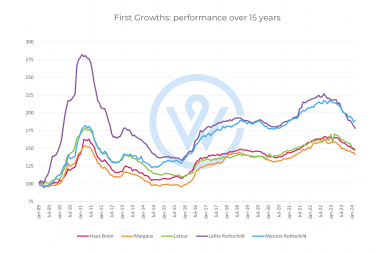
Historically, all First Growths have followed similar trajectories in terms of market highs and lows.
Key patterns include:

  • A dramatic surge during the China-led bull market (H1 2011)

  • A deep pullback in the years following

  • A recovery after the Brexit referendum, stabilising at higher levels

  • A recent decline in line with broader fine wine indices

The Liv-ex 50, which tracks the First Growths, is down 15.3% over the past year, mirroring the performance of the broader Liv-ex 1000 index.

Among the individual estates:

  • Lafite Rothschild saw the sharpest rise during the 2011 peak

  • It has also seen the largest recent fall (-19%)

  • Haut-Brion, despite never reaching the same peaks, has been more stable – dipping only 10% in the last year

This relative stability reinforces Haut-Brion’s status as a high-value First Growth brand. Its lower price per point and historically steadier performance make it appealing to collectors seeking reduced volatility without sacrificing Bordeaux pedigree.

First Growths performance

First Growth wines that offer value perform the best

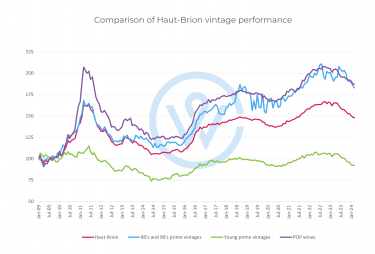
In the case of Haut-Brion, value plays an important role in market performance. POP wines (those with a lower price per point) have outperformed the rest over 15 years. These include vintages 2002, 2004, 2006, 2007, 2008, 2011, 2012, 2013, 2014, 2017 and 2019 (the only prime vintage among the POP wines).

The second-best-performing index comprises older ‘prime’ vintages – wines with high scores pre-2000. However, this index has shown higher volatility due to the limited availability and trading volumes of these wines.

The index comprising younger ‘on’ vintages like 2015, 2016, 2018 and 2020 has underperformed the rest of the pack. However, these wines have also had less time in the market and their evolution is yet to be seen.

Haut-Brion vintage performance

Historically, Bordeaux prime vintages often show accelerated growth after 10–15 years in bottle, meaning these more recent releases could see substantial performance shifts as they move further from their en primeur release period.

In conclusion, price per point offers an effective way to assess both value and quality, helping buyers look beyond brand prestige to uncover genuine opportunities. However, investors should also consider:

  • long-term market behaviour

  • storage and provenance

  • volatility of older vintages

  • the impact of global economic cycles

When combined with historical performance analysis, price per point becomes a powerful tool for building a balanced fine wine portfolio – identifying stable performers like Haut-Brion, premium prestige wines like Lafite Rothschild, and long-term growth opportunities across the First Growth category.

WineCap’s independent market analysis showcases the value of portfolio diversification and the stability offered by investing in wine. Speak to one of our wine investment experts and start building your portfolio. Schedule your free consultation today.
Categories
News

The impact of Mouton Rothschild’s artist labels on market value

  • This Friday will see the artist label announcement of Château Mouton Rothschild’s 2021 vintage.
  • Over the last ten vintages, the average price increase in the month following the announcement has been 5%, signalling a potential investment opportunity.
  • The 2000 vintage illustrates the power of the special label, perfectly weathering market downturns.

Every year, Château Mouton Rothschild commissions a different artist to produce the label for their Grand Vin. The tradition began in 1945 when Baron Philippe de Rothschild decided to celebrate the end of World War II by creating a special label featuring a ‘V’ for victory, designed by Philippe Jullian. Since then, the list of alumni has included the likes of Salvador Dalí, Pablo Picasso, Joan Miró, Andy Warhol, David Hockney, Jeff Koons, Anish Kapoor, Lucien Freud, and Wassily Kandinsky. This Friday will see the label reveal of the 2021 vintage.

How has the label announcement impacted prices?

Over the years, this innovative approach has turned the Mouton Rothschild labels into a fusion of fine art and fine wine, making each bottle a highly desirable collector’s item. What’s more, prices for Mouton Rothschild have consistently increased in the month following the announcement.

The increase averages just under 5% over the last ten vintages. The 2012 vintage, with a label by Miquel Barcelo, rose the most, up 14.9%, followed by the Xu Bing’s 2018, up 12.6%. Last year’s label reveal of the 2020 vintage drove prices 8.6% higher in a month. There has been only one exception to this pattern with the 2015 vintage, down 4.3%. However, the wine is still up 11% since release.

In the last decade, prices for the brand, represented by our Mouton Rothschild index, have risen 44% on average.

Which are the best value labels today?

While there is a strong investment case for the Grand Vin, which vintages offer the best value today? The 2020 boasts 100-points from The Wine Advocate and is 13% cheaper than the other 100-point 2016 vintage. Its price rose 8.6% after the label announcement, which was designed by Peter Doig.

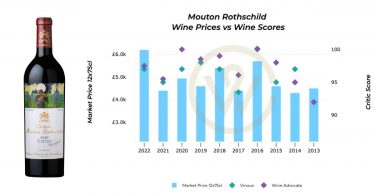
The 2021 is the most affordable recent release with a current Market Price of £4,400 per 12×75. However, given the trend of price rises post-announcement, one can expect potential changes.

Otherwise, buyers might wish to look back at the 2019 vintage, which received 100-points from Lisa Perrotti-Brown MW (The Wine Independent) and 97 points from Neal Martin (Vinous). The wine’s label, ‘The solar iris of Mouton’, was created by Olafur Eliasson.

The case of the 2000 vintage

If there is one special bottle that illustrates the power of art driving prices, it is that of the 2000 vintage. The bottle itself features an intricate gold engraving of the famous ram (Mouton) of the Rothschild coat of arms and stands out for its elegance and symbolic significance.

Mouton Rothschild 2000 weathered the Bordeaux market downturn of 2011-2014, when prices for the other First Growths fell sharply. The label continued to enjoy heightened demand in the Asian market, which only increased in 2015 – the year of the sheep, according to the Chinese zodiac. The wine has risen close to 750% in value since its release – an investment case that speaks for itself.

The innovative tradition of artist-designed labels by Château Mouton Rothschild not only merges the worlds of fine art and winemaking but also significantly elevates the market value, making them coveted treasures for collectors and investors alike.

WineCap’s independent market analysis showcases the value of portfolio diversification and the stability offered by investing in wine. Speak to one of our wine investment experts and start building your portfolio. Schedule your free consultation today.
Categories
Learn

The place of the Bordeaux First Growths in a changing fine wine market

  • Once the dominant force in the fine wine market, the Bordeaux First Growths have lost market share due to its broadening.
  • In the last decade, Château Mouton Rothschild has been the best price performer, up 43.2%.
  • Château Haut-Brion offers the best value, with the highest average critic score and the lowest average price per case.

The Bordeaux First Growths in a broadening market

The Bordeaux First Growths have long been the cornerstone of the fine wine investment market. Back in 2010, they made up close to 90% of all Bordeaux trade by value – at a time, when Bordeaux’s share of the total market stood at 96%.

With the broadening of the market, their share has decreased and they now regularly account for around 30% of all Bordeaux secondary market trade (which itself has fallen below 35% annual average).

This trend was also reflected in the 2022 Power 100 list, which offered a snapshot of the ever-changing landscape of the secondary market. For the first time ever, no Bordeaux wines featured among the top ten most powerful fine wine labels.

Even if trade for these brands remains consistent or increases, the First Growths are facing greater competition. Still, they are among the wines with the greatest liquidity, attracting regular demand and high praise from critics year after year.

First Growths’ price performance

In terms of price performance, the five First Growths have followed a similar trajectory (i.e. rising post-Covid and dipping in the last year in line with the current market reality). The relative outcast has been Château Latour, whose performance was impacted by the decision to leave the En Primeur system in 2012. The wine has been the worst-performing First Growth, up just 17.9% in the last decade.

The best performer has been Château Mouton Rothschild, with an increase of 43.2%. Recent releases have elevated the performance of the brand, like the 2020 vintage, which boasts 100-points from The Wine Advocate’s William Kelley, 99-100 from James Suckling, 98-100 from Jeff Leve and 99 from Antonio Galloni (Vinous). ‘Off’ vintages like 2011, 2013 and 2014, which have greater room to rise, have also fared well over the last five years.

The second-best performer has been Château Margaux, which is also the second most affordable First Growth. Similarly, its biggest price risers have been 2014, 2011 and 2013. Less classical years reveal the strength of these brands, as demand for the First Growths remains consistently high regardless of the vintage.

First Growths’ price and score comparison

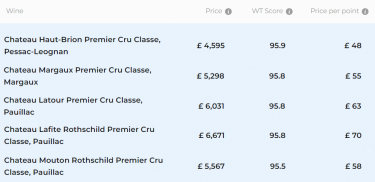
The table below shows the average price per case and critic score of the First Growths for vintages since 2000.

Château Haut-Brion tops the list with the highest average score (95.9) and the lowest average price per case (£4,595). With a price per point of £48, the wine seems to offer the best value among the First Growths. Vintages that have received 100-points from The Wine Advocate include 2018 (LPB), 2016 (LPB), 2015 (LPB), 2009 (LPB) and 2005 (RP).

Looking at the average prices, Château Lafite Rothschild stands out as the most expensive of the First Growths. The wine has achieved 100-points from The Wine Advocate for its 2019 (WK), 2018 (LPB), 2010 (LPB) and 2003 (RP) vintages.

In conclusion, the First Growths remain an important part of the changing secondary market, offering brand strength, consistently high quality and stable growth.

WineCap’s independent market analysis showcases the value of portfolio diversification and the stability offered by investing in wine. Speak to one of our wine investment experts and start building your portfolio. Schedule your free consultation today.
Categories
News

Marchesi Antinori acquires iconic Napa Valley’s Stag’s Leap

  • Marchesi Antinori has taken full ownership of Napa Valley’s iconic winery Stag’s Leap.
  • Stag’s Leap laid the foundation for the emergence of cult wines after winning the Judgement of Paris in 1976.
  • Antinori’s innovations in the ‘Super Tuscan’ revolution of the 1970s and recent acquisition of Stag’s Leap position both for continued success in the fine wine investment market.

Marchesi Antinori, one of the oldest and largest wine companies in the world, has gained full ownership of the iconic Napa Valley estate Stag’s Leap. According to Wine Spectator, the current sale includes ‘the winery, the brand and inventory, and close to 300 acres of Napa vines, including the Fay and S.L.V. vineyards’. These sites hold a near-mythical status in American wine, making the sale one of the most significant winery transactions in recent Napa Valley history.

Antinori is no stranger to Stag’s Leap. The Italian family first acquired a minority stake in 2007, partnering with Ste. Michelle Wine Estates after the property was purchased from founder Warren Winiarski. With the latest agreement, Antinori now transitions from long-standing partner to full owner – deepening its commitment to Napa Valley and expanding a global portfolio that already includes Tignanello, Guado al Tasso, and its American estate, Antica Napa Valley.

A historic Napa Valley estate

Stag’s Leap Wine Cellars holds a unique position in American wine history. It is widely credited as one of the pioneering Napa wineries that shaped the modern era of California fine wine. But it was one wine in particular that changed everything: the 1973 S.L.V. Cabernet Sauvignon.

This vintage, the estate’s second commercial release and first made at the winery, famously won the Judgment of Paris blind tasting in 1976. By outperforming top French estates – including Château Mouton Rothschild and Château Haut-Brion – Stag’s Leap stunned the global wine community and forced critics to take New World wines seriously. It was a defining moment not just for Napa Valley, but for American fine wine as a whole.

The S.L.V. vineyard, along with the Fay Vineyard, remains central to the estate’s identity. Both sites are now fully under Antinori ownership, giving the Italian group complete control over the terroir that shaped one of the wine world’s most important breakthroughs.

The rise of Stag’s Leap in the fine wine market

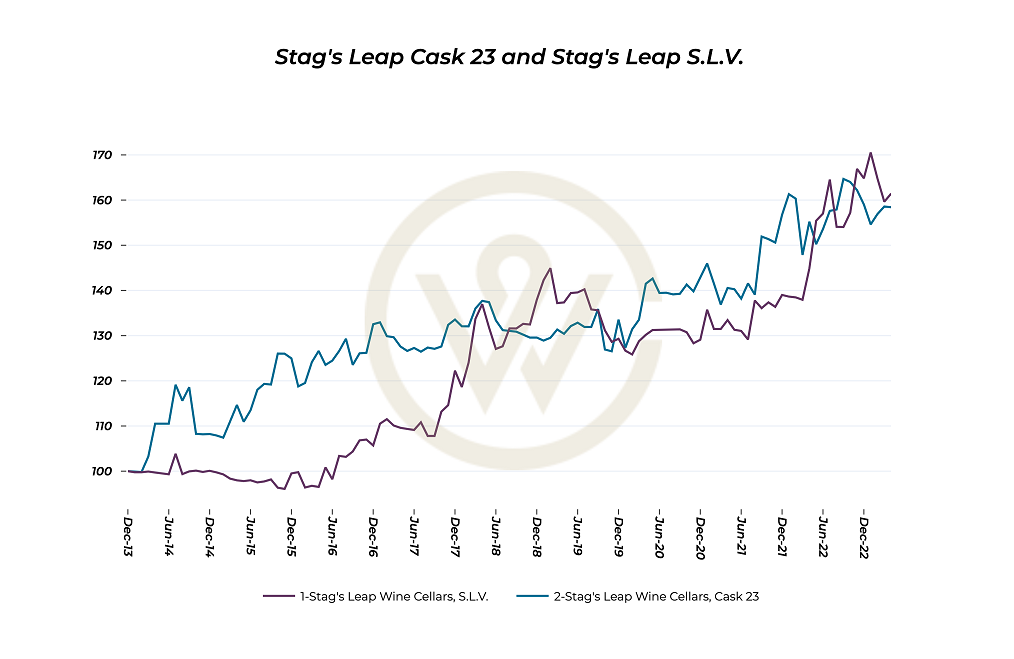
Over the last decade, Stag’s Leap has experienced substantial growth in the secondary market. Collectors have increasingly turned to the estate’s top wines – particularly Cask 23, S.L.V., and Fay – as demand for high-quality yet comparatively accessible Californian Cabernet Sauvignon continues to rise.

Several performance trends underscore Stag’s Leap’s strong market momentum:

1. Price appreciation

  • Cask 23 has increased 59% on average over the past 10 years.

  • S.L.V. Cabernet Sauvignon has risen 61% over the same period.

These gains reflect confidence among collectors who view Stag’s Leap as a historically significant winery with long-term growth potential.

2. Value for money

One of the brand’s greatest competitive advantages is its relative affordability compared to other Napa “cult” producers.

This stark gap highlights why many fine wine buyers see Stag’s Leap as offering high quality without extreme price premiums, a factor that has contributed to its increased trading activity.

3. Standout vintages

The estate’s 2014 releases, in particular, have shown remarkable performance:

  • S.L.V. 2014 has surged 80.5% since release.

  • Cask 23 2014 has climbed 77.4% in the past two years alone.

Such growth places these wines alongside some of Napa’s strongest performers in recent market cycles.

Why Antinori’s ownership matters

While Stag’s Leap helped establish the reputation of California Cabernet Sauvignon, Marchesi Antinori played an equally transformative role in Italy during the 1970s. Its groundbreaking wines – including Tignanello, Solaia, and others – helped spark the Super Tuscan revolution, challenging traditional DOC rules and elevating Italian red wine to new global heights.

Together, the two wineries share several parallels:

1. Both reshaped their national wine identities

  • Stag’s Leap redefined American wine after the Judgment of Paris.

  • Antinori reshaped Italian wine through innovative vineyard and cellar practices.

2. Both expanded the definition of “fine wine” beyond Bordeaux

Their success helped diversify the global fine wine conversation – proving that excellence could emerge from Tuscany and Napa Valley as convincingly as from France.

3. Both maintain powerful global brands

Antinori’s Tignanello is now one of the world’s most traded luxury wines. Liv-ex ranked it the 49th most powerful wine brand, partly due to its attractive average case price of £1,076, making it the best-value Italian label in the top 100.

With Antinori’s full acquisition of Stag’s Leap, the synergy between these two historic producers may deepen even further.

What comes next?

It remains to be seen exactly how Antinori will integrate Stag’s Leap into its global strategy. However, its track record suggests a continued focus on:

  • Estate-driven expression

  • Investment in vineyard health and sustainability

  • International distribution strength

  • Long-term legacy building

For Napa Valley, the acquisition signals sustained interest from established European wine families, affirming the region’s global prestige. For Antinori, it represents a strengthening of its American footprint. And for collectors, the transition offers reassurance that Stag’s Leap – already a historic and fast-rising winery – may be entering an era of renewed energy.

Final outlook

With its deep heritage, exceptional vineyards, and growing market demand, Stag’s Leap stands poised for an exciting new chapter under Antinori’s full stewardship. For both producers, this union brings together centuries of winemaking knowledge with some of Napa’s most important terroirs. As the dust settles on the acquisition, one thing seems certain: both Marchesi Antinori and Stag’s Leap are positioned to reach even greater heights in the fine wine market in the years ahead.

WineCap’s independent market analysis showcases the value of portfolio diversification and the stability offered by investing in wine. Speak to one of our wine investment experts and start building your portfolio. Schedule your free consultation today.

Categories
News

2020 Château Mouton Rothschild Label Unveiled

Château Mouton Rothschild has unveiled its 2020 label by Scottish artist Peter Doig. The renowned figurative painter settled in Trinidad in 2002 and divides his time between there and Scotland. Doig is the first British artist to have been commissioned to paint this leading Bordeaux château’s label since Lucien Freud in 2006. Other famous British contributors include (formerly) Prince Charles in 2004 and Francis Bacon in 1990. 

The initiative to invite an artist to adorn the Château Mouton Rothschild bottle label with a painting first began in 1924 with the poster artist Jean Carlu. 

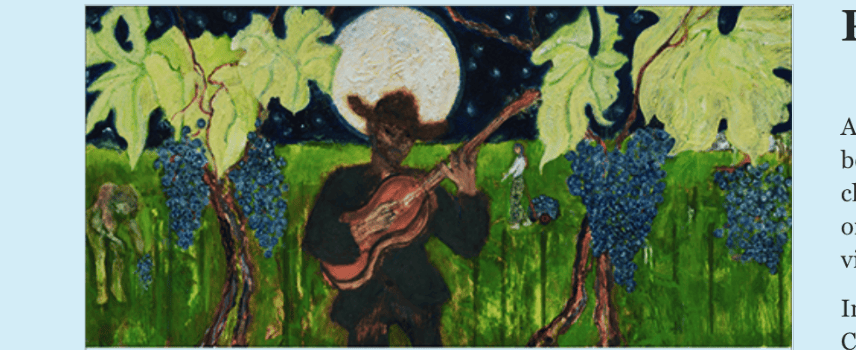
The 2020 label is of a dreamlike scene showing red grapes growing under the light of a full moon with workers in the vineyard. Doig has drawn parallels with other renowned artists such as van Gogh, Bacon and Cézanne who have all painted farm or vineyard workers. The main figure in the centre of the piece – Emheyo Bhabba – is one of Doig’s close connections and muses. A Trinidadian cuatro player, Emheyo has previously performed in one of the artist’s previous exhibitions in Paris using this four string guitar.

‘The painting shows something of what goes on behind the scenes in the production of wine, what happens offstage, as it were’, commented Doig. ‘It’s a sort of ode to workers, to all those involved at the various stages of making a wine before it’s finally bottled. It’s a dream with a romantic streak, as if someone spontaneously decided to sing in the vines. It’s a moment of poetry, where you can take your time. It’s neither really day nor really night, but rather something in between, between waking and sleeping. It is possible to see it as a progression, a dream journey in the world of the harvest.’

Commenting on this new label, Julien Beaumarchais de Rothschild said: ‘We wanted an artist who uses canvas and pictorial material to express figurative subjects.’ ‘Unrivalled as a colourist, Peter Doig focuses entirely on painting and has become one of his generation’s foremost exponents of the discipline, holding exhibitions all over the world. There is something very special about his technique and his universe that sets them apart in contemporary figurative art. His subjects are very varied, his painting resists any classification: he has succeeded in creating his own, inimitable world.’

Take a closer look at the 2020 label and at previous years’ here.