Categories
Learn

Do wine critics still matter in 2025? Bordeaux Diaries Part I

Discover how wine critics influence Bordeaux wine investment in 2025 and whether Robert Parker’s legacy still shapes today’s market.

Provenance, a good vintage, scarcity, and brand are all factors that influence the price of fine wine, and hence the world of wine investment. Another factor that has, traditionally, impacted wine value is the critic. A top score can inspire confidence in the price performance of a wine, while an unfavourable rating can have the opposite effect. 

However, is the role of the wine critic as important as it was in the past? With the retirement of the hegemonic world-renowned wine reviewer, Robert Parker, who helped put Bordeaux, California and the Rhône at the forefront of wine buyers’ minds, and the rise of digital media, what does the future hold?

WineCap met figures from leading Bordeaux estates for their insights into the place of wine criticism in 2025 and the years ahead. In Part I, we discuss the legacy and the evolving role of the wine critic.

  • Robert Parker’s era of singular influence is over – today’s wine criticism is a collective effort.
  • Critics still shape wine investment decisions, but their role is now one of many in a more democratic media landscape.
  • The rise of digital voices and ‘wine educators’ is expanding access and perspective in the fine wine world.

Wine criticism in transition: legacy vs digital influence

Several producers saw formal wine criticism as a keystone of information for customers, but also recognised that it was part of a developing media ecosystem largely because of the impact of the internet.

Château Valandraud, Premier Grand Cru Classé B, Saint-Émilion

Jean-Luc Thunevin, owner of Château Valandraud, thinks the importance of the traditional wine critic remains important for his château as the legacy of Robert Parker endures.

‘Parker had a hegemonic position; that is, he represented 80% of global influence. Today, in any case, there are collaborators who worked for him, who are very talented and who, two or three years ago, represented Parker’s influence,’ Thunevin told WineCap. ‘We can say that today, when you are a wine merchant, we use five or six major journalists, and we get an idea of what the wine is worth.’

Château Cheval Blanc, Saint-Émilion

‘In terms of the impact of the wine critics on the fame of our wines, we are very respectful of the job of the critics,’ Pierre-Oliver Clouet, technical manager at Château Cheval Blanc, explained. ‘We produce wine, there are wine distributors there to distribute the wine, there are wine collectors that collect the wine, and there are wine critics, who have to critique the wine. So, everybody has their own job in the wine world.’

The vast and varied selection of wine makes the role of the critic key, with Clouet adding that ranking wine estates, vintages, appellations, countries, and regions is important for consumers. 

‘The impact of critics is so important for the final client because the number of wines available on the market is huge. You have to find the critique who has your taste, and you have to follow him or her. This is the job: to help the consumer, to know more about what they’re going to purchase’.

Château Clinet, Pomerol

Ronan Laborde, managing director and owner at Château Clinet, is adamant that professional criticism is still an important fixture in the wine world, but acknowledges that information is more accessible to collectors and laymen alike today than in decades past. ‘We still need wine critique. When Robert Parker was reviewing and ranking, there was less wine criticism, and the web was not so widespread. Nowadays, there continue to be a lot of highly respectable wine critics.’

Laborde added that clients also have opportunities to bolster critic ratings with their own first-hand experience. ‘There are a lot of people who are really interested in wine and have the chance to visit wineries, taste the wines, and import the wines. So, it’s easier nowadays to try and have your own opinion than before. Robert Parker was a reference at the time he was active, but nowadays, it’s more split.’

Wine critique landscape in 2025: complexity and change

Château Margaux, First Growth, Haut-Médoc

Philippe Bascaules, managing director at Château Margaux, had an open-minded perspective on the shifting, changing, landscape of wine critique, not jumping to any conclusive opinion on its direction for the time being.

‘We are in a time when it’s very difficult to know the direction of journalists and social media and all this new communication, and how the consumers will use all of it to buy wine,’ he said. ‘Of course, it used to be so simple. Today, it’s much more complex and I think probably it’s even a good evolution, I would say, because then it can be a little bit more diverse, and everyone can find his own advisor. I think we are in transition and will know later exactly where it will lead and what it will mean.’

Château Coutet, Premier Cru, Sauternes

Other producers echo this sentiment. At Château Coutet, marketing director Aline Baly appreciates the rise of ‘wine educators’ who help spread awareness about lesser-known properties. 

‘In the last decade, we’ve seen a lot of new wine critics, or I also like to call them “wine educators” because they’re helping us get the message out there,’ marketing director Aline Baly told WineCap. ‘Some of the vineyards in this region are very tiny. We can’t be everywhere. We can’t be travelling and opening our wines and describing these wines. So, the wine critics, or wine educators help us get the message out.’

Regarding the growing number of critics, Baly was enthusiastic. ‘There is definitely a change from having very few people who are the spokespeople for all the vineyards in the world to a larger group of individuals who’ve come to visit, who’ve tasted wines and helped us get the message out there.’

Why wine critics still matter: education and expertise

Château Calon-Ségur, Third Growth, Saint-Estèphe

‘At the time of the Primeurs, we host many journalists from France and around the world,’ general director and owner of Château Calon-Ségur Vincent Millet said. ‘Today we have about fifteen journalists who come to taste the Primeurs every year. But what is also interesting is that these are the same journalists who will taste the wines when they are bottled, or a few months after bottling. So, they have a vision of a very young wine and a wine that has been aged in barrels, as well as a few months after bottling.’

This educational insider experience was invaluable for consumers, he added. ‘Today, what is interesting to see is that journalists have a culture of wine, follow the properties, follow the history of the property, and in some ways, these same journalists become true authorities on our wines. Even if we work with the brokers and merchants, the consumer will still look at the notes and comments of these same journalists. It is important for us to be able to explain how we work and what our philosophy is so that journalists can better understand the wines when they taste them’.

From Parker to pluralism: collective influence in wine

Several producers agree: the days of one critic dominating the wine conversation are behind us.

Château Pichon-Longueville Baron, Second Growth, Pauillac

‘I don’t think that we will ever again see one critic have such a completely dominant position as Robert Parker had. It was an accident of history in many ways. He just started at the right time, in 1982, when America was discovering the great wines of Bordeaux, and became accepted as the utterly reliable guide that he was,’ explained Christian Seely, managing director of AXA Millésimes, owner of Pichon-Baron

‘Today, there are many talented wine tasters and critics, and I think that it’s more of a collective influence. So, there will be perhaps a dozen really major critics who move the market, and I think on a collective basis, this is actually a much healthier thing. I think that for one person to have so much influence was probably slightly unbalanced and dangerous. These days, you can choose, as a consumer, from a number of very good critics and decide which ones you like best and follow them.’

Château La Mondotte, Premier Grand Cru Classé, Saint-Émilion

‘The time of the likes of Robert Parker is completely finished,’ said owner of Château La Mondotte Stéphane von Neipperg. ‘Now we will have perhaps five to ten well known wine critics for the consumer. So, it will be a much more open game. Parker was an important guy because he made what makes a good wine understandable for a lot of people. However, it is also good to have different opinions.’

Von Neipperg pointed to the 2021 vintage as an example of how critic viewpoints can vary significantly, supporting his view of the benefits of such diversity. ‘If you read about the ratings of 2021, there were sometimes five to ten points difference for the same wine.’

As Bordeaux and the broader wine world evolve, so too does the role of the critic – moving from singular gatekeeper to a chorus of trusted voices, guiding collectors, investors, and enthusiasts through an increasingly nuanced landscape.

See also our Bordeaux I Regional Report

WineCap’s independent market analysis showcases the value of portfolio diversification and the stability offered by investing in wine. 

Start your wine investment journey with WineCap’s expert guidance.
Categories
News

James Suckling’s top wines of 2024

  • American critic James Suckling has released his top 100 wines of 2024 list.
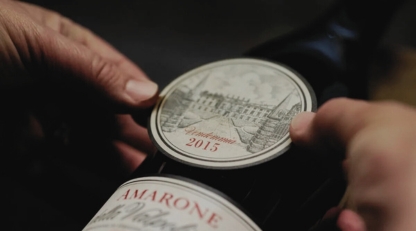
  • His wine of the year is Bertani Amarone della Valpolicella Classico 2015. 
  • Italy dominates the rankings followed by France and the US.

American critic James Suckling has released his top 100 wines of 2024 list, along with his wine of the year. Each year his team tastes tens of thousands of bottles, releasing comprehensive tasting reports, regional rankings, and ultimately selecting their wine of the year.

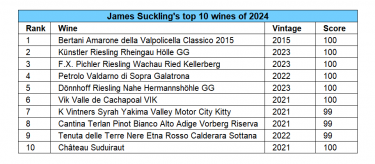
For 2024, the top honour went to Bertani Amarone della Valpolicella Classico 2015 – a wine Suckling describes as a perfect expression of “the greatness of time and place.” It received a perfect scoring of 100 points.

This article summarises the key findings from the James Suckling Top 100 and highlights notable regional trends, emerging regions, and value-driven opportunities for collectors.

A record year of tasting: More than 40,000 wines reviewed

James Suckling’s methodology is built on scale. In the past year alone, Suckling and his tasters reviewed more than 40,000 wines, producing hundreds of tasting reports, vintage overviews, and regional analyses. These include everything from everyday wines priced below $20 to rare cuvées from the world’s most prestigious estates.

What makes the James Suckling Top 100 uniquely valuable is that it distills this enormous volume of data into a curated list shaped not only by quality, but also by value, emotional impact, and availability. To be considered, wines must meet key criteria:

  • Minimum production of 5,000 bottles

  • Median release price below $500 (£385)

  • A score typically ranging from 97–100 points

  • A “wow factor” — Suckling’s term for the emotional reaction a wine can provoke

This creates a final list that balances prestige with approachability.

Regional overview: Italy dominates the top spots

While Suckling’s tastings spanned traditional and emerging regions worldwide, Italy once again emerged as the strongest performer. Italian producers submitted more than 9,100 wines for review, slightly surpassing France’s 9,000, and coming ahead of the 6,800 bottles tasted from the United States.

Total wines reviewed in 2024

The countries with the largest representation included:

  • Italy – 9,100 wines

  • France – 9,000 wines

  • United States – 6,800 wines

  • Spain – 3,800 wines

  • Argentina – 2,300 wines

  • Germany – 2,000 wines

  • Australia – 1,700 wines

  • Chile – 1,550 wines

Additional tastings from countries such as Greece, Hungary, Canada, Uruguay, and China

Countries featured in the James Suckling Top 100

Despite fierce global competition, Italy secured 26 positions in the top 100. These included a mix of Amarone, Barolo, Alto Adige whites, Brunello, and Super Tuscan wines. France followed with 18, showcasing a strong lineup of Bordeaux, Champagne, and Rhône releases.

The United States delivered 15 wines to the list, highlighting the continuing excellence of producers in Napa Valley and Oregon. Germany contributed 12 wines, a remarkable showing that underscores its rising profile among critics and consumers alike.

Chile, Australia, Argentina, and Spain all delivered respectable performances, and notably, China secured one place with Ao Yun Shangri-La 2020 – evidence of China’s growing relevance in the fine wine market.

James Suckling’s Wine of the Year: Bertani Amarone della Valpolicella Classico 2015

At the top of the ranking stands Bertani’s Amarone della Valpolicella Classico 2015, a wine that Suckling calls “one of the great Amarones.” Awarded a perfect 100-point score, it showcases deep concentration, complexity, and finesse.

Suckling describes the wine as “full-bodied and elegant, with ripe, filigree tannins, long acidity, and a toasty, savory aftertaste.” Its combination of structure, balance, and aromatic depth makes it a quintessential example of Amarone’s potential when produced in a traditional, long-ageing style.

The selection of an Amarone as the wine of the year reinforces a broader trend: the rising international appreciation for Italy’s great red wines beyond the usual Barolo and Brunello icons.

James Suckling top wine scores 2024

Value and accessibility: A core theme of the 2024 rankings

Despite the prestige associated with many wines on the list, a significant number of selections in the James Suckling Top 100 fall into surprisingly approachable price brackets. According to Suckling:

  • Nine wines in the Top 100 are priced between $30 and $60

  • Many top-performing whites, including Italian Sauvignon Blancs and Austrian Rieslings, remain accessible

  • Even the second-ranked wine is priced around $65 (£50)

This emphasis on accessibility reflects Suckling’s commitment to highlighting wines that deliver outstanding value, especially at a time when the global wine market is facing both economic pressure and shifting consumer behaviour.

Notable regional highlights

Germany’s breakthrough year

Germany’s outstanding performance – with 12 wines in the Top 100 – confirms the exceptional quality of recent vintages, particularly for dry Riesling. The Künstler Riesling Rheingau Hölle GG 2023 serves as the benchmark, showcasing precision, structure, and aromatic clarity.

Austria’s continued rise

Austria’s representation reflects its steady upward trajectory in global tastings. The wines selected – especially from Wachau – show impressive consistency and terroir expression.

China’s growing presence

The placement of Ao Yun Shangri-La 2020 demonstrates China’s expanding role in the fine wine space. Produced in the foothills of the Himalayas at high elevation, this wine emphasises craftsmanship, innovation, and a distinctive style uncommon in traditional European regions.

What collectors should take away from the 2024 Top 100

The James Suckling Top 100 is more than a “best of” list. It offers insight into:

  • Shifting stylistic preferences

  • Regions delivering strong value

  • Vintages worth buying now

  • Wines with long-term investment potential

  • Global developments beyond traditional wine regions

For collectors and investors, the list serves as a tool for building a diversified cellar, especially at a time when the fine wine market is recalibrating.

Whether your interest lies in high-scoring Amarone, precision-driven Riesling, or ambitious New World expressions, the 2024 rankings provide a highly curated list of wines that blend excitement, accessibility, and long-term promise.

WineCap’s independent market analysis showcases the value of portfolio diversification and the stability offered by investing in wine. Speak to one of our wine investment experts and start building your portfolio. Schedule your free consultation today.

Categories
News

Bordeaux 2021 in bottle: Vinous’ top-scoring wines

  • Neal Martin said Bordeaux 2021 shouldn’t be dismissed and identified an ‘overachiever’ among the wines in this challenging vintage.
  • According to Antonio Galloni, the quality is higher on the Left Bank than on the Right Bank.
  • A dry white wine and a Sauternes were the critics’ top-scoring wines from the vintage.

Vinous recently published two separate Bordeaux 2021 in-bottle reports by Neal Martin and Antonio Galloni. In this article, we summarise their views on this polarising vintage.

Why Bordeaux 2021 should not be ignored

In his report, titled ‘2+2=5: Bordeaux 2021 In Bottle’, Neal Martin explained why ‘irrationality tastes good’ and why Bordeaux 2021 shouldn’t be ignored. He said that ‘on paper, a cursory glance at the troubled growing season would make any rational person dismiss its wines’. But the critic argued that they would be wrong.

While Martin awarded few wines more than 95 points, he advised readers against ‘thinking that the 2021 vintage is incapable of giving sensory and intellectual pleasure’.

According to him, advanced technology and refined winemaking made a fundamental difference at the top end, and thus 2021 cannot be compared ‘with off-vintages like 1977, 1992 or arguably even 2013’.

Martin singled out Les Carmes Haut-Brion as an ‘overachiever’ that ‘halts you in your tracks’ and noted that ‘there is a cluster of very strong-performing wines on the Left Bank that merit attention and possess the substance to repay cellaring’. He added that ‘the Right Bank matches the Left Bank, particularly the usual names on the Pomerol plateau […] and likewise those in Saint-Émilion on free-draining limestone soils’.

Similarly, Galloni found ‘a wide range of compelling wines that merit attention’ within the context of a challenging growing season.

‘In many ways, 2021 can be summarized as a year in which classic Bordeaux weather of the past meets the technical know-how of today in both the vineyard and winery,’ the critic argued.

Overall, he said, ‘the quality is higher and more consistent on the Left Bank over the Right Bank, even though at the very top, the best Right Bank wines can only be described as stellar’.

Galloni called Calon Ségur, Ducru-Beaucaillou, Lafite Rothschild, Pichon-Comtesse and Rauzan-Ségla ‘magnificent’, Les Carmes Haut-Brion – ‘majestic’, Vieux Château Certan, Cheval Blanc, Canon, and Lafleur – ‘compelling’. He also made a special mention of the dry white wines, namely Smith Haut Lafitte Blanc, Haut-Brion Blanc and Domaine de Chevalier Blanc.

Top-scoring Bordeaux 2021 wines

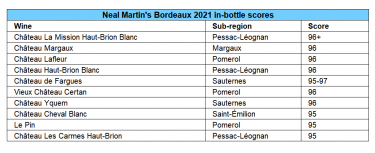
Neal Martin Bordeaux 2021 scores

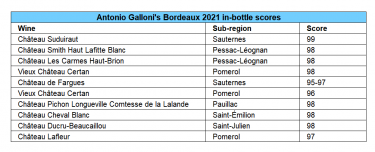
Neal Martin’s top-scoring Bordeaux 2021 was a dry white wine, La Mission Haut-Brion Blanc, while Galloni gave a near-perfect score to a wine from Sauternes – Suduiraut.

Wines that appeared in both critics’ top ten included Les Carmes Haut-Brion, Vieux Château Certan, Lafleur, and Cheval Blanc.

For Galloni, Vieux Château Certan ‘may very well be the wine of the vintage from the Right Bank’, while Martin commented that it ‘transcends the limitations of the growing season’, calling it ‘outstanding’.

Another wine that critics agreed on was Lafleur, which Galloni described as ‘incredibly fascinating’ in 2021, and Neal Martin noted as a ‘strong contender for the wine of the vintage’.

Antonio Galloni Bordeaux 2021 scores

Full report and tasting notes are available on Vinous.

WineCap’s independent market analysis showcases the value of portfolio diversification and the stability offered by investing in wine. Speak to one of our wine investment experts and start building your portfolio. Schedule your free consultation today.